

5 Minutes
A decade-long mystery comes to light
Stranger Things is preparing to close its portal on a mystery that has loomed over Hawkins since the show's debut. The Duffer Brothers have signaled that the fifth and final season will finally answer the show's central question: what is the true nature and origin of the Upside Down? For fans who have devoured cold-case theories and pieced together Easter eggs for years, this promises to be the revelation moment.
What the creators promise
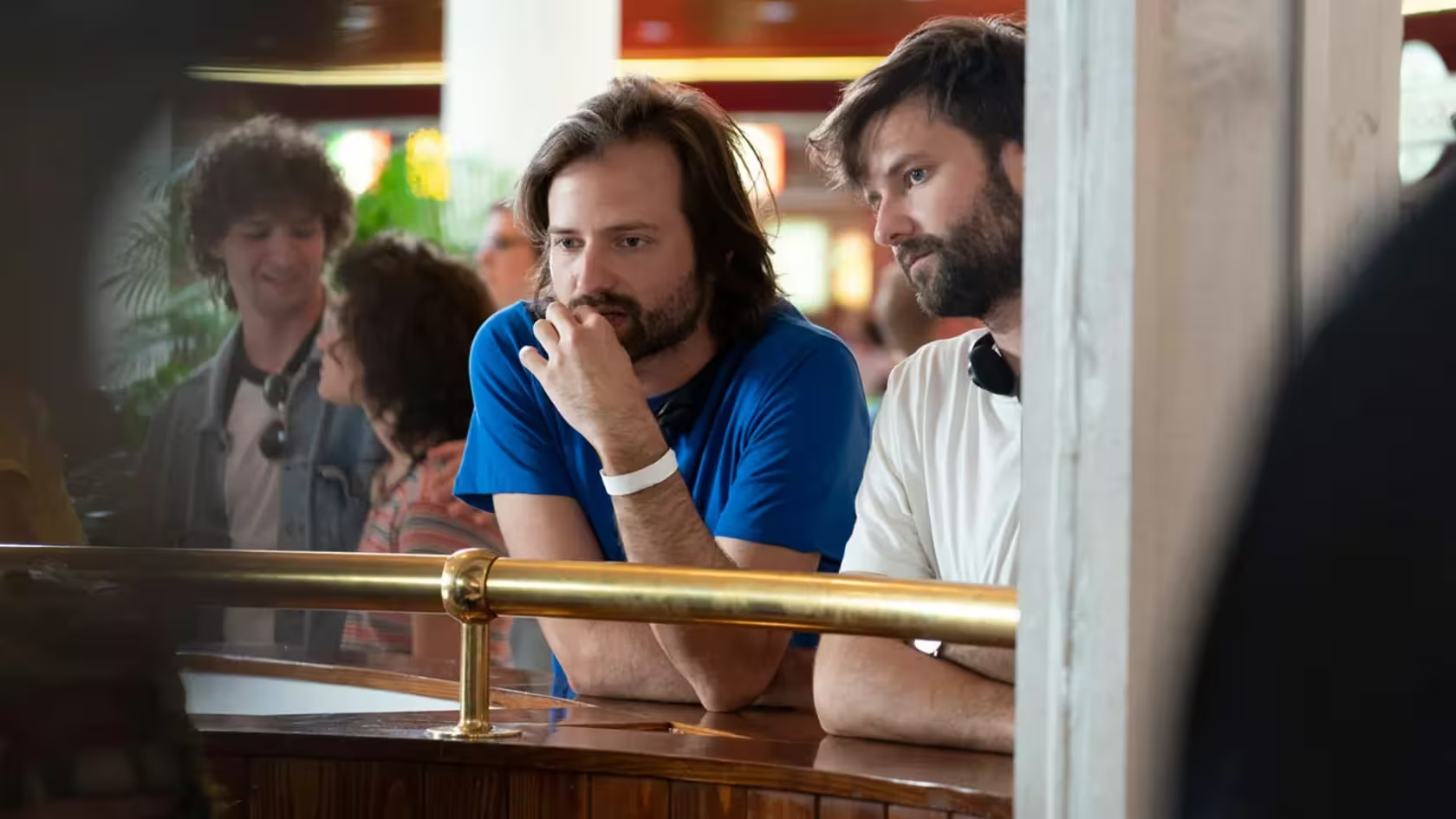
In recent interviews, Matt and Ross Duffer confirmed that Season 5 will dig into the roots of the Upside Down — the shadowy dimension introduced in 2016 that has haunted Hawkins and its characters. After deliberately delaying certain revelations in earlier seasons, the creators said they now felt it was time to bring the mythology full circle. The final chapter will not only identify the Upside Down’s origins but will also tie up long-running threads: Vecna, Mind Flayer, Demogorgons, and the town of Hawkins itself.
A story built to satisfy
The brothers describe the finale as “a complete story” designed to close every major arc. Executive producer and frequent director Shawn Levy added that the team rewrote the final scripts several times to preserve emotional coherence and to avoid the all-too-common pitfall of leaving fans disappointed. The creative aim was simple: no dangling plotlines, and an ending that feels both inevitable and emotionally satisfying.
When and how it will air
Netflix will roll out the eight-episode fifth season in three parts late in 2025. The staggered release mirrors industry trends where platforms split final seasons to extend audience engagement while preserving event-status around key episodes. The first four episodes debut in late November, a three-episode mid-block follows around Christmas, and the finale lands on New Year’s Eve — a scheduling choice that underscores the series’ desire to make the finale a cultural moment.
Episode lengths are also cinematic: the penultimate episode runs approximately 83 minutes, and the final episode approaches a two-hour runtime. That scale points to an ambition bordering on franchise cinema rather than a standard TV finish, comparable to how Game of Thrones and several prestige shows expanded their finales into feature-length events.
Context and comparisons
Stranger Things sits at the crossroads of 1980s nostalgia, horror, and ensemble coming-of-age drama. Its willingness to mix serialized mystery with blockbuster set pieces places it alongside other modern TV phenomena such as Dark and Twin Peaks in terms of ambitious myth-building. Unlike science-fiction-led closers that prioritize puzzle-solving, the Duffer Brothers have emphasized emotional resolution — tying character arcs to the reveal of the Upside Down rather than letting the mythology overshadow human stakes.
Fans and critics alike have debated whether Netflix’s event-style releases dilute or amplify the impact of finales. The split release can heighten anticipation but also fragments momentum. Still, given the Duffer Brothers’ insistence on a carefully crafted ending and the long runway the show has had to plan for its exit, expectations remain high.
"Stranger Things has always been as much about friendship and grief as it is about monsters," says cinema historian Marko Jensen. "This final season aims to reconcile its supernatural spectacle with intimate character payoffs — a balance that will determine whether the ending becomes beloved or merely remembered for its scale."
Behind the scenes and fan reaction
Behind the cameras, the writers reportedly rewrote the finale multiple times to keep the emotional core intact. Casting, production design, and the decision to dedicate blockbuster-length runtimes to the final episodes reflect Netflix’s investment in making the end feel definitive. Fans have responded with a mix of excitement and anxiety: social channels are alive with theory art, countdowns, and retrospective deep dives into clues planted across five seasons.
Whether you’re drawn to Stranger Things for its horror beats, its nostalgic soundtrack, or the friendships at its center, Season 5 promises to deliver an answer to the franchise’s biggest question while aiming to close a decade-long chapter in television.
A final note: if the Duffer Brothers succeed at balancing spectacle with soul, Stranger Things could become a model for how to end a beloved series without betraying what made it matter in the first place.



Leave a Comment