
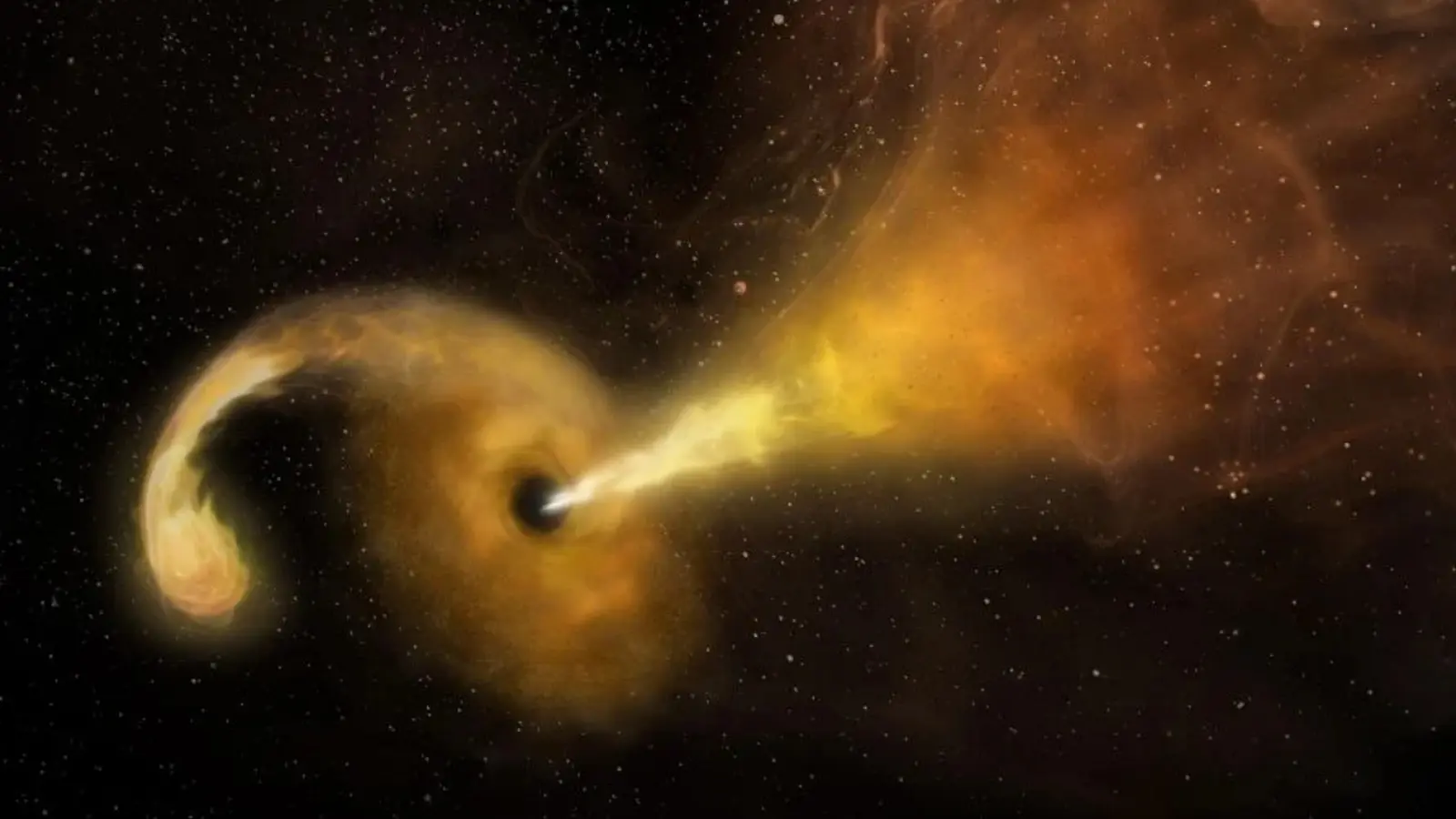
Four years after a star met its violent end, the aftermath keeps getting louder. AT2018hyz — a tidal disruption event watched first in visible light — has entered a rare, drawn-out crescendo in radio frequency that continues to puzzle astronomers. The source is not simply fading into the cosmic background; it is growing brighter, and fast.
How an ordinary transient became extraordinary
When ASASSN (All Sky Automated Survey for SuperNovae) flagged AT2018hyz in 2018, it looked like one of many tidal disruption events (TDEs) — a doomed star scattered by a supermassive black hole’s tidal forces. Those events typically produce a brief flare of optical and ultraviolet emission as stellar debris orbits and accretes. But AT2018hyz refused to behave like the textbook examples.
Radio emission from AT2018hyz did not appear immediately. It first registered in radio wavelengths roughly 972 days after the initial optical flare, and then kept rising. New observations, spanning about 1,370 to 2,160 days after disruption, report continued brightening across multiple radio bands. In plain terms: the system has been getting steadily louder for years.

These panels illustrate the light curve coming from AT2018hyz. The left panel shows its radio emissions (y-axis) over time (x-axis) across multiple radio frequencies. The right panel compares AT2018hyz's emissions to other TDEs.
What the data show (and what it might mean)
Yvette Cendes and colleagues, writing in The Astrophysical Journal, present continuing radio monitoring that reveals a remarkable, ongoing rise in luminosity. The source is now about 50 times brighter than when the radio emission was first detected. The increase is not subtle; it challenges the simplest models in which an outflow is launched at the moment of disruption and then fades.
Two physical pictures currently compete to explain the radio brightening. The first is a delayed spherical outflow — effectively, a massive puff of material ejected well after the star was torn apart. In this scenario, the outflow launched roughly 620 days following the initial optical flare, meaning the engine that drove it switched on long after the disruption itself. The expansion and evolving radius measured in radio are consistent with such a delayed, roughly spherical blast.
The second possibility is more cinematic: an off-axis relativistic jet. Jets pointed almost toward us appear bright early because of relativistic beaming; jets pointed away are suppressed at first and only become visible when they decelerate and widen. If a powerful jet was launched but aimed away from Earth, its radio signature would rise sharply as it slows and spreads into our line of sight.
Either model implies a remarkable energy budget. The team’s estimates put the radio-emitting outflow’s energy on par with that of a gamma-ray burst (GRB) — among the most energetic explosions in the universe. To make that human-scale (or cinematic) for a moment, the authors compared the release to the fictional Death Star: their numbers indicate the black hole’s radio output exceeds a fully operational Death Star by at least a trillion times, possibly reaching one hundred trillion times that fictional weapon’s energy. These comparisons are playful but underline a serious point: this is an unusually powerful TDE.
Why this matters for black hole science
Delayed radio emission is not unheard of. A handful of TDEs have shown late-time radio brightening before, but AT2018hyz stands out for both its luminosity and the duration of the rise. If this behavior is common but simply missed, surveys that stop follow-up after months could be overlooking a whole class of delayed outflows or misaligned jets. Deep, long-term radio monitoring can expose physical processes in the accretion flow and the circumnuclear environment that are invisible at early times.
Predictions based on the new monitoring indicate the radio light curve will continue rising until around 2027, when it should peak. That gives observers a narrow window to collect multi-frequency data that will discriminate between a delayed spherical ejecta and an off-axis relativistic jet. Each outcome carries different implications: a delayed outflow suggests episodic engine activity and complex accretion physics; an off-axis jet would argue that relativistic jets from TDEs are more common than we thought, but often hidden by geometry.
Expert Insight
"This is a textbook case of why patient observing matters," says Dr. Mira Halvorsen, an astrophysicist specializing in high-energy transients. "If you assume a transient dies out quickly, you rarely catch these late-time phenomena. AT2018hyz tells us the engine can restart or change behaviour months to years after the star is disrupted. That forces theorists to rethink when and how jets or outflows are launched in TDEs."
Cendes herself emphasized the rarity: "This is really unusual," she said in a press release. "I'd be hard-pressed to think of anything rising like this over such a long period of time." The remark captures both the surprise and the opportunity: unusual events drive new proposals for telescope time, and AT2018hyz gives astronomers a compelling reason to ask for more long-term radio follow-up.
Beyond the immediate puzzle, AT2018hyz raises a broader observational question: How many other TDEs hide late-time, powerful radio emission simply because no one looked long enough? Telescope time is competitive, and without striking early radio signatures, many transients are dropped from follow-up lists. The team hopes their result will shift priorities: a single, well-studied outlier can reshape search strategies and reveal whole populations previously undercounted.
For now, monitoring continues across radio frequencies. The coming years will be decisive: continued brightening, a turnover, spectral evolution, and expansion rates will help separate the delayed outflow and off-axis jet possibilities. Whatever the answer, AT2018hyz has already forced astronomers to accept that some cosmic catastrophes take their time to show their full power.

“The cosmos has always fascinated me. I write about space missions, astronomy, and the technologies pushing humanity beyond Earth.”

Discussion
Leave a Comment