
For more than half a year, a Sun-like star all but disappeared from view. Ninety-seven percent dimmer. Nearly 200 days of shadow. Astronomers watched a light that had burned steadily for decades drop and linger in a way few had ever seen. What could cast such a long, almost total shadow?
What the sky revealed
The culprit, according to a new study in Monthly Notices of the Royal Astronomical Society, appears to be an enormous ring system surrounding a hidden companion—either a brown dwarf or a massive gas giant sometimes called a super-Jupiter. The object crossed the face of the star ASASSN-24fw, located roughly 3,200 light-years away in the constellation Monoceros, and produced one of the longest stellar dimming events on record.
ASASSN-24fw is estimated to be about twice the diameter of our Sun and, until late 2024, showed no dramatic variability. Then its brightness faded sharply and, remarkably, did not rebound quickly. Instead it remained almost obscured for more than nine months. Typical stellar occultations and eclipses usually last days to weeks; this one stretched toward 200 days, forcing astronomers to consider very large, slow-moving structures as the cause.
A giant ring system comes into focus
Photometric and spectroscopic data collected by an international team point to a companion whose mass exceeds three times that of Jupiter. Around that object, the researchers modeled a vast, dense ring system whose outer edge spans about 0.17 astronomical units—roughly half the distance between the Sun and Mercury. When those rings crossed the star’s disk, they blocked nearly all incoming light.
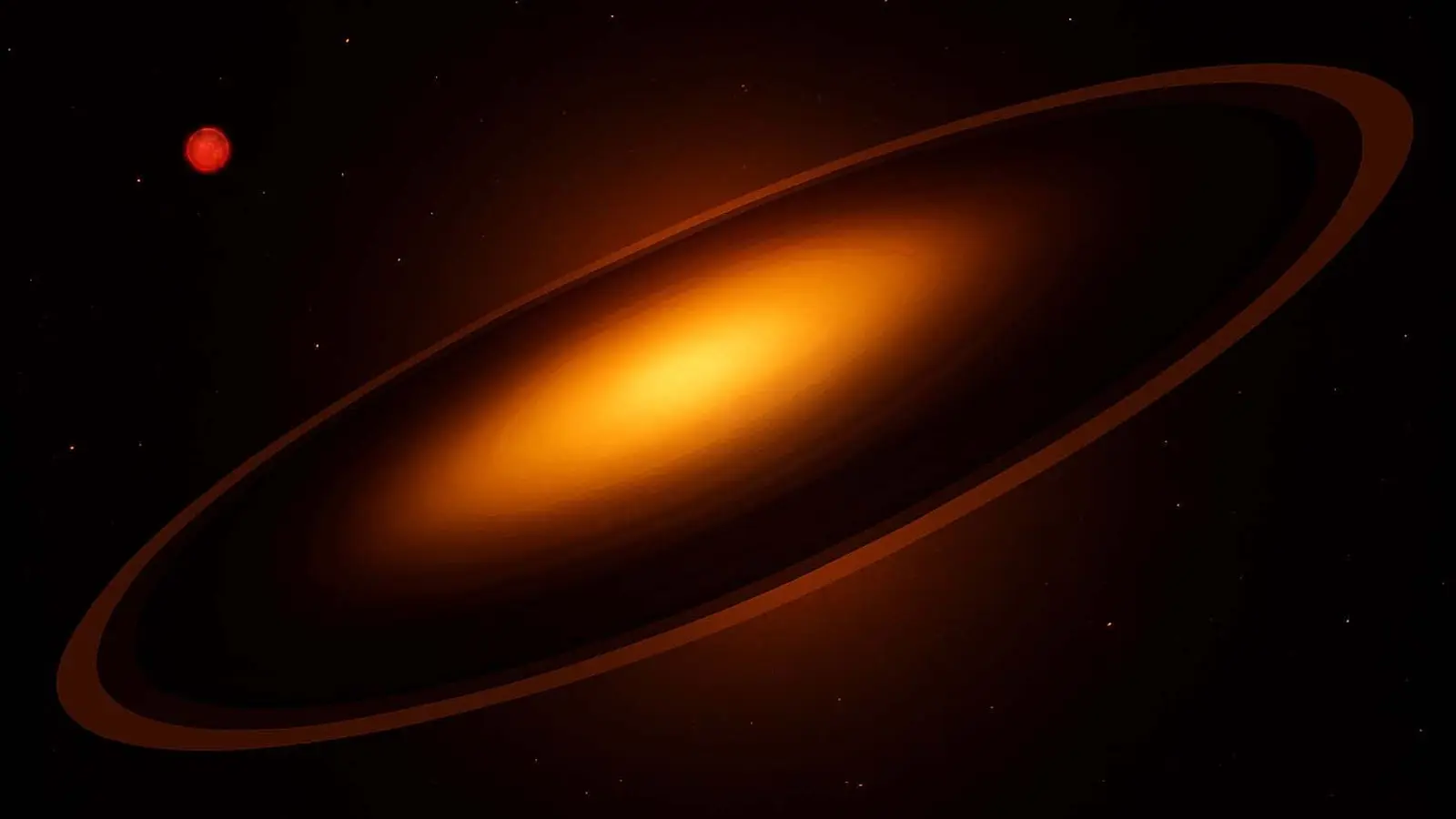
Imagine Saturn, but scaled up many times over and strewn across a saucer-sized plane. The dimming began gradually because the ring's outer regions are tenuous. Then denser bands moved across the star, producing the deepest portion of the eclipse. Such a configuration implies an architecture of gaps and dense annuli within the rings, hinting at dynamic processes—perhaps moons forming or debris shepherded by unseen satellites.
Brown dwarfs sit between stars and planets: too massive to be planets, too light to sustain hydrogen fusion like stars. Super-Jupiters, on the other hand, are exceptionally massive gas giants that blur the line between planet and brown dwarf. The data leave both as plausible options; in either case, the transiting ring system is a rare laboratory for studying extrasolar circumplanetary disks at scales we rarely observe directly.
An artist’s impression of ASASSN-24fw after the eclipse is over, where the star is seen shining unobstructed – with its own remnants from possible planetary collisions along with its companion red dwarf star and the dark “saucer.”
Scientific context and observations
Besides the ringed companion, researchers identified circumstellar material close to ASASSN-24fw—likely debris from past or ongoing collisions among minor bodies. That is surprising because the system’s age is probably more than a billion years, and such prominent debris belts are more typical of younger systems. Spectroscopy and time-series photometry allowed the team to constrain the companion’s mass and the structure of the obscuring material, but many questions remain.
Large ring systems around massive companions have been theorized but are seldom observed. Only a handful of events—such as those linked to eclipsing discs or debris—offer direct clues about how rings and moons form around planetary-mass or substellar objects. This event therefore provides a rare opportunity to test models of circumplanetary dynamics, ring stability, and the processes that create gaps or shepherd moons.
Follow-up proposals are already in play. The team hopes to secure time on the European Southern Observatory’s Very Large Telescope and the James Webb Space Telescope to measure chemical composition, temperature, and finer structural details. High-resolution infrared and optical spectroscopy could reveal the rings’ dust grain sizes, gas content, and perhaps signatures of tidal interactions with moons. And because orbital calculations suggest the system will reproduce a similar alignment, astronomers expect the star to dim again in roughly 42 to 43 years—an astronomical appointment for future generations of observers.
Expert Insight
Dr. Elena Varela, an astrophysicist specializing in exoplanetary systems, reacted to the discovery: "Events like this are astronomical gold. They let us study ring dynamics around objects we cannot directly image. If rings include gaps, that tells us something about embedded satellites; if they are smooth and extended, that points to a different evolutionary history. Either way, such a long eclipse is a rare probe of circumplanetary physics."
Dr. Varela added a practical note: "Patience will pay off. Observations across wavelengths—optical, infrared, and submillimeter—will paint the full picture. We should view this as an open invitation to refine how we model planet and moon formation beyond the Solar System."
Why this matters
Beyond the drama of a star nearly disappearing, the event forces a re-evaluation of how large structures evolve around substellar objects. Rings that span fractions of an astronomical unit challenge our assumptions about stability and longevity. They also expand the catalog of environments where planet formation processes may occur, supplying fresh comparisons to the familiar rings of Saturn and the debris discs we see around other stars.
For now, ASASSN-24fw and its dark companion stand as a reminder: the sky still holds slow-moving, massive phenomena that can hide in plain sight for months. The next time astronomers catch a star dimming, they will read the shadow with new perspective—and prepare powerful telescopes to follow the story as it unfolds decades from now.

“My work centers on sustainability, energy, and environmental science — examining how innovation can lead to a greener future.”

Discussion
Leave a Comment