
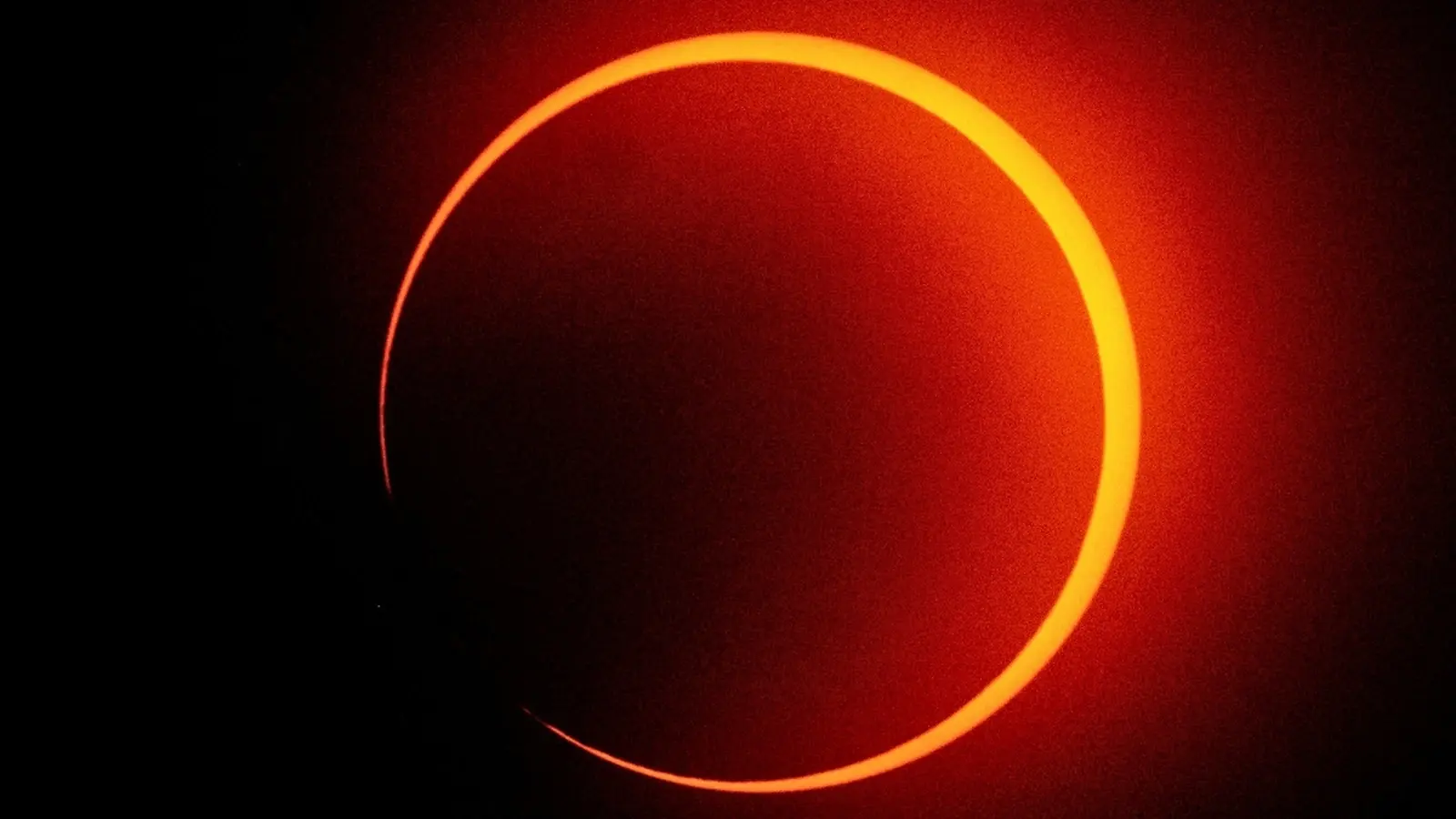
Antarctica will host the first solar eclipse of the year — an annular event that will paint a thin, fiery ring across the southern sky. Only a handful of people on the ice, and perhaps a few curious penguins, will witness the full spectacle as the Moon slips in front of the Sun but does not cover it completely.
During an annular eclipse the Moon sits slightly farther from Earth in its elliptical orbit, so its apparent diameter is too small to hide the solar disk entirely. That leftover rim of sunlight gives the phenomenon its popular name: the 'ring of fire.' The geometry is elegant and exact — a reminder that celestial mechanics can produce near-perfection without meaning to.
'The penguins down there are going to have a great show,' said astronomer Joe Llama of Lowell Observatory, capturing the irreverent human side of a rare astronomical alignment. Clear skies will be decisive; cloud cover can erase an eclipse as quickly as it forms one.

Where the eclipse will be visible and why it matters
The narrow annular path crosses Antarctica, so the full ring will be confined to the southernmost continent and the ice fields that sit beneath the sky. Around the margins of that path, observers will see a partial eclipse — a bite taken out of the Sun — from distant points such as the tips of Chile and Argentina and parts of southeastern Africa, including Madagascar, Lesotho, and South Africa.
Solar eclipses occur whenever the Sun, Moon, and Earth align closely enough that the Moon's shadow falls on Earth's surface. That alignment happens a few times a year somewhere on the planet, but any single eclipse is visible only along a particular path determined by orbital geometry. Last year brought two partial eclipses; in 2024 a total solar eclipse swept across North America and drew millions of viewers. The 2026 annular event continues a cadence of spectacles that alternate between partial, total, and annular configurations.
'It’s this beautiful coincidence between the size and the distance of the Moon and the Sun,' noted astrophysicist Emily Rice of the City University of New York, describing how apparent diameters line up to produce total or annular eclipses.
Watching safely — and creatively
Never look directly at the Sun without proper protection. Even when most of the solar disk is covered, the remaining light can damage your eyes. Certified eclipse glasses block ultraviolet radiation and almost all visible light and must meet ISO 12312-2 standards. Ordinary sunglasses, camera viewfinders, and binoculars are not safe without proper solar filters.
If you prefer an indirect view, inexpensive and effective options are easy to make. A simple pinhole projector built from cardboard will project the Sun’s crescent onto a screen. Household items that perforate light — a colander, a cheese grater, or even the gaps in leafy trees — create many small images of the eclipsed Sun on the ground. These low-tech techniques are ideal for groups, classrooms, or anyone who wants to share the event without specialized gear.
For skygazers planning ahead: another significant solar eclipse will occur in August, offering totality to observers in Greenland, Iceland, Spain, parts of Portugal, and stretches of Russia, with broader regions enjoying partial views. The calendar of eclipses is predictable; deciding where to watch is the human part.

“The cosmos has always fascinated me. I write about space missions, astronomy, and the technologies pushing humanity beyond Earth.”

Discussion
Leave a Comment