
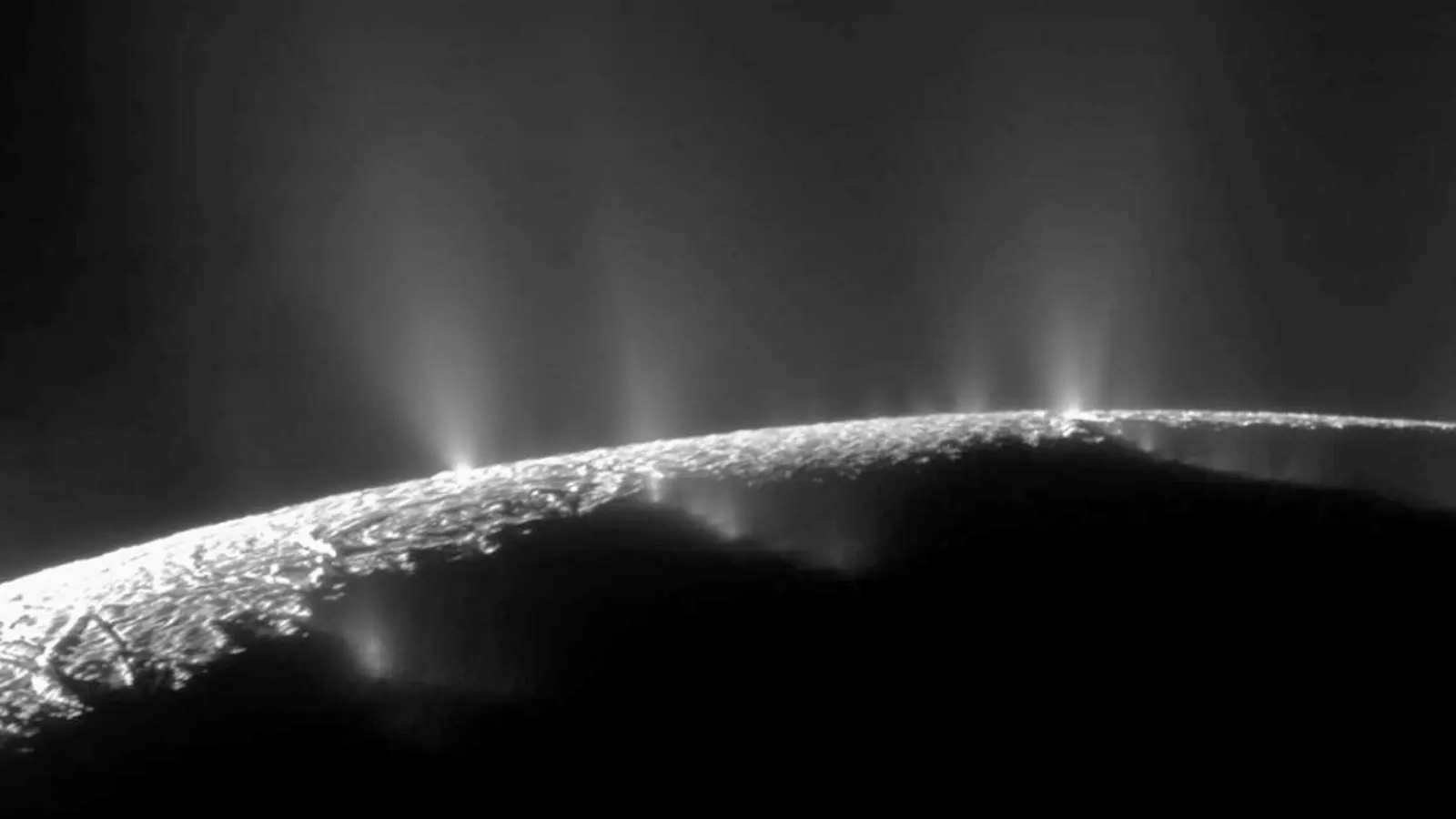
Something small can make a giant planet blink. Enceladus, a moon barely 500 kilometers across, stirs Saturn's magnetic environment in unexpected ways. Invisible currents, called Alfvén wings, form where the moon's expanding plume meets the planet's magnetized plasma. The result is auroral marks high above Saturn's poles.
Electromagnetic reach of Enceladus
New research shows that the main Alfvén wing is not a smooth sheet but a braided, filamentary structure. Turbulence fragments the waves into narrow strands. Those filaments act like mirrors and guideposts, enabling electromagnetic waves to reflect off Enceladus's dense plasma torus and propagate toward higher latitudes in Saturn's ionosphere. The visible consequence: localized auroral features that trace the moon's magnetic footprint.
Why does this matter? Because it changes how we interpret remote auroral signatures. A point of light in Saturn's ultraviolet aurora no longer implies a simple, one-to-one interaction; it can be the final waypoint of a complicated journey shaped by turbulence and plasma structure.

The findings offer a framework for other systems too. Jupiter's icy moons, including Europa, Ganymede, and Callisto, live in similarly active magnetospheres. The same physics could shape their electromagnetic linkages, and by extension, the magnetically mediated environments of exoplanets that host moons.
For mission planners, these results flag measurement priorities: fine-scale magnetometers, high-resolution plasma sensors, and coordinated auroral imaging. Studies like this one — published in the Journal of Geophysical Research: Space Physics — help justify instruments for proposed Enceladus mission concepts aimed at the 2040s.
Small moon. Big effects. And a reminder that even tiny, turbulent filaments can illuminate planetary systems in surprising ways.

“My work centers on sustainability, energy, and environmental science — examining how innovation can lead to a greener future.”

Discussion
Leave a Comment