
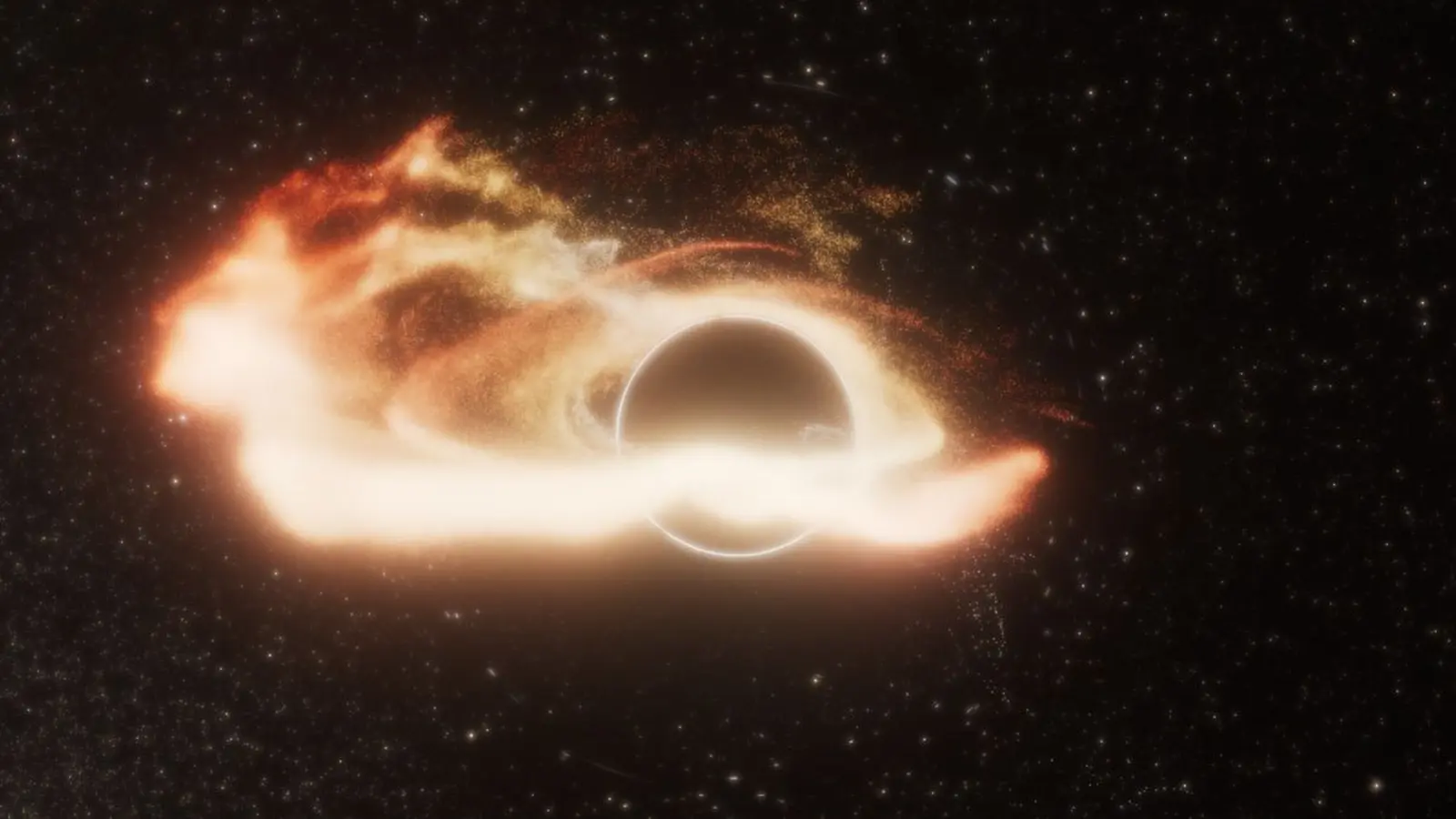
The sky flashed. Then it faded—fast and outrageously bright. What astronomers caught in July 2025 was not a garden-variety burst; it was a violent, high-energy flare that rose and died on the order of days, and its fingerprints hint at a cosmic crime scene few have ever seen.
How a tiny corpse met a savage predator
White dwarfs are compact. Extremely compact. Imagine squeezing a Sun’s worth of mass down to roughly Earth’s size; that is the scale we’re talking about. Those stellar remnants are the dense embers left after medium-mass stars exhaust their fuel. And because they are so tightly packed, only a narrow class of black holes can tear them apart in a way that leaves an observable signature.
Enter the intermediate-mass black hole—an object with a mass between a few hundred and a few tens of thousands of Suns. Too small to be a supermassive behemoth, too large to be a typical stellar remnant, these middleweights occupy a theorized sweet spot. If one crosses paths with a white dwarf at close range, tidal forces can shred the star, heat the debris, and in some cases launch energetic jets visible across the universe.
The event, cataloged as EP250702a, was first picked up by China’s Einstein Probe in X-rays. Within a day, NASA’s Fermi satellite registered a gamma-ray signal. Chandra and Hubble followed. The evolution was dramatic: the emission plummeted by factors of 100,000 in roughly three weeks, and the X-ray spectrum softened as the source faded. Location matters, too—the flare came from the outer regions of its host galaxy, where older stars like white dwarfs are more likely to linger than newborn factories for massive stars.
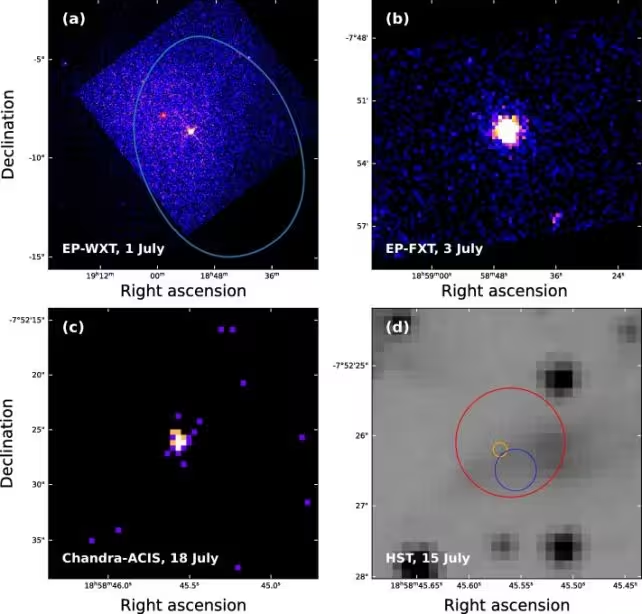
Observations recorded using the a) Einstein Probe's Wide-field X-ray Telescope; b) Einstein Probe's Follow-up X-ray Telescope; c) the Chandra X-ray Observatory; and d) Hubble. (Li et al., Sci. Bull., 2026)
Why EP250702a points to a white dwarf disruption
Short-lived flares can come from several astrophysical sources—gamma-ray bursts, supernova shock breakouts, or accreting stellar binaries. But the particular time profile and energy budget of EP250702a strain those alternatives. Stellar-mass black holes typically produce shorter, less energetic X-ray flares when they interact with dense objects; supermassive black holes, on the other hand, usually swallow a white dwarf whole before tidal forces can produce an observable flare.
Simulations led by researchers at the Chinese Academy of Sciences and collaborators in Hong Kong show that an intermediate-mass black hole ripping apart a white dwarf can reproduce both the jet energies and the fast evolutionary timescales recorded for EP250702a. In plain terms: the numbers line up. The spectral change from hard to soft X-rays as the source dims also matches models where hot, compact debris cools and expands after an initial violent encounter.
Mission details and the observational chain
Einstein Probe’s Wide-field X-ray Telescope first flagged the flare, and its Follow-up X-ray Telescope tracked the early decline. Chandra provided high-resolution X-ray imaging, while Hubble supplied optical context for the host galaxy. Ground-based observatories and Fermi’s gamma-ray instrument filled in the multiwavelength picture. That coordinated coverage is exactly what’s needed to separate exotic tidal disruption events from more mundane transients.
“This early X-ray signal is crucial,” one team member said, explaining why the event cannot be easily grouped with typical gamma-ray bursts. Other collaborators added that computational models which combine the extreme density of white dwarfs with the intermediate-mass black hole’s tidal reach produce jet energetics and light-curve shapes consistent with the data.
Expert Insight
“Discovering a white dwarf being shredded by an intermediate-mass black hole is like finding a missing chapter in black hole demographics,” says Dr. Maya Alvarez, an astrophysicist not on the study. “We’ve suspected these middleweight black holes exist for years, but they’re faint and elusive. A tidal disruption of this kind gives us a bright beacon to study their mass, spin and environment.”
If EP250702a holds up under further scrutiny, it will be more than a single spectacular flare. It could become a new method for locating and weighing intermediate-mass black holes, helping to fill a gap in our understanding of how black holes grow and how they populate galaxies. For observers, the message is plain: watch the skies, especially in X-rays. The universe still writes sudden, violent stories—and sometimes it hands us the page itself.

“My work centers on sustainability, energy, and environmental science — examining how innovation can lead to a greener future.”

Discussion
Leave a Comment