

New analysis suggests identical twins raised apart can end up with IQ gaps as wide as those between strangers — and the key variable may be the schools they attended. This fresh look challenges a long-standing belief that IQ is almost entirely hardwired.
Rethinking the nature versus nurture story
For decades, studies of identical twins — especially rare pairs reared apart — have been central to debates about heredity and intelligence. Earlier research found many matched traits, including similar IQ scores, reinforcing the idea that intelligence is mainly genetic. But cognitive neuroscientist Jared Horvath and developmental researcher Katie Fabricant revisited the data with one important addition: schooling.
They re-examined 87 twin pairs from published projects and separated those pairs by how similar or different their educational experiences were. When twins had markedly different schooling histories, the researchers observed much larger IQ splits than expected — in some cases roughly a 15-point gap, a difference more commonly seen between unrelated individuals.
Education appears to widen or narrow IQ gaps
That 15-point difference emerged when twin siblings experienced substantially different schools, curricula, or years of formal education. The pattern suggests that schooling can amplify or reduce cognitive divergence even between genetically identical people — a striking clue that environmental inputs matter at the level of measured intelligence.
At the same time, the study has limits. Only 10 twin pairs met the strict criteria for clearly distinct school experiences, a small sample that weakens broad generalizations. Horvath and Fabricant acknowledge this, noting more research is needed to map the many environmental influences on cognitive test performance.
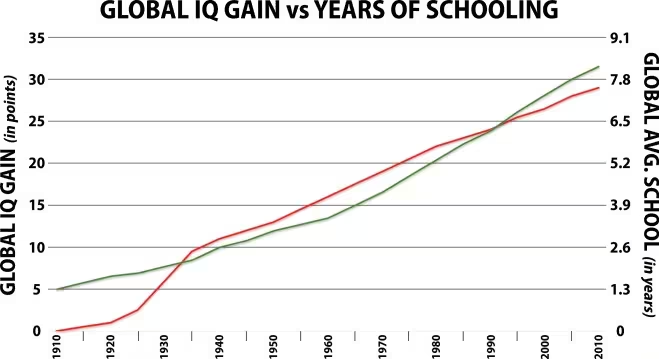
Comparison of global IQ gain (red line) and global average years of schooling (green line) from 1910 to 2010 in 5-year intervals. (Horvath and Fabricant, Acta Psych, 2025)
Why this matters for IQ research and education policy
The study sits within a larger context: IQ tests were originally developed in 1905 to help schools identify children needing additional support. Over the past century, average test scores have climbed across many countries — a phenomenon linked by many researchers to changes in nutrition, public health, and especially schooling quality and access.
If schooling shapes IQ scores significantly, then policies that change educational opportunity could reshape measured cognitive outcomes across populations. That doesn’t erase the role of genetics, but it does complicate simple claims that IQ is fixed and primarily inherited.
What to watch next
Future studies will need larger samples of twins with well-documented, divergent schooling histories and better control for factors like socio-economic status, family separation circumstances, and quality of instruction. Longitudinal data that track children through different educational systems would help isolate which elements of schooling most influence cognitive test gains.
For now, Horvath and Fabricant’s analysis serves as a reminder: identical genomes don’t guarantee identical outcomes. Education — where, when, and how someone learns — can steer cognitive development in meaningful ways.

“The cosmos has always fascinated me. I write about space missions, astronomy, and the technologies pushing humanity beyond Earth.”

Discussion
Leave a Comment