
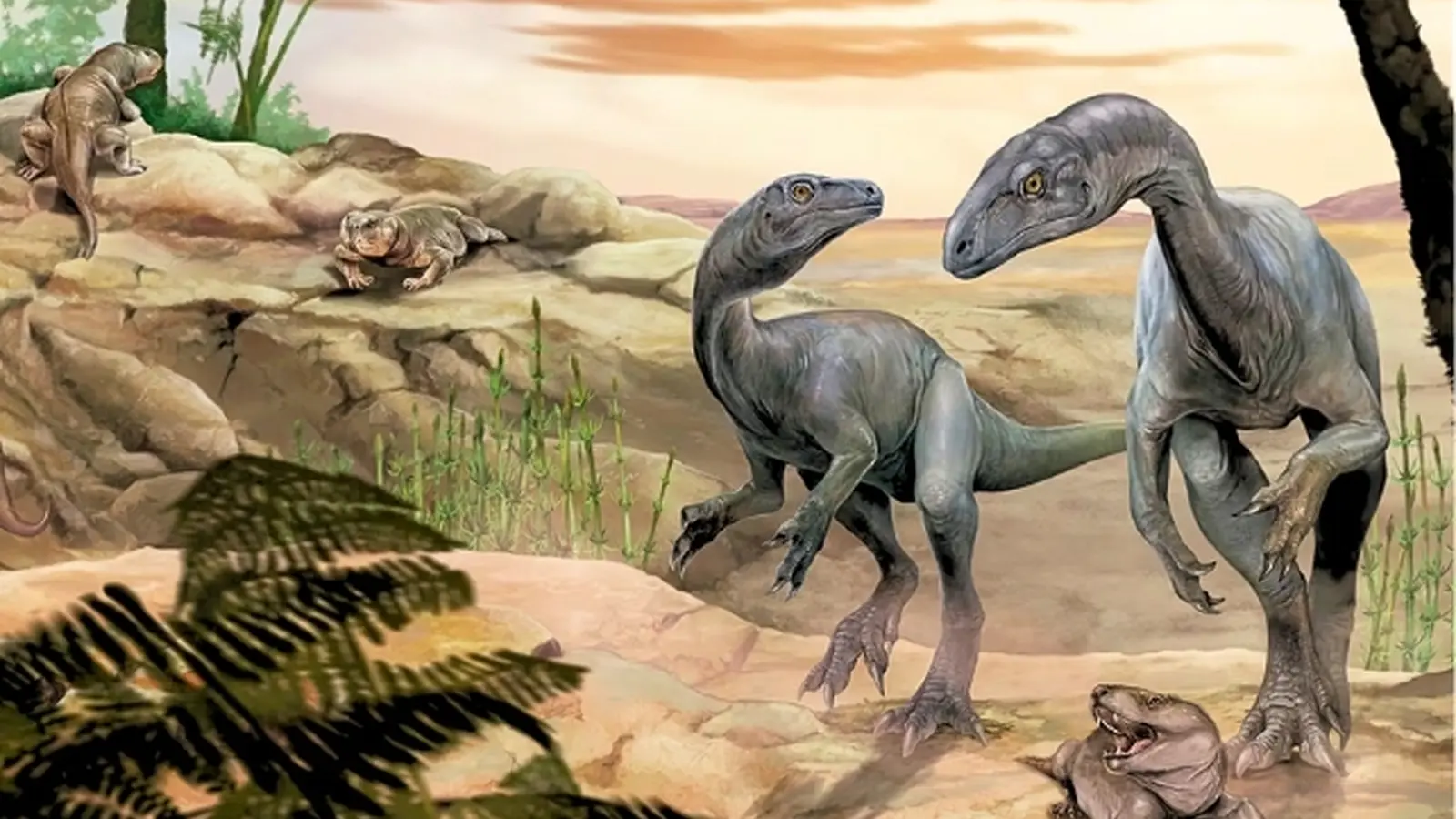
Argentinian researchers have recovered an almost complete skeleton of one of the planet’s earliest known dinosaurs high in the Andes. The small, long-necked reptile — named Huayracursor jaguensis — promises new clues about dinosaur evolution at the close of the Triassic.
A remarkable fossil dug out at 3,000 meters
Scientists from CONICET announced the find after excavations in Argentina’s northwest, in the foothills of La Rioja. The team uncovered part of the skull, a complete vertebral column extending to the tail, and nearly intact forelimbs and hindlimbs. The specimen was recovered at about 3,000 meters (9,842 feet) altitude — an unusually high-elevation discovery for a Triassic fossil.
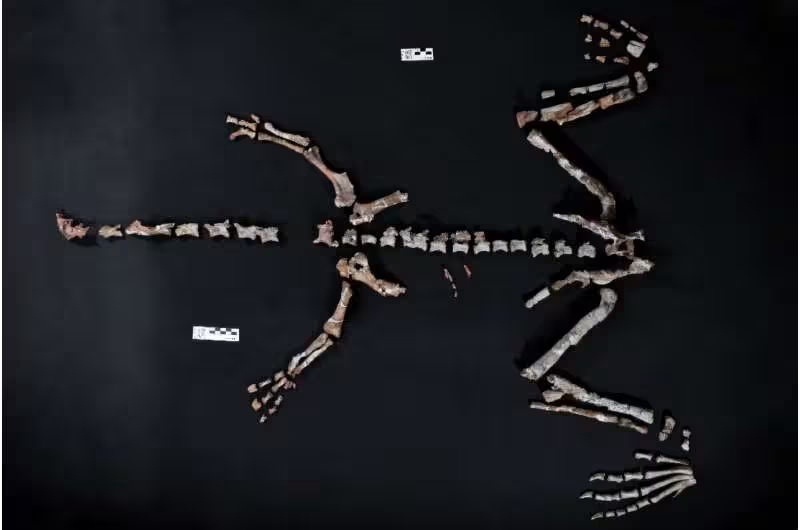
Almost complete skeleton of the small, long-necked reptile, Huayracursor jaguensis, discovered in the foothills of La Rioja. (AFP/CONICET PRESS OFFICE/HANDOUT)
Why Huayracursor matters to paleontology
Published in Nature, the study places Huayracursor in a lineage of early herbivorous dinosaurs that later produced long-necked giants. Yet this species was modest in size: adults are estimated to have reached roughly two meters in length while weighing only around 18 kilograms (40 pounds). "Huayracursor lived between 230 and 225 million years ago," said Agustín Martinelli, one of the paper’s authors, placing it near the end of the Triassic period when the first dinosaurs and early mammal relatives were emerging.
What this tells us about early dinosaurs
The near-complete nature of the skeleton makes Huayracursor especially valuable. Vertebrae preserved along the full spine, plus well-preserved limbs, allow researchers to study the early stages of neck elongation and body-size change in herbivorous dinosaur lineages. These traits are key to understanding how later sauropodomorphs evolved into the giants that dominated Mesozoic ecosystems.
Beyond anatomy, the high-altitude find and precise dating help reconstruct the environments where early dinosaurs diversified. Fossils from the late Triassic offer snapshots of ecological shifts that preceded the Jurassic radiation of dinosaurs.
Looking ahead
Researchers say further analysis of the specimen's microanatomy and bone histology could refine growth-rate estimates and life history. For now, Huayracursor jaguensis stands out as a compact but informative piece of the deep-time puzzle — a reminder that significant discoveries often come from unexpected places, like the high Andes.

“The cosmos has always fascinated me. I write about space missions, astronomy, and the technologies pushing humanity beyond Earth.”

Discussion
Leave a Comment