
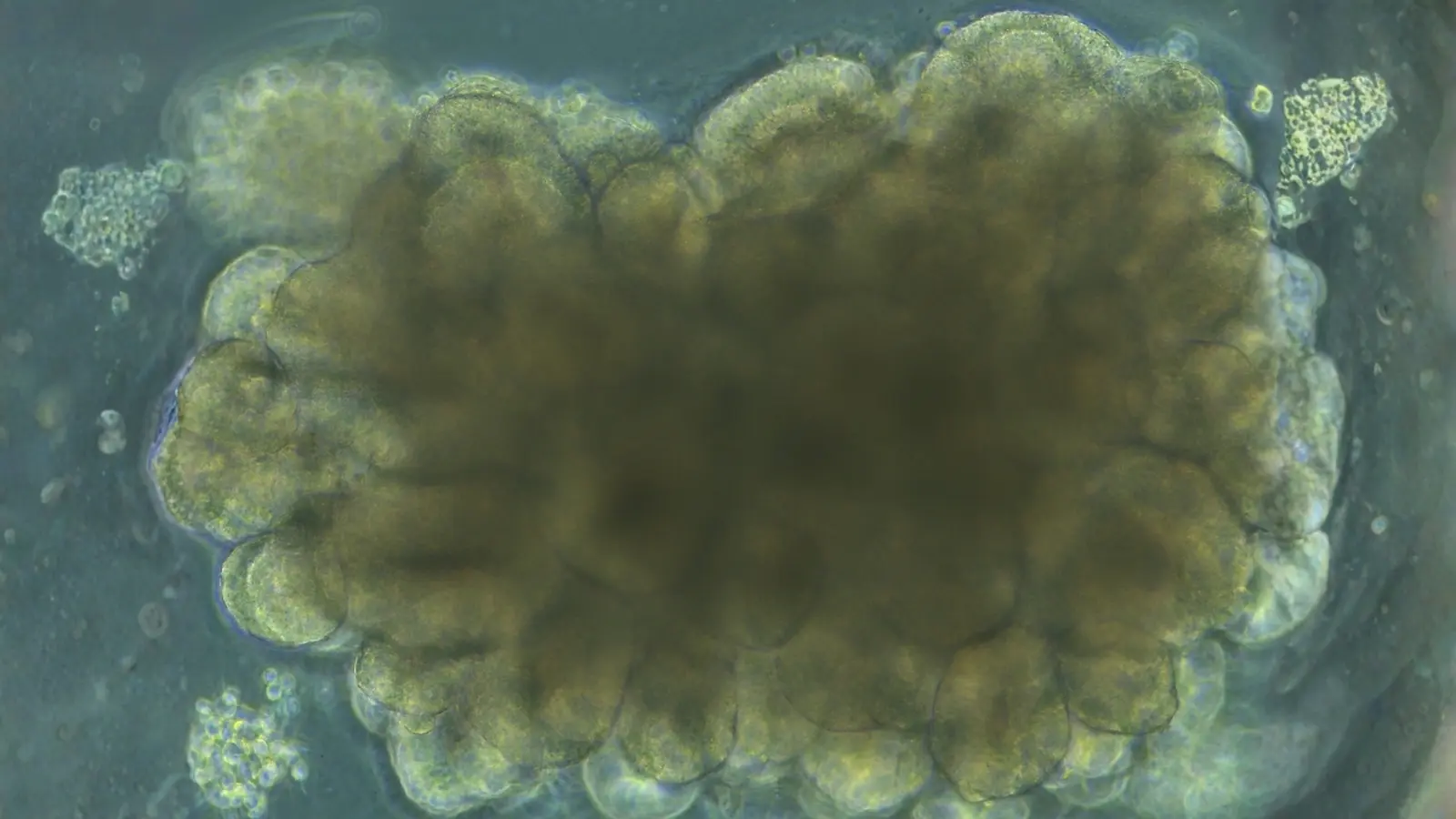
It sounds like a scene from a science-fiction sketch: tiny clusters of neural tissue, grown in a dish, nudged until they can help keep an unstable virtual object upright. Yet that is essentially what a research team at UC Santa Cruz demonstrated when they trained mouse-derived cortical organoids to improve performance on a classic control task known as the cartpole problem.
Why the cartpole matters
Think of balancing a pencil on the palm of your hand. That sense of constant, split-second correction — lean slightly left, shift your hand right — is what makes balancing inherently unstable. In engineering and artificial intelligence research, this toy problem has a formal name: cartpole. A virtual cart moves left or right to keep a hinged pole upright; small deviations rapidly compound, so the controller must deliver continuous, fine-grained adjustments rather than a single correct answer.
Cartpole is a favorite benchmark in reinforcement learning because it is simple to simulate, yet it demands adaptive, ongoing control. That combination made it an attractive probe for neuroscientists curious about whether living neural tissue could be coaxed, through feedback, into behaving like a controller — not by reasoning, but by changing wiring and signaling patterns in response to training.

Mature organoids grown for the experiment.
How the experiment worked
The organoids used here were not human. The team began with mouse stem cells directed to form small aggregates of cortical tissue capable of producing and transmitting electrical signals. These structures lack the complexity associated with cognition or consciousness; they are collections of neurons that form synapses and can be driven to alter their connectivity through stimulation.
The researchers set up a closed-loop system. The cartpole simulator emitted a set of signals encoding the pole's tilt and direction. Those signals were translated into patterned electrical stimulations delivered to selected neurons in the organoid. The organoid’s resulting electrical activity was then decoded into a left-or-right command that moved the virtual cart, completing the loop.
Crucially, the team compared three training regimes. One group of organoids received no feedback. A second got random stimulation unrelated to past performance. The third experienced adaptive feedback: if performance over a recent window of attempts deteriorated relative to the prior baseline, a brief high-frequency burst was delivered to certain neurons. An algorithm tracked which stimulation-target pairs tended to precede improvement and adjusted delivery accordingly — a kind of trial-and-error coaching tuned by short-term results.
“You could think of it like an artificial coach that says, ‘you’re doing it wrong, tweak it a little bit in this way,’” robotics and AI researcher Ash Robbins explained, describing the experimental logic. The question was not whether the tissue understood the task but whether synaptic and network-level changes could be driven in a direction that produced better control.
Results that surprised even the team
To distinguish genuine learning from lucky runs, the researchers set a statistical benchmark based on purely random controllers. Without feedback, organoids reached the proficiency threshold only rarely. Randomized stimulation produced a small improvement. But when adaptive feedback governed stimulation choices, nearly half of the training cycles produced performance exceeding what randomness would predict: a jump to 46 percent proficiency in those sessions.
That jump is not a jump to intelligence. The researchers emphasize the limits: changes were short-lived. If the organoids sat idle for roughly 45 minutes, the improved behavior largely vanished, and performance fell back to baseline. The team described the effect as short-term learning achieved by shaping network responses through targeted stimulation.
David Haussler, a bioinformatician at UC Santa Cruz, put the work into perspective: while it’s tempting to imagine hybrid systems that combine living tissue and silicon for computation, the immediate value here lies elsewhere. “Our goal is to advance brain research and the treatment of neurological diseases, not to replace robotic controllers and other kinds of computers with lab-grown animal brain tissues,” he said, noting that experiments with human tissue would raise significant ethical concerns.
Scientific context and implications
At its core, this experiment probes plasticity — the brain’s capacity to rewire itself in response to experience. In vivo, plasticity underpins learning, memory, recovery after injury, and many developmental processes. Organoids offer a controllable, observable window into those mechanisms. If a dish-based network can be nudged reliably toward a desired functional regime via patterned stimulation, that technique could become a research tool to study how different diseases, genetic variants, or pharmacological agents affect adaptive capacity.
The work also touches on broader themes in biohybrid systems. Interfaces that translate biological signals into machine actions, and vice versa, are central to prosthetics, brain–machine interfaces, and neuromorphic research. This study does not produce a practical bio-computer, but it demonstrates a proof of principle: living neural tissue can be guided by closed-loop feedback to solve a continuous-control task better than chance.
Expert Insight
“This is a cleverly designed experiment that leverages a simple task to reveal complex properties of neural tissue,” says Dr. Mira Patel, a neuroscientist who studies synaptic plasticity at a major research university. “What stands out is the adaptive-feedback algorithm: it acts as an external tutor guiding synaptic changes. The fragile retention of the trained state highlights how network architecture and synaptic consolidation differ in organoids compared with intact brains, and that points to clear next steps — longer culture times, richer inputs, or hybrid stimulation protocols to nudge short-term gains into more durable changes.”
From an ethical and practical standpoint, the path forward will require careful choices. Increasing complexity might improve memory and robustness, but researchers must weigh scientific gain against ethical implications, especially if human-derived tissue enters similar experiments. For now, mouse-derived organoids offer a safer proving ground.
The immediate next questions are both technical and biological: which stimulation patterns most strongly drive durable rewiring? How do network topology, cell-type composition, and connectivity maturity influence the capacity to retain trained behavior? And crucially for medical research, how do disease-model organoids respond when subjected to the same adaptive coaching?
Those are the directions the team and the broader field seem likely to pursue. If organoids can become reliable testbeds for plasticity, they may help accelerate therapies and deepen our grasp of how brains, from the simplest circuits to the most intricate networks, learn to act in a world that won’t stay still.
When living tissue and control theory meet at the bench, the result can be unexpected: not a brain that thinks, but a living network that, for a time, learns to keep a pole from falling.

“The cosmos has always fascinated me. I write about space missions, astronomy, and the technologies pushing humanity beyond Earth.”

Discussion
Leave a Comment