
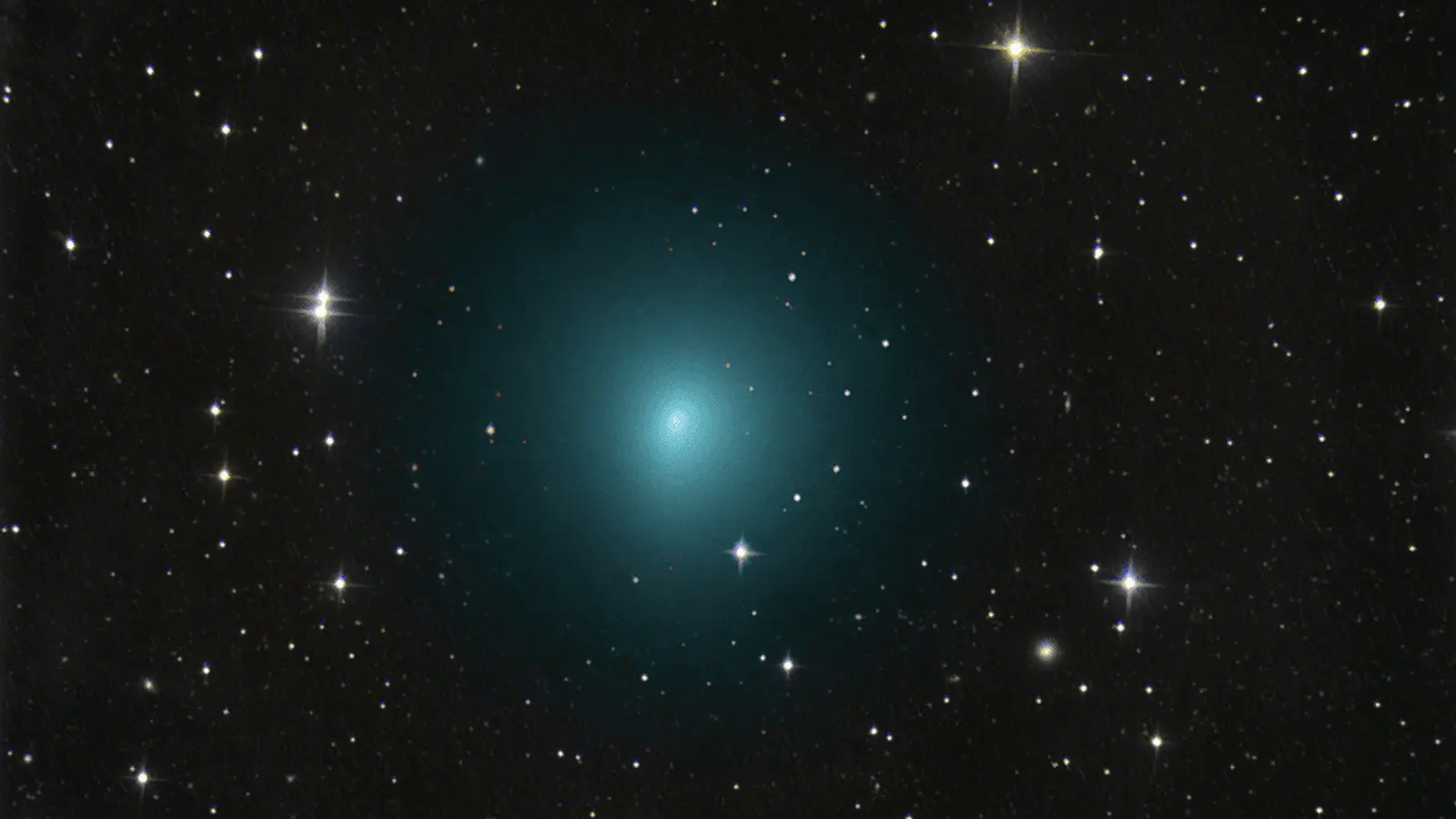
Something rare and a little theatrical happened to a small comet in 2017: it slowed, stopped, then appears to have spun up the other way. Short. Surprising. Unusual enough that astronomers are still piecing together the physics.
When a comet changes its mind
Observers tracking 41P/Tuttle-Giacobini-Kresák during its 2017 perihelion—its closest swing by the Sun—saw the comet’s rotation period stretch dramatically. In March the nucleus completed a turn in roughly 20 hours. Two months later that spin had stretched to about 53 hours. By December the clock seemed to have reset to around 14.4 hours. That sequence makes sense only if the comet’s rotation slowed to zero and then resumed in the opposite direction.
That kind of turnaround is not unheard of in principle. Comets are loose, dirty conglomerates of rock and volatile ices. When they warm up, ices vaporize and form jets that act like tiny rocket nozzles. Those jets apply torques—gentle but persistent forces—that can alter a comet’s spin. But the speed and magnitude of 41P’s change were extraordinary. As University of Maryland astronomer Dennis Bodewits summarized the context, previous dramatic slowdowns took months to produce small changes; 41P reformed its rotation faster and far more completely than anything previously recorded.

How outgassing can flip a nucleus
The mechanism is straightforward physics. Sublimation—the direct shift from solid ice to gas—creates concentrated outflow from exposed regions. Each localized outflow imparts an angular impulse, nudging the nucleus toward faster or slower rotation depending on the direction of the jet relative to the spin axis. Small bodies are vulnerable; a kilometer-scale object like 41P is roughly the size of ten football fields end-to-end, and that modest scale makes it easy for uneven heating or asymmetric ice distribution to produce large rotational effects.
Light curves—how the comet’s brightness varies with time—tell us about rotation rate and shape, but they don’t reveal the spin direction. To reconstruct the flip, UCLA astronomer David Jewitt combined light-curve measurements with updated size estimates from archival Hubble Space Telescope images. The pieces lined up best if the nucleus paused its rotation around mid-2017 and then reversed. Jewitt frames this as a natural outcome of torques from outgassed volatiles acting on a very small nucleus; mathematically, the numbers fit.
Why this matters
Comet rotation matters because it controls how and where sunlight heats the surface, which in turn governs which patches of ice sublimate and how jets evolve over many orbits. If jets repeatedly nudge the spin the same way, a comet can accelerate to breakup speeds and fragment. Jewitt’s models suggest that if 41P continues to evolve at the same pace it did in 2017, centrifugal forces could tear it apart within a few decades.
That isn’t a guaranteed fate. We lack measurements from the comet’s 2022 perihelion, and reliable spin-rate data will next be available when 41P returns in 2028. Until then, the comet’s future is an open question—but one with stakes for understanding small-body evolution in the inner Solar System. Repeated spin changes like this hint that some comets we now see as small remnants may once have been parts of much larger progenitors, gradually whittled down by repeated heating and shedding.
Scientific background and observation details
Studies of comet rotation combine photometry, imaging, and thermal modeling. Light curves reveal periodic brightness variations produced by an irregular shape rotating under solar illumination. High-resolution imaging from space telescopes refines nucleus size and helps separate coma brightness from nucleus light. In 41P’s case, archival Hubble images provided the size constraint that made Jewitt’s rotational model coherent.
Beyond academic curiosity, this work has practical implications. Comet fragmentation can seed the inner Solar System with debris, influence meteor showers at Earth, and complicate any potential missions to these bodies. Understanding how jets torque a nucleus helps mission planners predict orientation and surface exposure—critical when thinking about landings or sample-return operations.
Expert Insight
“What makes 41P special isn’t merely that it reversed; it’s how abruptly it happened,” says Dr. Elena Marquez, an astrophysicist who studies small-body dynamics. “Imagine a spinning top that slows to a wobble, pauses, and then spins back the other way because tiny jets kept shoving it. That sensitivity tells us these objects are dynamically alive—changing over human-observable timescales. It also means we need more frequent monitoring to catch these transitions as they occur.”
Continued surveillance—photometry during future perihelion passages, targeted imaging, and thermal modeling—will reveal whether 41P’s flip was a one-off event or part of a repeating pattern that will ultimately fragment the nucleus. For now, the comet offers a vivid demonstration that small Solar System bodies remain active and unpredictable, even after 4.5 billion years.
Scientists will watch 41P closely when it returns, ready to learn whether this nucleus keeps surprising us.

“My work centers on sustainability, energy, and environmental science — examining how innovation can lead to a greener future.”

Discussion
Leave a Comment