
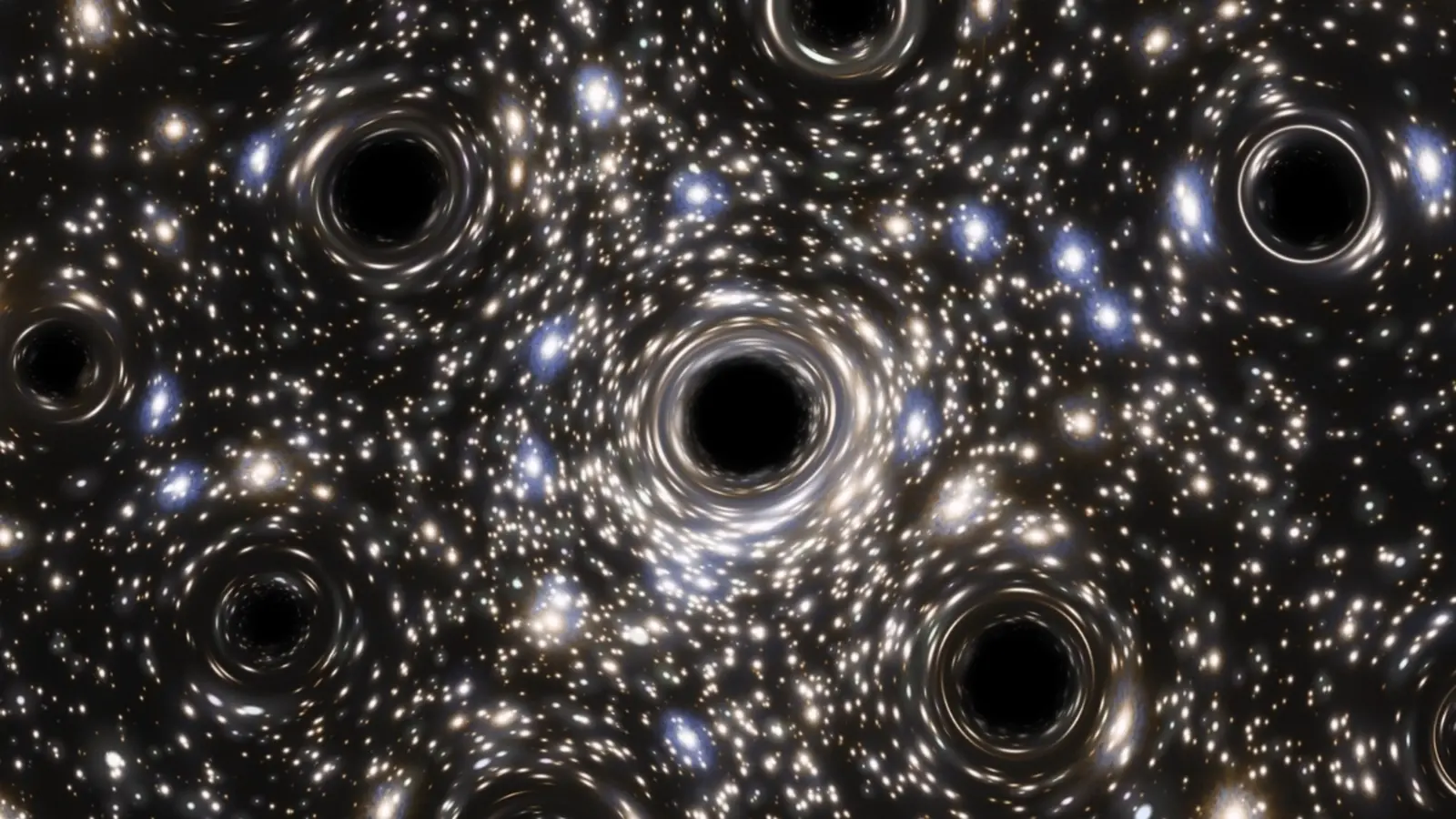
Imagine a loosely bound cluster of ancient stars strewn like breadcrumbs across the sky — and discover that its core is crowded not with bright suns but with dark, compact remnants: more than a hundred stellar-mass black holes. That is the striking picture emerging from new work on Palomar 5, a diffuse globular cluster and tidal stream far out in the Milky Way halo.
Palomar 5 is unusual. The group of stars that bears the name stretches into a tidal stream spanning tens of degrees on the sky and extends some 30,000 light-years along its length; the system itself sits roughly 80,000 light-years from Earth. Where many globular clusters are compact, spherical, and densely packed with hundreds of thousands of old stars, Palomar 5 is loose and already being pulled apart by the Galaxy’s gravity. That fragility, it turns out, may be key to what it hides inside.
For decades astronomers treated globular clusters as fossilized records of the early Universe: dense stellar labs where every star was born at the same time from one cloud. But when the European Space Agency’s Gaia mission began mapping the Milky Way in unprecedented detail, long, riverlike tidal streams — the shredded remains of clusters and dwarf galaxies — came into view. Palomar 5 has both a visible progenitor cluster and an extended tail of escaped stars, making it an ideal laboratory to test how streams form and evolve.
Simulations, black holes, and the ejection of stars
Researchers used high-resolution N-body simulations to rewind and replay possible histories for Palomar 5, tracking the gravitational interactions of individual stars over billions of years. When they included populations of stellar-mass black holes in the cluster core, the models reproduced the unusually diffuse present-day structure and a strong, long tidal tail. When they omitted black holes, the simulated cluster stayed too compact and could not account for the number and distribution of escaped stars.
Why do black holes matter here? Because they act like heavy billiard balls in a crowded table. Interactions between stars and black holes pump kinetic energy into lighter stars, slingshotting them onto wide orbits or ejecting them into the stream. Over time the lighter stars preferentially escape, leaving behind a larger fraction of massive, compact remnants inside the shrinking core. The simulations indicate that Palomar 5’s behavior is best explained if roughly one in five of the cluster’s mass is in black holes — a population three times larger than naive estimates based on the present number of visible stars.
"The number of black holes is roughly three times larger than expected from the number of stars in the cluster, and it means that more than 20 percent of the total cluster mass is made up of black holes," said Mark Gieles, who led the study. "They each have a mass of about 20 times the mass of the Sun, and they formed in supernova explosions at the end of the lives of massive stars, when the cluster was still very young."
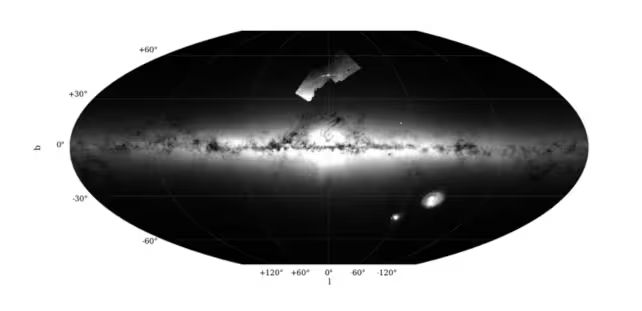
Map of the Milky Way plane obtained from data from the Gaia catalog (eDR3). The upper part shows a region where the Palomar 5 star cluster and its tidal tails are observed (DESI Legacy Imaging Survey, DECaLS/E. Balbinot, Gaia, DECaLS-DESI)
Why this matters: gravitational waves and cluster fates
There are two immediate scientific payoffs. First: if globular clusters like Palomar 5 retain large black hole populations, they could be efficient nurseries for binary black holes that later merge and produce gravitational waves detectable by observatories such as LIGO and Virgo. The dynamics inside dense cluster cores can assemble binaries through close encounters; those binaries then harden and eventually coalesce.
Second: the life story of many clusters may end as a black-hole-dominated remnant that dissolves into the halo. In the simulations, Palomar 5 loses mass steadily and will likely evaporate completely in about a billion years. Just before dissolution, the remaining bound object would be overwhelmingly composed of black holes orbiting the Galaxy — a ghostly echo of the original star cluster.
"A big unknown in this scenario is how many black holes there are in clusters, which is hard to constrain observationally because we cannot see black holes," noted astrophysicist Fabio Antonini. "Our method gives us a way to learn how many black holes there are in a star cluster by looking at the stars they eject." That indirect approach — inferring invisible populations from the motions and distribution of visible stars — is becoming a powerful tool in cluster astrophysics.
Expert Insight
Dr. Laura Mitchell, an astrophysicist at the Institute for Galactic Dynamics, comments: "What makes Palomar 5 compelling is the combination of a visible progenitor and an extended stream: it’s a rare case where models can be tested against both internal structure and external debris. The idea that a cluster's visible stars can be stripped away while black holes remain is intuitive in hindsight, but actually quantifying that process requires the kind of detailed N-body work the Gaia era now allows. This has implications across astrophysics — from stellar evolution to gravitational-wave source populations."
Beyond Palomar 5, the broader lesson is clear: tidal streams are more than pretty patterns on the sky. They are forensic evidence. Their shape, density, and the pace at which stars are lost encode the unseen mass and the dynamical past of their parent systems. With Gaia and next-generation surveys, astronomers can map streams and test whether other clusters harbor similarly large caches of black holes.
The study was published in Nature Astronomy and draws on Gaia’s precise astrometry combined with deep imaging surveys and modern simulation techniques. As the catalogue of streams grows and models improve, astronomers will refine estimates of how many black holes clusters produce and retain — a number that matters for predicting gravitational-wave rates, understanding cluster survival times, and charting the Milky Way’s assembly history.
Palomar 5 is, in a sense, a Rosetta Stone for stream formation: it connects the visible and the invisible, showing how dark remnants sculpt the light we see. If we keep reading the patterns left in the stars, who knows what other hidden populations we will uncover?

“The cosmos has always fascinated me. I write about space missions, astronomy, and the technologies pushing humanity beyond Earth.”

Discussion
Leave a Comment