
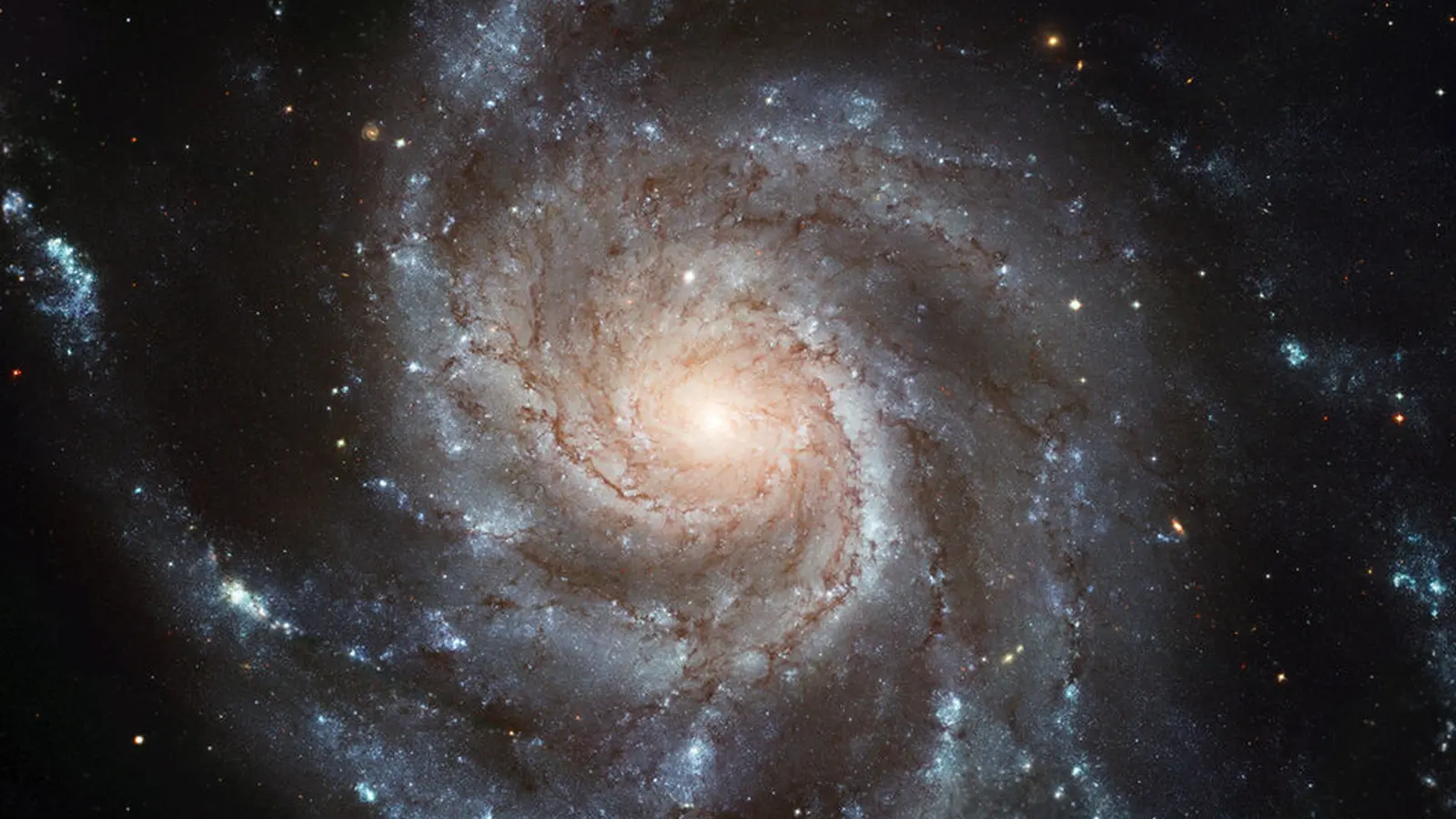
They were hiding in the cold light between stars — faint, dust-shrouded galaxies that push the known era of intense star formation deeper into the universe’s past. The discovery isn't a small nudge to our story of cosmic history. It's a challenge.
Using a powerful combination of ALMA and the James Webb Space Telescope, researchers have identified faint, dust-shrouded galaxies at the edge of the observable universe. These long-hidden systems may represent a transitional phase in galaxy evolution, bridging gaps between previously known populations.
An international team led from the University of Massachusetts Amherst has uncovered a population of dusty, star-forming galaxies that emerged roughly one billion years after the Big Bang. The collaboration — nearly 50 astronomers across 14 countries — blended deep submillimeter imaging from the Atacama Large Millimeter/submillimeter Array (ALMA) with near-infrared observations from NASA’s James Webb Space Telescope (JWST) to reveal objects most optical surveys miss.
How they found them
Dust is a double agent in astronomy: it conceals and it signals. Tiny grains of carbon and silicates absorb ultraviolet and visible light from young, hot stars, rendering the host galaxy nearly invisible to traditional optical telescopes. But that same dust warms and re-radiates the absorbed energy as infrared light — light that ALMA and JWST can detect, each at complementary wavelengths.
The team started with ALMA detections of roughly 400 bright, dust-rich sources. They then searched JWST’s near-infrared maps for faint counterparts and isolated about 70 candidate galaxies whose colors and faint fluxes indicate extreme distances. To lift these weak signals above the noise, the researchers stacked ALMA data — a technique that averages many observations to reveal the underlying emission from objects that are individually too faint to study securely.
Stacking confirmed a subset of these candidates as dusty systems that formed nearly 13 billion years ago. Among them, the authors highlight around eighteen galaxies whose inferred ages and properties place them at the tail end of the universe’s first billion years — a period when, according to many models, such massive, dust-rich systems should be rare.
“We’re looking at galaxies that built up metals and dust very quickly,” said Jorge Zavala, lead author and assistant professor of astronomy at UMass Amherst. “Their existence implies vigorous star formation and chemical enrichment significantly earlier than our simplest models predict.”
Why this matters for cosmic evolution
The newly revealed population may be the missing middle in a fragmented timeline. Recent JWST studies have found ultrabright, intensely star-forming galaxies at extreme redshifts — the energetic adolescence of the universe. Separately, observers have identified surprisingly massive quiescent galaxies that appear to have shut down star formation within a billion or two after the Big Bang. The dusty galaxies sit between those phases: not the hottest, bluest newborns, and not the quenched elders either. They look like the universe’s young adults.
That image matters because it changes when and how astronomers think heavy elements and dust formed, how quickly gas turned into stars in the first galactic generations, and how feedback processes — from supernovae and possibly early black holes — shaped growth. If dust and metals were widespread earlier, it affects how photons escaped into intergalactic space and thus bears on reionization studies too.
Methodologically, the work is also a demonstration of modern multiwavelength astrophysics. ALMA’s sensitivity to submillimeter emission and JWST’s near-infrared depth make a powerful pair for spotting systems that neither facility could characterize alone. The project depended on careful cross-matching, photometric redshift estimates, and the collective expertise of dozens of institutions with support from agencies including the U.S. National Science Foundation.
Expert Insight
“Finding dust so soon after the Big Bang tells us that the first wave of star formation was both intense and efficient,” said Dr. Amina Khatri, an astrophysicist specializing in galaxy formation. “These galaxies are laboratories: they let us study how the first heavy elements were produced and distributed. Follow-up spectroscopy will be crucial to measure velocities, masses, and the chemical fingerprints of those early stars.”
Looking ahead, the next steps are straightforward in concept but technically demanding. Spectroscopic confirmation with ALMA and JWST will pin down redshifts and dust properties. Wider-area surveys at submillimeter wavelengths could determine whether these dusty systems are rare curiosities or a common mode of early galaxy growth. The answer will reshape models of star formation, feedback, and the timeline of cosmic chemical evolution.

Eighteen of the recently discovered dusty, star-forming galaxies (in red) formed almost 13 billion years ago.
No single discovery rewrites the universe on its own, but this one pulls at threads that tie together the youngest, the most luminous, and the surprisingly aged galaxies we already knew. It is a reminder that the cosmos still keeps secrets, and that pairing the right instruments can make the invisible suddenly visible.

“The cosmos has always fascinated me. I write about space missions, astronomy, and the technologies pushing humanity beyond Earth.”

Discussion
Leave a Comment