

A faint metallic breath has been spotted hundreds of kilometres above the Atlantic — and scientists have traced it back to a discarded SpaceX rocket stage. On 20 February 2025, researchers using highly sensitive laser instruments recorded a sudden spike in lithium ions in the mesosphere and lower thermosphere. The chemical signature matched materials used in lithium batteries and satellite casings, and atmospheric trajectory modelling pointed straight to the uncontrolled re-entry of a Falcon 9 upper stage west of Ireland.
How the plume was found and why it matters
The discovery is unusual for two reasons. First, it’s the first time ground-based observations have tied a discrete chemical plume to a specific piece of re-entering space debris. Second, the detection relied on laser-induced fluorescence — a technique that can pick out trace metal atoms against the thin background air of the upper atmosphere. The study, led by Robin Wing of the Leibniz Institute of Atmospheric Physics and published in Communications Earth & Environment, demonstrates that human activity in orbit is already leaving a measurable fingerprint far above the weather.
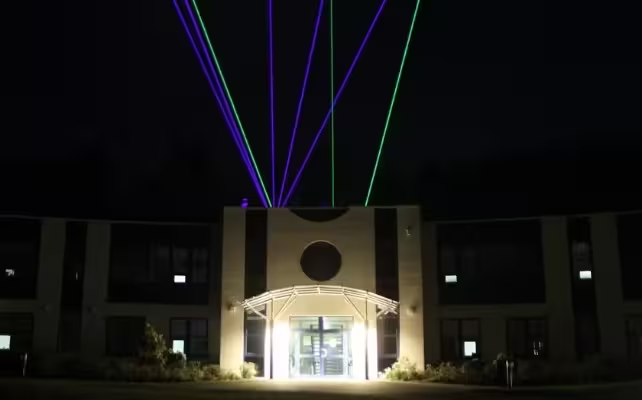
Lasers in operation at the Leibniz Institute of Atmospheric Physics.
Why lithium? Because the element is uncommon in natural meteoric layers at the altitudes monitored, and the form of the signal — ions consistent with battery components and metallic casings — was distinct from ordinary meteor dust. The team combined the spectroscopic detection with re-entry timing and atmospheric modelling to make the link to a Falcon 9 upper stage. The match was not a statistical hint. It was a clear, time-correlated plume aligned with the re-entry path.
Upper atmosphere: an overlooked, fragile region
The layer where this event occurred — roughly 80 to 120 kilometres above Earth — sits in a scientific blind spot. It’s too high for conventional balloons, too low for most satellites, and beyond the reach of routine aircraft. Yet it's critical for radio propagation, GPS signals and the chemistry that controls ozone. Until now, the upper stratosphere, mesosphere and lower thermosphere have been largely free of persistent human pollutants; natural meteors dominated metal layers.
That balance is changing fast. The orbital population has ballooned from a few thousand satellites to roughly 14,000 today, driven by megaconstellations. Tens or even hundreds of thousands more hardware pieces are planned. Every launched satellite — and every discarded rocket stage — will eventually re-enter. Estimates suggest that by 2030 several tonnes of spacecraft material could be burning in the upper atmosphere every day.
The potential consequences are not trivial. Laboratory and model studies have flagged aluminium and chlorine releases from rocket launches and re-entries as factors that could slow ozone recovery. Soot from engine plumes is expected to alter radiative balance and cause localized heating. What this lithium detection shows is that emissions from re-entries are not just hypothetical; they are measurable and can be traced back to individual events.
Policy, monitoring and the path forward
There is, however, a yawning gap between discovery and regulation. No international framework currently governs upper-atmospheric emissions from re-entries; there are limited monitoring networks and few mandated reporting standards for rocket stages and end-of-life satellites. If a single re-entry can be traced to a chemical signature on this scale, it becomes feasible to build accountability — but only if governments, industry and scientists agree on monitoring priorities and share data.

Should we treat rocket emissions the way we treat other industrial pollutants? Maybe. The comparison is imperfect. The upper atmosphere is remote, but the processes there influence ozone chemistry, long-range communications and climate-sensitive layers. Ignoring the emissions until effects become obvious would be risky.
Expert Insight
"Detecting a lithium plume tied to one re-entry is a wake-up call," says Dr. Elena Marquez, an atmospheric physicist who studies trace-metal chemistry. "We now have the tools to observe these plumes from the ground, but we need sustained networks and open data. Short-term studies answer immediate questions; long-term monitoring will reveal trends and cumulative impacts."
The technical path forward is straightforward in principle: deploy more laser-based sensors, coordinate optical and radar tracking of re-entries, and require operators to report re-entry timing and composition. The political path is harder. Spacefaring nations and commercial operators must negotiate new norms for emissions, transparency and risk-sharing.
For now, the lithium plume is a single, measurable example of human influence at the edge of space. It changes one thing for certain: re-entry is no longer invisible.

“My work centers on sustainability, energy, and environmental science — examining how innovation can lead to a greener future.”

Discussion
Leave a Comment