

Some days everything clicks. Other days you feel like you are pushing through fog. That rhythm of highs and lows turns out to be more than a figure of speech: researchers estimate that when your cognitive gears are running at their best, you can get the equivalent of roughly 40 extra minutes of productive work into a typical day.
What the study measured and why it matters
A team at the University of Toronto Scarborough followed 184 students for 12 weeks, asking them to complete brief cognitive tasks every day and then report whether they reached the goals they had set. The clever part of the design was that participants were compared against themselves rather than against each other. That made it possible to isolate how day-to-day changes in mental sharpness influenced the odds of finishing planned tasks.
The headline finding is simple and striking. On days when a person scored at the top of their own cognitive range, they were roughly as productive as if they had an extra 40 minutes to work. On down days, performance fell by about the same amount. In other words, the gap between your best and worst days could amount to nearly 80 minutes of effective work time.
Beyond grades: this applies to everyday tasks
This was not just an academic effect. The extra minutes applied across the board — from writing an essay to cooking dinner to clearing routine chores. Better mental acuity not only made participants more likely to meet existing goals, it also led them to set loftier goals on good days. Conversely, routine jobs could become surprisingly difficult on days of mental sluggishness.
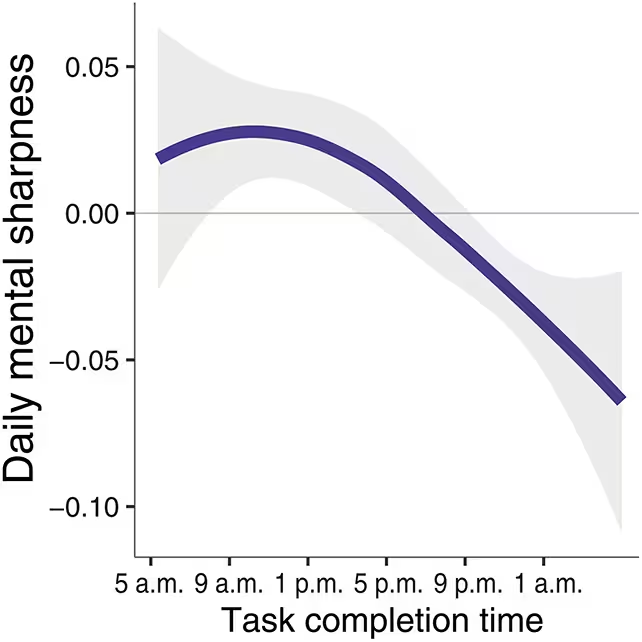
Time of day also played a role in task completion, which echoes long-standing research on circadian rhythms and cognitive performance. But personality traits like conscientiousness and self-control, while linked to overall task success, did not shield people from daily swings in sharpness. In the words of study author Cendri Hutcherson, 'Some days everything just clicks, and on other days it feels like you are pushing through fog. What we wanted to understand was why that happens, and how much those mental ups and downs actually matter.'
Scientific context and caveats
Technically, the team was probing the intention behavior gap, the mismatch that can emerge between what we intend to do and what we actually accomplish. The research implicates momentary cognitive performance as an important factor that widens or narrows that gap. That said, the authors stop short of claiming direct causation. Mental sharpness correlates with productivity, but the relationship is likely multi layered, with health, stress, sleep and mood all acting as mediators or moderators.
The study sample — university students — points to the need for broader demographic work. Future experiments could test whether interventions that boost cognitive function, such as napping, cognitive warm ups, or structured breaks, produce the predicted uplift in real-world task completion. More granular monitoring could also reveal whether specific cognitive domains, like working memory or inhibitory control, drive the effect more than others.
Practical takeaways
From the data the researchers examined, three everyday levers stood out as worth trying: getting sufficient sleep, managing long-term workload to avoid burnout, and addressing depressive symptoms that can suppress daily motivation. Those are broad prescriptions, but they point to where small changes could pay tangible dividends in productivity.
There is also a management lesson here. Employers and educators who build some flexibility into deadlines and task allocation can allow people to capitalize on their good days without being punished for low ones. That flexibility need not lower standards; it can simply synchronize effort and opportunity.
Expert Insight
Dr Maya Chen, a cognitive neuroscientist who researches attention and daily performance, notes that the result is both intuitive and actionable. 'We have always known that attention waxes and wanes. What this study does is quantify that ebb and flow in a way managers and individuals can use. Small investments in sleep and recovery are not indulgences, they are efficiency tools.'
Chen adds that measuring cognitive readiness before important tasks could be a low cost strategy. 'A two minute cognitive check in the morning could help you decide whether to tackle a demanding project or to do something less taxing and schedule the deep work for a peak day.'
There are limits. The research does not yet prove that deliberate cognitive boosts will translate directly into the full 40 minute gain for everyone. But it does provide a useful frame: daily mental sharpness is a resource, and like any resource it can be managed, conserved, and sometimes replenished.
So the next time you have a day that feels wired and effective, take note. And on the off days, give yourself the same practical grace you would offer a machine with a drained battery — because the battery can be recharged.

“My work centers on sustainability, energy, and environmental science — examining how innovation can lead to a greener future.”

Discussion
Leave a Comment