
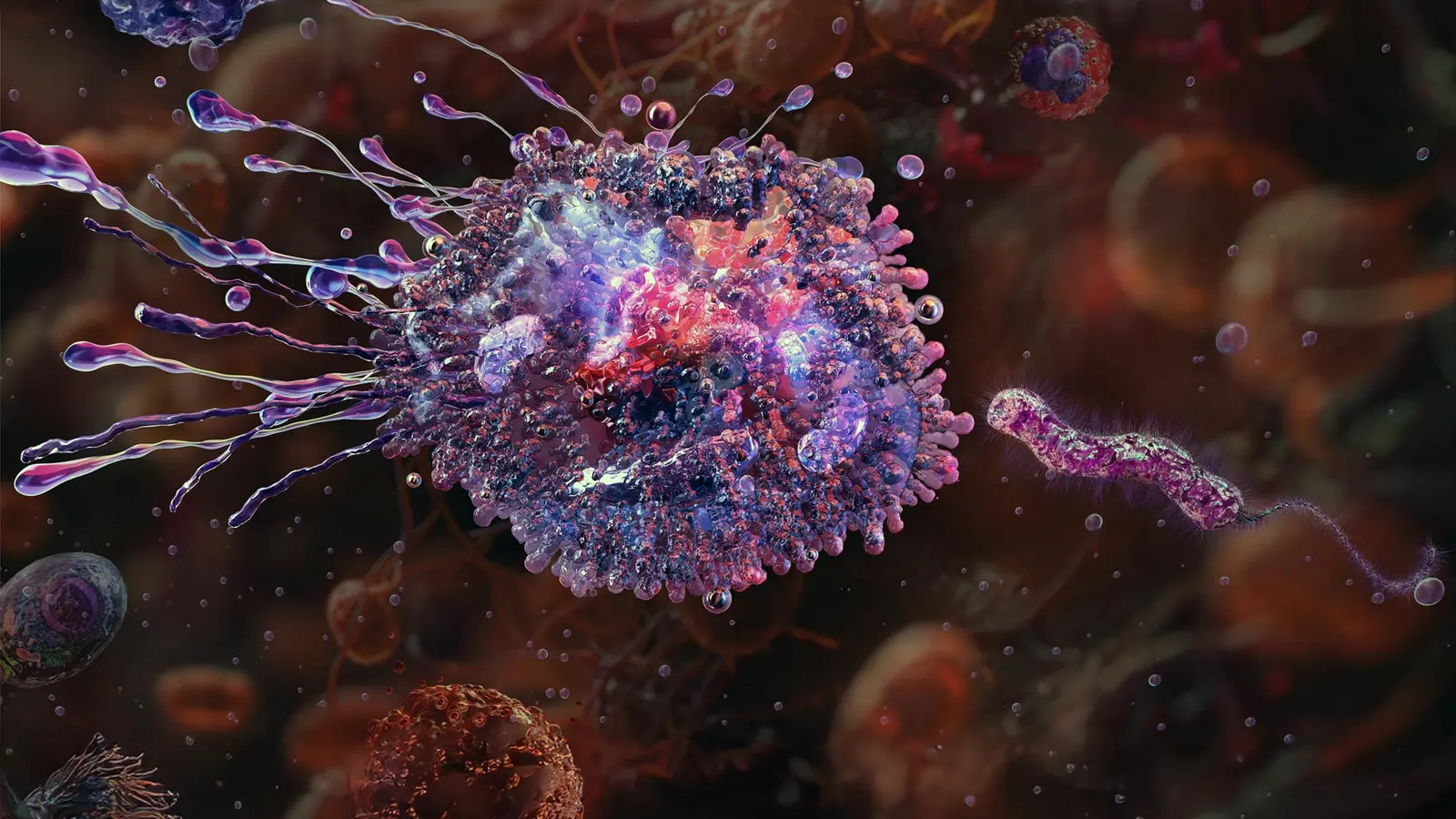
Think of macrophages as the body's custodial team: they clear debris, recycle vital elements, and quietly tune organ function. But who trains that team? Recent work points to a single genetic regulator that hands these cells their playbook.
Researchers have discovered that a genetic factor called MafB acts as the master switch that gives macrophages their identity and power to protect organs. Without it, these vital immune cells can’t fully mature—disrupting processes from iron recycling to lung and kidney health.
From monocyte to mature macrophage: the MafB pivot
Beneath the microscope, maturation looks like choreography. Blood-borne monocytes arrive in tissues and, depending on local cues, take on specialized roles. MafB, a transcription factor, steadily rises during this transition. It does not act alone. It coordinates a broad genetic program that flips on genes needed for phagocytosis, debris clearance, and tissue maintenance. Remove MafB, and many of those switches never flip. Cells linger in a limbo state: present, but not equipped.
That limbo has consequences. In experiments led by the Immunophysiology Laboratory at the University of Liège, cells lacking MafB appeared morphologically immature—rounder, less ramified, and functionally deficient.

Macrophages with MafB (WT) look mature and well-shaped, while those without MafB (KO) appear round and less developed.
Why does this matter? Because macrophages do more than fight infection. They shuttle iron from aged red blood cells, remodel extracellular matrix, and send metabolic signals that keep lungs, kidneys, intestine and spleen balanced. A global regulator like MafB provides a conserved identity so macrophages can adapt locally while preserving core abilities across tissues and species.
Evolutionary conservation and systemic effects
The more you dig into the DNA, the clearer the pattern becomes. MafB governs a network of genes found in mice and humans and echoed across vertebrates. That evolutionary conservation signals a biological principle: the body deploys a shared genetic program to produce reliable cellular actors wherever they are needed.
When this program fails, the ripple effects show up as organ dysfunction. The University of Liège team documented impaired iron recycling in the spleen and subtle but measurable dysfunction in lungs, intestines and kidneys when macrophage maturation stalled. Those organ-level readouts make an important point: immune cell identity shapes physiology, not just pathogen defense.
There is also a clinical angle. Chronic disorders such as fibrosis, persistent inflammation, metabolic disease and some infections have macrophage dysfunction at their core. If MafB or key downstream pathways can be modulated, researchers could restore macrophage competence and, by extension, improve tissue repair and homeostasis. That’s a long road, but one with a clear molecular signpost.
Techniques and evidence
The findings combine genetic models, single-cell profiling and comparative genomics. Tracking MafB expression as monocytes become tissue-resident macrophages revealed a reproducible pattern: a rise in MafB correlated with activation of phagocytosis genes and other functional markers. Loss-of-function studies produced the most telling data: animals lacking MafB in myeloid lineages carried macrophages that failed many of their essential tasks, and those failures manifested in measurable changes in organ physiology.
These are not abstract changes. Iron recycling defects can alter systemic iron homeostasis and anemia of chronic disease. Pulmonary and renal perturbations may sensitize tissues to injury. In short, MafB’s role bridges cell biology and whole-body health.
Implications for therapy and future research
Targeting a master regulator is tempting but delicate. Transcription factors like MafB sit at the heart of many genetic programs; nudging them could have wide-ranging effects. A more likely near-term path involves downstream effectors—genes and pathways MafB controls that are druggable or that can be modulated in a tissue-specific manner. Another strategy is to harness cell therapy: program macrophages ex vivo to a mature, MafB-high state and reintroduce them where they are needed.
What questions remain? Plenty. How do local tissue signals interact with MafB to produce the remarkable diversity of macrophage phenotypes? Can partial restoration of MafB-driven programs rescue organ function in disease models? And might environmental or metabolic stresses disrupt this program in ways that accelerate chronic disease?
Expert Insight
Dr. Eleanor Voss, an immunologist and translational researcher, observes: "MafB represents a fulcrum between identity and action. We’ve long known macrophages adapt to local niches; now we see a conserved genetic backbone that makes that adaptation reliable. Therapeutically, the challenge is to respect that backbone while selectively tuning its outputs. It’s precision biology in action."
Understanding how a single transcription factor can coordinate such sweeping cellular responsibilities reframes our view of immune cells. These are not ad hoc defenders; they are programmed caretakers. The question now is how to translate that programming into treatments that preserve function without breaking the network that evolution has carefully assembled.

“The cosmos has always fascinated me. I write about space missions, astronomy, and the technologies pushing humanity beyond Earth.”

Discussion
Leave a Comment