

Japanese scientists have engineered next-generation vitamin K molecules that markedly boost the brain’s ability to form new neurons. By chemically fusing vitamin K with retinoic acid, researchers produced hybrid compounds that trigger neuronal differentiation far more effectively than natural vitamin K — a finding with potential implications for therapies against Alzheimer’s and related neurodegenerative disorders.
Why neuronal regeneration matters now
Neurodegenerative diseases such as Alzheimer’s, Parkinson’s and Huntington’s progressively erode neurons — the brain’s information-processing cells. As neurons die or lose function, patients face memory loss, impaired movement and steady cognitive decline. Current drugs mainly address symptoms; they seldom reverse the underlying loss of neurons. That gap has prompted researchers to explore regenerative strategies: if the brain can be nudged to produce new neurons from progenitor cells, damaged circuits might be repaired or stabilized.
Vitamin K, a fat-soluble nutrient known for blood clotting and bone metabolism, has emerged in recent years as a surprising player in the brain. Laboratory studies linked certain vitamin K forms to neuron survival and the promotion of neuronal differentiation. But naturally occurring variants like menaquinone-4 (MK-4) exhibit limited potency for therapeutic applications — prompting chemists and neuroscientists to ask whether molecular redesign could amplify vitamin K’s neuroactive effects.
Designing a more potent vitamin K
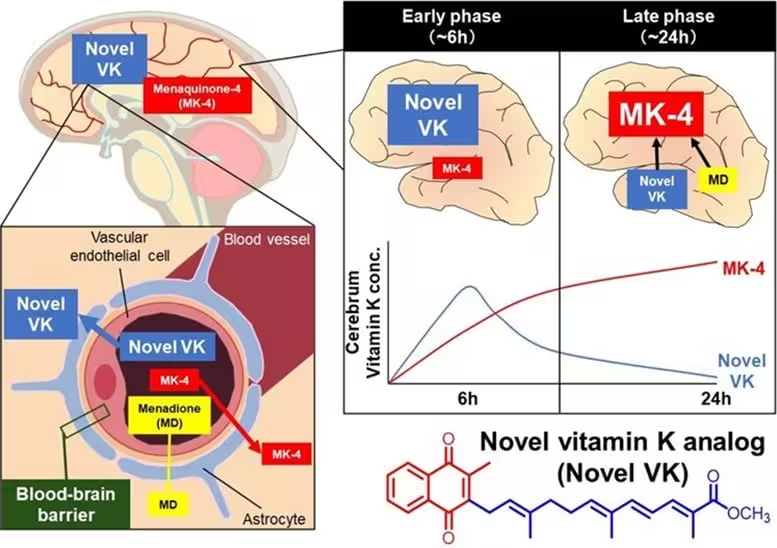
Researchers at the Shibaura Institute of Technology in Japan set out to do exactly that. Led by Associate Professor Yoshihisa Hirota and Professor Yoshitomo Suhara, the team synthesized a series of hybrid vitamin K analogues by chemically conjugating vitamin K scaffolds with retinoic acid — the active metabolite of vitamin A that is well known to promote neuronal differentiation.
In total, the group created a panel of 12 hybrid homologs that combined vitamin K with either a retinoic acid unit, a carboxylic acid group, or a methyl ester side chain. The scientific aim was twofold: preserve the biological signatures of both parent molecules (vitamin K and retinoic acid) and test whether the fused structure produced stronger induction of neuronal fate in neural progenitor cells.
Using cultured mouse neural progenitors, the team evaluated transcriptional activation of two nuclear receptors: the steroid and xenobiotic receptor (SXR), influenced by vitamin K, and the retinoic acid receptor (RAR), activated by retinoic acid. Importantly, the hybrid molecules retained activity at both receptors, indicating that each functional unit remained biologically competent after conjugation.
Novel VK: a standout candidate
Among the synthesized compounds, one hybrid — described in the study as Novel vitamin K analogue (Novel VK) — exhibited exceptional potency. This molecule combined the retinoic acid conjugate with a methyl ester side chain and increased neuronal differentiation by roughly threefold compared with the natural vitamin K control. The researchers measured neuronal conversion by tracking microtubule-associated protein 2 (Map2), a well-established marker of mature neurons.
Such a gain in activity is more than a laboratory curiosity. A molecule that reliably nudges neural progenitors into a neuronal fate could be developed as a regenerative agent to replenish cells lost to neurodegeneration.
Peering into the mechanism: mGluR1 and epigenetic cues
Understanding how vitamin K and its analogues trigger neuronal differentiation was central to the team’s work. Gene expression comparisons between MK-4–treated cells and cells exposed to inhibitors revealed an unexpected molecular partner: metabotropic glutamate receptors (mGluRs). In particular, mGluR1 emerged as a key mediator of vitamin K’s gene regulatory and epigenetic effects linked to neuronal fate decisions.
mGluR1 is a cell surface receptor known for modulating synaptic signaling and intracellular cascades. Prior animal studies show that loss of mGluR1 impairs motor control and neuronal communication — phenotypes relevant to neurodegenerative disease. The Shibaura group used computational structural modeling and molecular docking to test whether the novel vitamin K analogues interact directly with mGluR1. Their simulations supported a strong binding relationship between Novel VK and mGluR1, consistent with the pronounced biological effects observed in cell assays.
Cellular uptake and conversion to active MK-4
Another important finding was the efficiency with which Novel VK entered cells and converted into MK-4, the active intracellular form. In cell culture and in mice, intracellular MK-4 levels rose in proportion to Novel VK exposure. Compared with standard vitamin K, the hybrid converted to MK-4 more efficiently and achieved higher brain concentrations. Critically, animal studies showed that Novel VK crossed the blood-brain barrier and maintained a favorable pharmacokinetic profile — essential properties for any central nervous system drug candidate.
Researchers confirmed that Novel VK produced higher MK-4 levels in the brain than conventional vitamin K formulations, strengthening the case that chemical redesign improves both potency and bioavailability.
Translational implications: toward vitamin K–based therapies
These findings illuminate a concrete path from nutrient biology to potential therapeutics. By mapping the receptors and molecular pathways involved, the study supplies both a lead compound (Novel VK) and a mechanistic rationale for further development. If subsequent preclinical and clinical work validates safety and efficacy, vitamin K–derived drugs could become a new class of regenerative treatments aimed at slowing or reversing neuronal loss in Alzheimer’s and other neurodegenerative diseases.
Practical hurdles remain. Any candidate therapy must undergo rigorous toxicity testing, dose optimization, and demonstration of long-term benefit in animal models that reflect human disease pathology. Trial design will also need to address timing: regenerative strategies may be most effective in early or mid-stage disease, when neural progenitors and surviving circuits can still respond to differentiation cues.
Dr. Yoshihisa Hirota and colleagues emphasize the broader value of the approach: “Our analogues show that modest chemical changes can dramatically enhance vitamin K’s neurogenic potential. That opens new avenues for therapeutics that combine safety profiles of vitamins with targeted molecular activity,” the team notes.
Researchers from Shibaura Institute of Technology have designed and synthesized novel vitamin K analogues conjugated with retinoic acid, which exhibit potent neuronal differentiation-inducing activities. Their findings highlight unique mechanisms underlying the neuroprotective effects of vitamin K and its analogues, paving the way for the development of effective treatments against neurodegenerative diseases. Credit: Associate Professor Yoshihisa Hirota, Shibaura Institute of Technology, Japan
What this means for patients and the research pipeline
For patients and caregivers confronting Alzheimer’s and related disorders, this research represents hope rather than an immediate cure. The most important near-term impact will likely be on preclinical research: the availability of a potent, brain-penetrant vitamin K analogue gives labs a new tool to probe neuronal regeneration, synaptic repair and disease-specific models.
On a population level, an effective regenerative therapy could eventually reduce long-term care needs and healthcare costs tied to progressive dementia. But translating laboratory success into safe, effective human treatments typically takes years and careful, incremental validation.
Cover image featuring the study about novel vitamin K analogues conjugated with retinoic acid, exhibiting neuroprotective effects. Credit: ACS Chemical Neuroscience
Expert Insight
“This study elegantly bridges small-molecule chemistry and neural biology,” says Dr. Eleanor Park, a fictional neuropharmacologist and science communicator. “Two aspects stand out: the rational design to combine vitamin K and retinoic acid motifs, and the mechanistic link to mGluR1. Together, they create a coherent story from molecule to mechanism. The next critical steps will be validating long-term benefits in disease-relevant animal models and ensuring safety at therapeutic doses.”
Dr. Park adds, “It’s rare to see nutrient-derived compounds that both cross the blood-brain barrier and modify differentiation pathways so robustly. If those properties hold up outside the initial study, the result could reshape our approach to neuroregeneration.”
Looking ahead: research priorities and future prospects
- Expand preclinical testing in Alzheimer’s and Parkinson’s animal models to evaluate cognitive and motor outcomes after treatment with Novel VK.
- Investigate long-term safety, potential off-target effects and pharmacodynamics across age groups and disease stages.
- Refine compound chemistry to optimize brain delivery, metabolic stability and receptor selectivity.
- Design early-phase clinical trials focused on safety, biomarkers of neuronal regeneration and functional outcomes in carefully selected patient populations.
In short, the study from the Shibaura Institute of Technology delivers a compelling proof of concept: chemically enhanced vitamin K analogues can be potent triggers of neuronal differentiation, interact with meaningful neural receptors like mGluR1, cross the blood-brain barrier and increase active MK-4 in the brain. These are the essential ingredients for a promising therapeutic lead, albeit one that will require years of rigorous testing before reaching clinic shelves.

“The cosmos has always fascinated me. I write about space missions, astronomy, and the technologies pushing humanity beyond Earth.”

Discussion
Leave a Comment