
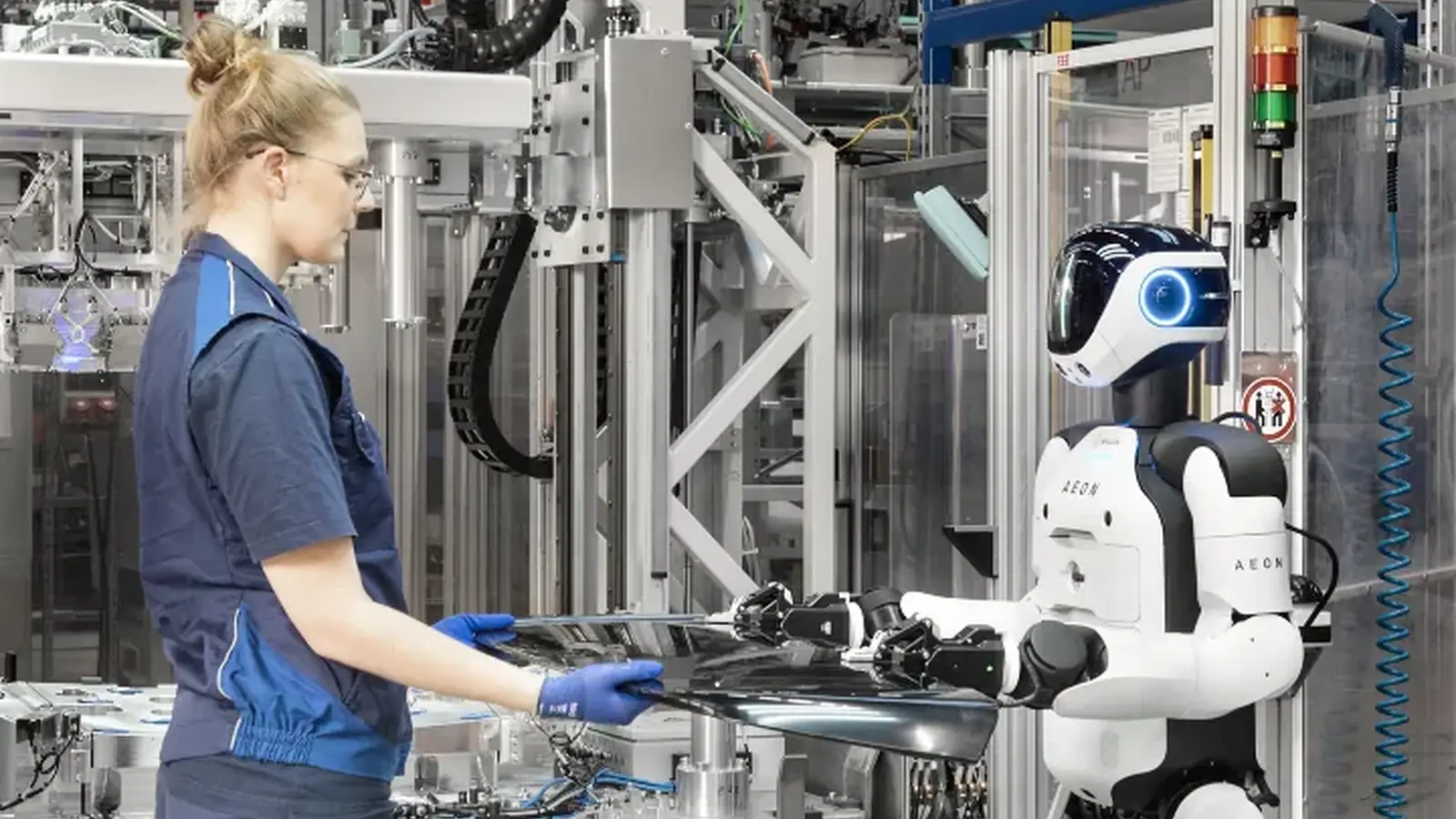
On a busy factory floor in Spartanburg, South Carolina, something unusual has been quietly walking between the assembly lines. Not a new engineer. Not a technician. A humanoid robot.
BMW’s experiment with bipedal machines—robots that move and operate with a human‑like form—has moved beyond curiosity. After months of real-world testing in the United States, the automaker now plans to extend the idea to Europe, bringing the next phase of its robotics trial to its Leipzig plant in Germany.
The message from Munich is clear: the factory of the future may not look the way we expect.
During the initial pilot program, BMW worked with robotics startup Figure AI, deploying its Figure 02 humanoid robots inside the Spartanburg facility. Over the course of roughly eleven months, those machines became surprisingly active members of the production ecosystem. Operating in shifts of about ten hours—limited largely by battery capacity—they helped support the assembly of more than 30,000 vehicles, many of them BMW X3 SUVs.

Collectively, the robots walked more than 200 miles across the plant floor. Their main job? Handling repetitive tasks such as moving and positioning components with millimeter-level accuracy. In total, they helped transport over 90,000 individual parts along the production line.
That may not sound revolutionary at first glance. But for BMW, the real breakthrough was how quickly the technology adapted to real factory conditions.
Motion routines trained in controlled lab environments transferred to production shifts faster than engineers expected. By connecting the robots through standardized interfaces to BMW’s internal Smart Robotics ecosystem, the machines were able to work alongside existing automated systems without major disruption.
“Digitalisation improves the competitiveness of our production—both in Europe and globally,” said Milan Nedeljković, BMW AG board member responsible for production. According to him, the combination of engineering expertise and artificial intelligence is opening entirely new possibilities inside manufacturing plants.

A cautious step into the humanoid era
Still, perspective matters. Despite the optimistic headlines, the Spartanburg project was unmistakably a pilot program. Only a small number of robots were involved, and their responsibilities were tightly controlled.
That nuance often gets lost in the broader industry narrative. Right now, nearly every major automaker is experimenting with humanoid robotics in some form. Mercedes‑Benz has been evaluating Apptronik’s Apollo robots for logistics tasks. Hyundai took a more dramatic step back in 2021 when it acquired Boston Dynamics, positioning its Atlas robot as a potential future factory worker. Tesla, meanwhile, has been loudly promoting its Optimus humanoid robot as part of a broader pivot toward AI and robotics.
The appeal is obvious. A robot built with a human-like body can theoretically operate in spaces designed for humans—climbing stairs, carrying boxes, or working with tools that weren’t originally designed for machines.
But theory and reality rarely move at the same speed.
Today’s humanoid robots remain expensive, power‑hungry, and mechanically complex. They require specialized maintenance and still perform most tasks slower than skilled human workers. Many of the slick promotional videos circulating online show robots completing simple routines under highly controlled conditions.
And then there’s the human side of the equation.

Factories have relied on industrial robots for decades, ever since General Motors installed the first programmable Unimate arm in 1961. Those machines dramatically reshaped manufacturing, but they typically stayed bolted to the floor performing a single repetitive motion. Humanoid robots are different—they’re mobile, adaptable, and potentially capable of replacing tasks traditionally handled by people.
That possibility makes labor groups uneasy. Hyundai’s plan to begin introducing Boston Dynamics Atlas robots later this decade has already triggered strong pushback from unions in South Korea. In Germany, the powerful IG Metall union has warned that expanding robotic labor could eventually impact employment across the manufacturing sector.
BMW has been careful with its messaging. Company executives emphasize that humanoid robots are intended for repetitive or physically demanding work, potentially freeing human employees to focus on less strenuous tasks.
Whether the workforce sees it that way remains an open question.
For now, BMW’s Leipzig experiment will serve as the next proving ground. Instead of the Figure units used in the United States, the German plant will evaluate humanoid robots from Hexagon Robotics, known as AEON. Engineers hope the new environment will reveal how well these machines adapt to different production setups.
One thing is certain: automakers increasingly want to be seen not just as car companies, but as technology companies.
And nothing signals that ambition quite like a robot walking through the factory.

“I love exploring gadgets, apps, and trends that redefine how we connect, work, and play in a digital world.”

Discussion
Leave a Comment