
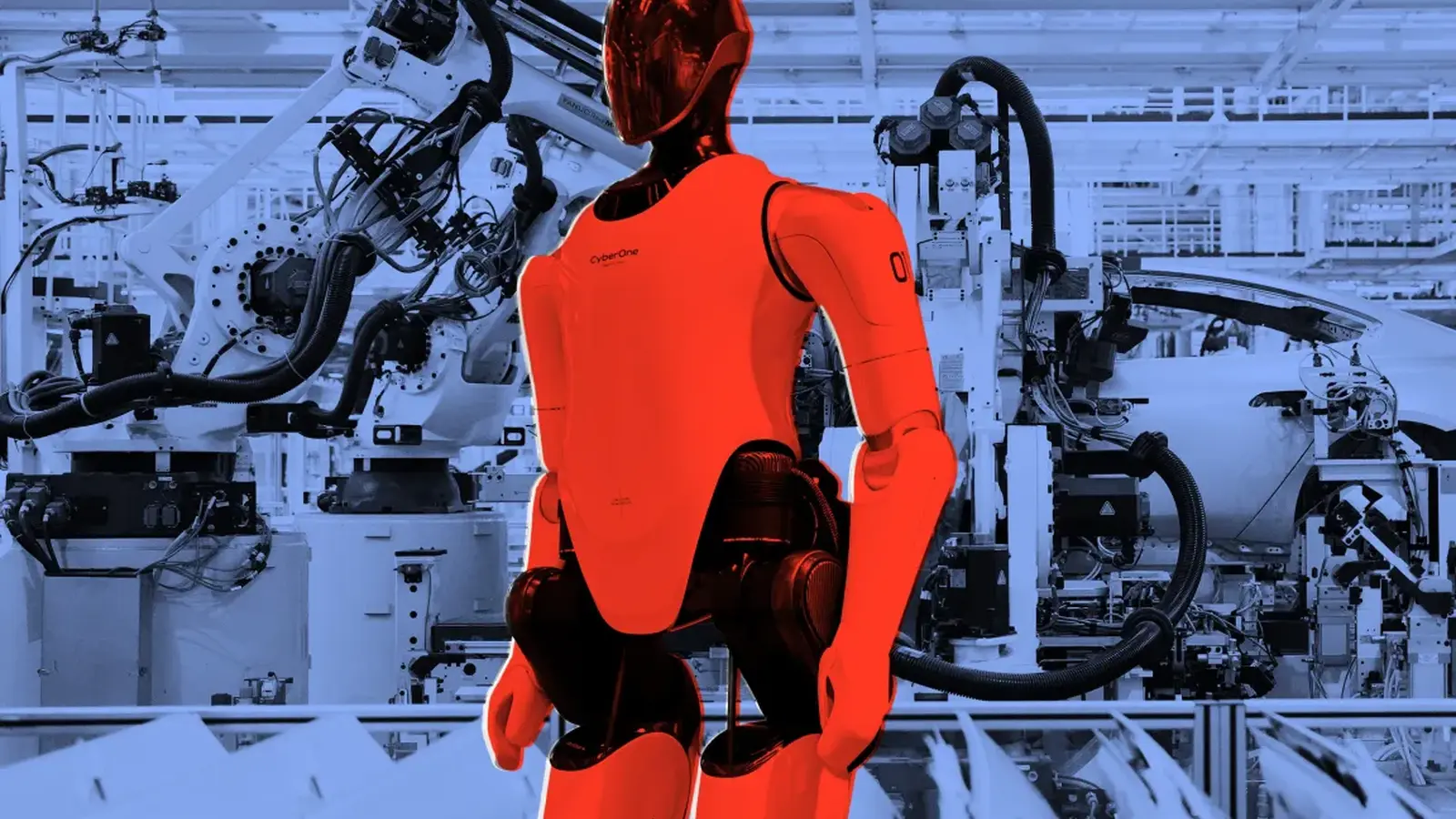
On Xiaomi’s electric vehicle assembly line in Beijing, two unusual workers have quietly joined the shift. They don’t clock out. They don’t stretch their backs. And they definitely aren’t asking where the coffee machine is.
The Chinese tech giant recently revealed that humanoid robots are now being tested inside its EV manufacturing facility. During a controlled trial, the company allowed a pair of bipedal robots to handle a real production task—installing lug nuts onto a vehicle chassis. It may sound like a small job, but in a modern auto factory, every second and every millimeter matters.
According to Xiaomi president Lu Weibing, the robots completed about 90.2 percent of their assigned work during a three‑hour evaluation period. That figure alone turned heads across the robotics and manufacturing industries. Not because the task was flawless—but because the machines kept pace with the rhythm of a real factory floor.
In a promotional video released by the company, the robots stand at opposite ends of the assembly line. Their movements are careful, almost cautious, as mechanical hands position and tighten the lug nuts. The process isn’t lightning fast. Each cycle takes around 76 seconds. In many factories, experienced human technicians could complete the same step quicker.
But speed isn’t the real headline here. Integration is.
Xiaomi’s factory pushes out a new car roughly every 76 seconds, a tempo that leaves little room for hesitation. Any robotic system joining that environment must synchronize perfectly with the existing production rhythm. According to Lu, that synchronization was the biggest hurdle.
“To integrate robots into our production lines, the biggest challenge is for them to keep up with the pace,” he explained in an interview with CNBC. The experiment suggests that, at least for certain tasks, humanoid robots can already match that cadence.
More like interns than coworkers—for now
Despite the promising numbers, Xiaomi isn’t pretending the robots are ready to replace human workers. Not yet. Lu described their role using a surprisingly humble analogy: interns.
They are learning the environment, performing limited tasks, and operating under supervision. In other words, the robots are still in the training phase of what could eventually become a much larger role in automated manufacturing.
Still, the symbolism matters. China already deploys more industrial robots than any other country in history, but most of those machines are traditional robotic arms bolted to fixed positions. Humanoid robots—machines designed with two legs and human‑like mobility—represent a very different vision for factories.
Instead of redesigning production lines around stationary robots, companies could eventually deploy machines that move through the same spaces built for human workers. A robot that walks, reaches, and manipulates tools like a person could theoretically adapt to existing factories without massive infrastructure changes.
Xiaomi isn’t alone in exploring that possibility. Earlier this year, UK-based robotics firm Humanoid ran its own pilot program using humanoid machines to stack storage totes. The robots achieved a success rate above 90 percent, according to industry reports.
The tasks, however, were quite different. Tote stacking involves larger objects and less microscopic precision. Xiaomi’s robots, by contrast, handled small mechanical components that demand careful alignment and accurate torque—closer to the fine motor skills required in automotive assembly.
There’s also debate about what truly counts as “humanoid.” Xiaomi’s machines walk and balance on two legs while performing the task. Some competing systems rely on a fixed base or wheeled platform for stability, which simplifies engineering but reduces flexibility.
For now, no company has deployed bipedal humanoid robots across a full production line on a permanent basis. The technology remains experimental, expensive, and occasionally fragile. But the direction of travel is clear.
Factories are slowly becoming test grounds for a new generation of machines—robots designed not just to work alongside humans, but to move like them.
If the early trials from Xiaomi are any indication, those “interns” on the assembly line may not stay interns for very long.

“Cars are evolving faster than ever. I cover electric vehicles, smart mobility, and the future of transportation worldwide.”

Discussion
Leave a Comment