
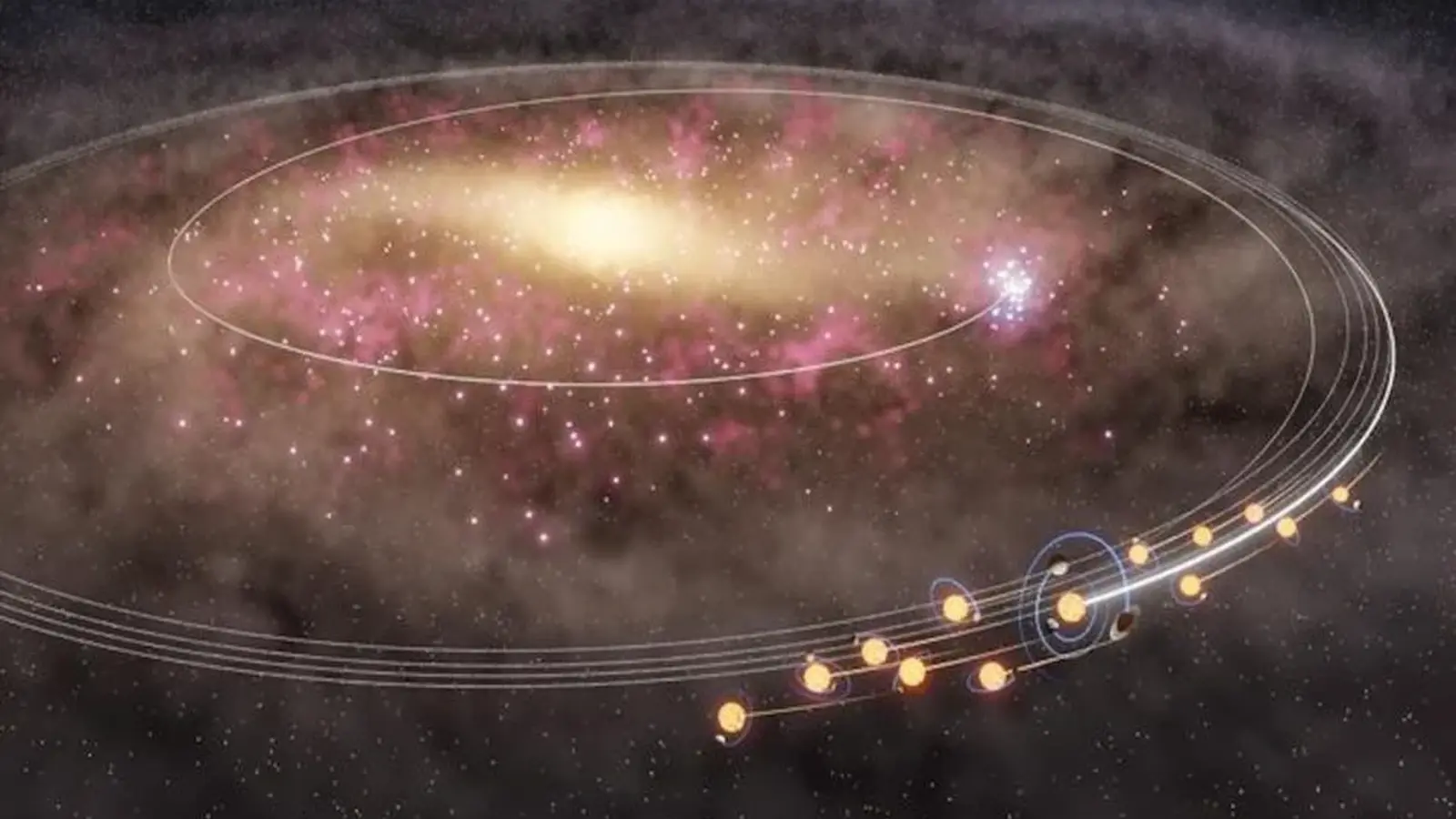
Four and a half billion years ago, the place where our Sun first ignited was anything but peaceful. The inner regions of the Milky Way were crowded, violent, and constantly stirred by gravitational forces. Massive stars exploded, gas clouds collapsed into new suns, and the supermassive black hole at the galaxy’s center loomed nearby. Yet today, our Sun drifts through a relatively calm stretch of the galaxy—far enough from that chaos that life had a chance to appear on Earth.
New astronomical research suggests this tranquil location was not the Sun’s original home. Instead, our star likely formed much closer to the Milky Way’s core before slowly migrating outward to its current orbit. The discovery helps solve a long-standing mystery in galactic astronomy: how the Sun ended up in such a life-friendly region of space.
Clues Hidden in Stellar Chemistry
A star’s chemical makeup acts like a fingerprint of its birthplace. Regions closer to the center of the Milky Way contain higher concentrations of heavy elements—what astronomers call “metals,” meaning any element heavier than hydrogen or helium. These elements accumulate over time as generations of stars forge them through nuclear fusion and scatter them through supernova explosions.
The Sun contains more of these heavy elements than expected for a star born at its current distance from the galactic center, roughly 26,000 to 28,000 light‑years away. That chemical mismatch has puzzled astronomers for years. If the Sun formed here, its composition should look different.
The new studies argue that the simplest explanation is movement. When the Sun formed about 4.6 billion years ago, it may have been more than 10,000 light‑years closer to the center of the Milky Way.
Tracking the Sun’s Long-Lost Twins
To explore this possibility, researchers from Tokyo Metropolitan University and the National Astronomical Observatory of Japan turned to data from the European Space Agency’s Gaia spacecraft. Gaia has been mapping the positions, movements, and properties of stars across the Milky Way with extraordinary precision.
The team combed through observations of nearly two million stars, searching for what astronomers call “solar twins.” These stars share characteristics with the Sun—similar temperature, size, and chemical composition—and likely formed during the same general era of galactic history.
Out of that enormous dataset, the scientists identified 6,594 promising candidates. When they estimated the ages of these stars, an intriguing pattern appeared. A large number clustered around 4 to 6 billion years old, closely matching the Sun’s age.
Even more interesting was their position in the galaxy. Many of these solar twins occupy similar orbital distances from the Milky Way’s center today, suggesting they may have participated in the same large-scale migration event billions of years ago.
A Galactic Traffic Jam and a Way Out
The inner Milky Way is dominated by a structure known as the galactic bar—a dense, elongated band of stars and gas stretching across the galaxy’s central region. For years, astronomers suspected that this structure might act as a gravitational barrier, preventing stars from drifting outward.
The new research proposes a different timeline. According to the analysis, the bar may have reached its present strength only after the migration of many Sun-like stars had already begun. During the bar’s early formation, gravitational disturbances could have pushed groups of stars outward, reshaping their orbits and redistributing them across the galactic disk.
In that scenario, the young Sun joined a slow cosmic exodus—gradually moving away from the densely packed inner galaxy toward quieter territory.
The difference matters enormously. The central regions of the Milky Way are far more dangerous environments. Stars are packed closer together, increasing the chance of gravitational disruptions to planetary systems. Supernova explosions occur more frequently. Intense radiation and high-energy cosmic events are also more common near the supermassive black hole Sagittarius A*.
Had the Sun remained there, the delicate conditions required for life on Earth might never have survived long enough to develop.
Reconstructing the Solar System’s Past
Identifying solar twins does more than explain the Sun’s migration. These stellar siblings act as historical markers, allowing astronomers to reconstruct the broader story of how the Milky Way evolved over billions of years.
By studying their motions, chemical compositions, and ages, scientists can trace patterns of stellar migration across the galaxy. Those patterns reveal how gravitational structures—such as spiral arms and the central bar—have reshaped the Milky Way over cosmic time.
For planetary science, the implications are just as compelling. Understanding where the Sun formed helps researchers refine models of how the solar system assembled and how the conditions for life emerged on Earth.
In other words, the story of our planet may depend on a long journey that began deep inside the Milky Way’s most turbulent neighborhood. Billions of years later, the Sun now shines in a far quieter corner of the galaxy—a fortunate address that may have made all the difference.

“The cosmos has always fascinated me. I write about space missions, astronomy, and the technologies pushing humanity beyond Earth.”

Discussion
Leave a Comment