
There’s a clear reason why the Snapdragon 8 Gen 5 is already turning heads: it feels like the first “non-Elite” chip that borrows real muscle from Qualcomm’s top-tier playbook. Built around Oryon cores, it lands with the kind of punch you’d expect from a flagship, not just a premium mid-range platform.
The MediaTek Dimensity 9300, meanwhile, is no lightweight. Yes, it’s older, and yes, it usually comes in at a friendlier price. But it still has enough pace, efficiency, and all-round polish to remain a very tempting option for buyers who want strong everyday performance without paying top dollar.
So which one actually makes more sense in 2026? That depends on whether you want the sharper, faster, more future-facing chip, or the one that still gets the job done while saving you some cash. The benchmarks tell a pretty decisive story.

Benchmarks tell the story fast
In CPU testing, the Snapdragon 8 Gen 5 pulls ahead in both single-core and multi-core results by roughly 27 percent. That gap is not subtle. It points to quicker app launches, smoother multitasking, and a little more breathing room when a phone is pushed hard.
Single-core score: Snapdragon 8 Gen 5 at 2,837 versus Dimensity 9300 at 2,208.
Multi-core score: Snapdragon 8 Gen 5 at 9,352 versus Dimensity 9300 at 7,380.
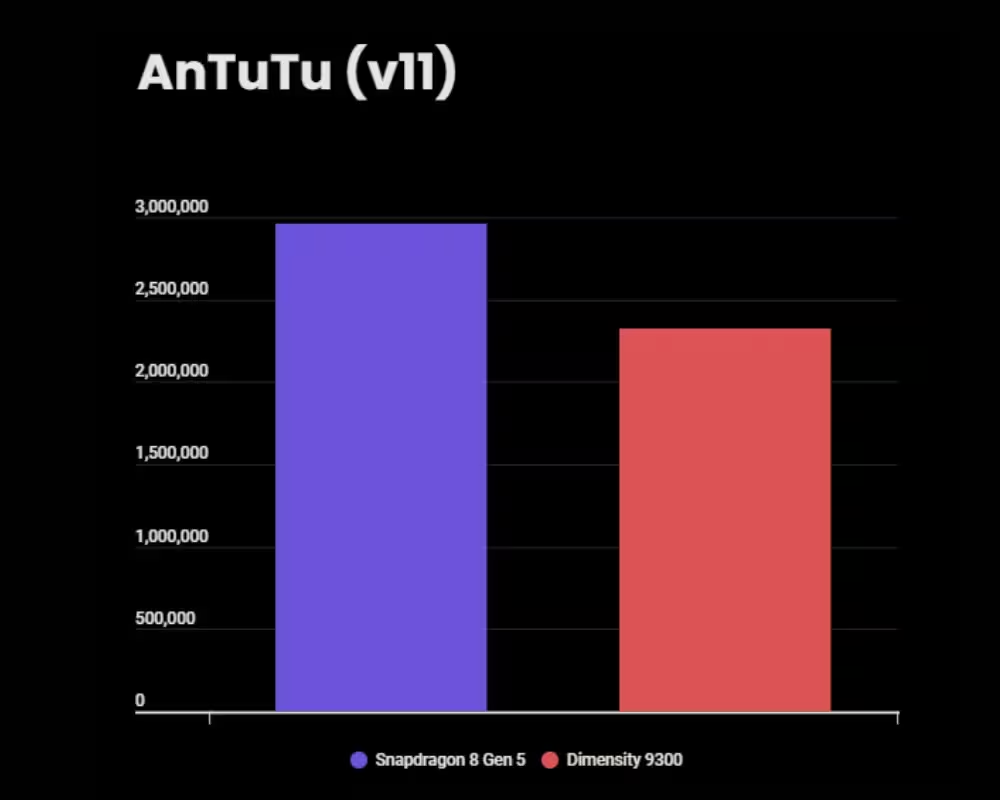
The same pattern shows up in AnTuTu, where Qualcomm’s chip reaches 2,961,236 points while MediaTek’s lands at 2,324,872. That is a healthy 27 percent advantage overall, and the breakdown makes the gap even clearer.
CPU performance is up by 32 percent, GPU output by 19 percent, memory by 13 percent, and UX performance by a much larger 44 percent. In other words, the Snapdragon 8 Gen 5 does not just win. It wins across the board.
That advantage carries into 3DMark Wild Life Extreme Stress Test as well, where the Snapdragon chip posts a best loop score of 5,009 compared with 4,062 for the Dimensity 9300. The bigger story is stability. Snapdragon holds on far better under pressure, with a stability score of 66.30 percent against 47.59 percent for MediaTek’s chip. For gamers, that matters. A lot.
Where the gap really opens up
Part of the reason comes down to process node. The Snapdragon 8 Gen 5 is built on TSMC’s newer 3nm process, while the Dimensity 9300 uses a 4nm node. On paper, that sounds like a small difference. In practice, it helps Qualcomm deliver better efficiency and stronger performance headroom.
The CPU designs are also very different. Snapdragon 8 Gen 5 uses a 2 plus 6 setup with two Oryon prime cores clocked at 3.8GHz and six Oryon performance cores at 3.32GHz. The Dimensity 9300 takes a 1 plus 3 plus 4 approach, using one Cortex-X4 prime core at 3.25GHz, three Cortex-X4 performance cores at 2.85GHz, and four Cortex-A720 efficiency cores at 2.0GHz.
Put simply, Qualcomm leans harder into peak performance, and the numbers back that up. Every CPU core in the Snapdragon chip runs at a higher clock speed, which helps explain why it comes out on top in heavy-duty tasks.
Graphics is another battleground, and here too the Snapdragon 8 Gen 5 lands the cleaner punch. Its Adreno 829 GPU uses Qualcomm’s sliced architecture, supports ray tracing, Unreal Engine 5 features, and AI-assisted upscaling, while also tapping into the company’s full Elite Gaming toolkit for steadier frame rates and lower latency.
The Dimensity 9300 responds with a 12-core Arm Immortalis-G720 GPU, 2nd-gen hardware ray tracing, and MediaTek’s HyperEngine Adaptive Gaming Technology. It is still a serious gaming platform and can handle demanding titles well, especially for extended play. But in the head-to-head, Snapdragon simply feels more complete.

The AI side of the story is close, though the Snapdragon 8 Gen 5 again feels more forward-looking. Its Hexagon NPU is tuned for on-device assistants, multimodal AI, and heavier generative AI workloads. MediaTek’s NPU 790 is no slouch either. It supports large language models with up to 33 billion parameters and can run complex on-device AI tasks with impressive efficiency. For most buyers, both are more than capable. Qualcomm just appears better positioned for the next wave of features.
Camera hardware is another area where the Snapdragon 8 Gen 5 pushes ahead. Its 20-bit Spectra AI ISP supports up to a 320MP single camera and 4K at 120fps, with OEMs able to enable 8K recording if they want to go big. It also brings advanced real-time semantic segmentation and stronger AI-driven image tuning.
The Dimensity 9300 counters with an 18-bit Imagiq 990 ISP, support for a 320MP camera, and 8K video. It adds AI Semantic Analysis Video Engine features, zero-latency preview, and pixel-level autofocus with dual-lossless zoom. That makes it a capable imaging platform, though Qualcomm’s newer ISP gives the Snapdragon a fresher edge.
Connectivity is more of a mixed bag. Snapdragon 8 Gen 5 reaches 10Gbps download speeds on 5G, compared with 7Gbps on the Dimensity 9300. The MediaTek chip, however, offers faster peak Wi-Fi 7 speeds at 6.5Gbps versus 5.8Gbps for Snapdragon. Qualcomm answers with Bluetooth 6.0, while MediaTek remains on Bluetooth 5.3.
So, which chip is better? If performance is the priority, the Snapdragon 8 Gen 5 is the stronger choice. It delivers better CPU and GPU numbers, better stability in long gaming sessions, stronger connectivity, and a more modern camera and AI stack. It feels like the chip for phones that want to stay relevant longer.
The Dimensity 9300 still deserves respect. It is fast, efficient, and perfectly capable of handling daily use, photography, and gaming without drama. And if the price gap is meaningful, it can still be the smarter purchase. But if the cost difference is small, the Snapdragon 8 Gen 5 is the easier recommendation. It simply offers more.

“I love exploring gadgets, apps, and trends that redefine how we connect, work, and play in a digital world.”

Discussion
Leave a Comment