
AMD's landmark arrangement with OpenAI has rattled markets and reignited the debate over who will lead the AI accelerator race. Shares swung sharply as investors digested a multibillion-dollar deployment of AMD GPUs at one of the industry's most influential AI labs.
Stocks react as OpenAI backs AMD's Instinct chips
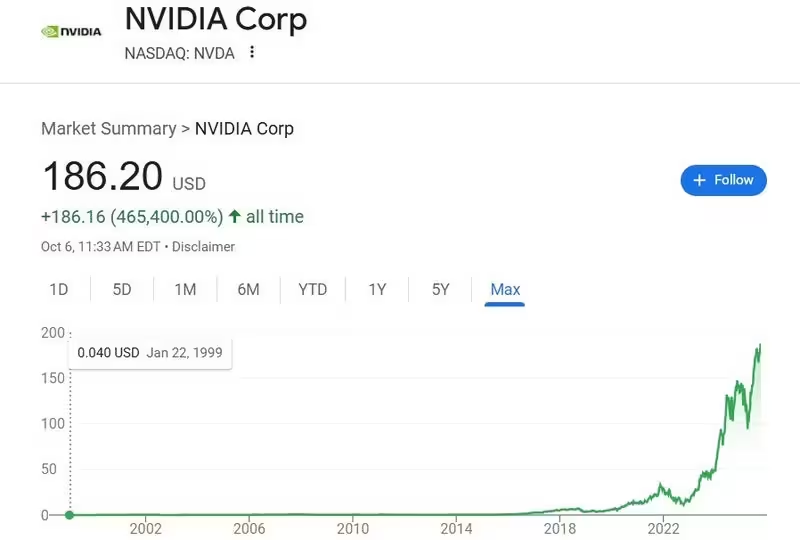
On the heels of AMD's announcement that OpenAI plans to deploy roughly 6 gigawatts of its Instinct GPUs, AMD shares surged more than 27% in early trading. Nvidia's stock slipped in response, falling a few dollars at the open before rebounding later in the session. The move underscores how quickly market sentiment can shift when a major AI player signals vendor diversification.
The headlines were amplified by the financial terms tucked into the deal: OpenAI receives a warrant to buy up to 160 million AMD shares at a nominal price, a vehicle that could give OpenAI a roughly 10% stake in AMD at minimal upfront cost. For perspective, AMD's market value sits in the hundreds of billions, while Nvidia remains among the most highly valued US tech companies.
Why GPUs still matter for AI — and why competition is heating up
GPUs excel at parallel processing, running thousands of cores simultaneously to handle the matrix math that modern large language models demand. CPUs perform tasks sequentially and are far less efficient for that specific workload. That technical advantage is why GPUs became the default accelerators for training and inference at scale.
But the AI compute landscape is changing. OpenAI's deal with AMD — plus recent agreements with Nvidia and Broadcom — shows a deliberate strategy to diversify hardware suppliers and reduce reliance on a single vendor. At the same time, hyperscalers and cloud providers like Google and Amazon continue to design custom accelerators, raising the stakes across the industry.
Analysts see big AI spending, but Nvidia remains a heavyweight
Most Wall Street analysts remain bullish on Nvidia despite the short-term volatility. A large majority of tracked analysts rate the stock a buy, pointing to sustained demand for AI infrastructure. Some industry analysts predict total addressable market for AI compute and networking could expand dramatically by 2030, potentially into the trillions — a prize that makes competition fierce.
Even so, Nvidia's entrenched ecosystem, software stack, and large installed base give it a significant advantage. New entrants and rival chipmakers can win meaningful share, especially if they deliver comparable performance or better cost and power efficiency, but displacing an incumbent at scale is neither quick nor guaranteed.
What to watch next
- OpenAI deployment timelines and which workloads will run on AMD versus Nvidia hardware.
- Further commercial terms, including whether OpenAI exercises the warrant and how that affects investor sentiment.
- Announcements from hyperscalers about custom accelerators or expanded partnerships that could shift procurement plans.
- Benchmarks showing performance, power efficiency, and total cost of ownership for AMD Instinct versus Nvidia GPUs and custom chips.
Imagine AI data centers where multiple architectures share the load: that scenario is now more plausible. The industry is still in the early innings, with major players jockeying for technical leadership and long-term economic benefits. For investors and engineers alike, this deal is a reminder that the AI hardware story is far from settled.

“I cover emerging technologies, digital innovation, and the intersection of tech and everyday life. My goal is to make complex trends accessible and inspiring.”

Discussion
Leave a Comment