

Meta has quietly flipped the switch on a much bigger AI ambition. The company has refreshed the Meta AI app inside and out, and with that update comes a new closed-source model family called Muse, led by Muse Spark. What used to be known internally as Avocado is now the face of Meta’s next push into high-end AI.
Muse Spark is not just another chatbot upgrade. Meta says the model was built by Meta Superintelligence Labs and arrives with native multimodal understanding, reasoning, tool use, visual chain of thought, and multi-agent orchestration. In plain English, it is designed to see, think, and act in a more coordinated way than earlier systems.
The rollout is already live for users on meta.ai and in the Meta AI app, as long as the app has been updated from the store. A private API preview is also being opened to selected users, hinting that Meta wants developers and enterprise teams paying close attention.
Meta is framing Muse Spark as the first step on what it calls a scaling ladder. That matters. It suggests the company is not treating this as a one-off release, but as the foundation for a broader AI stack built from the ground up. To support that plan, Meta is putting money into everything from model research and training to the infrastructure underneath it, including its Hyperion data center.

Why Meta thinks Muse Spark can compete
On paper, the numbers are aggressive. Muse Spark Thinking is being positioned against some of the heaviest hitters in the market, including Opus 4.6 Max, Gemini 3.1 Pro High, GPT 5.4 Xhigh, and Grok 4.2 Reasoning. Meta says the model performs strongly in multimodal perception, reasoning, health-related tasks, and agentic workflows.
Still, the company is not pretending the job is finished. Meta admits there are gaps in long-horizon agentic systems and coding-heavy workflows. That kind of honesty is rare in a launch announcement, and it gives a clearer picture of where the model stands today. Strong in several areas, yes. Complete, not yet.
To close those gaps, Meta is already working on the next phase. Alongside Instant and Thinking modes, the company is developing a Contemplating mode that has not been released yet. This version is designed to coordinate multiple agents reasoning in parallel, which would bring Muse Spark closer to the extreme reasoning systems used by frontier models such as Gemini Deep Think and GPT Pro.
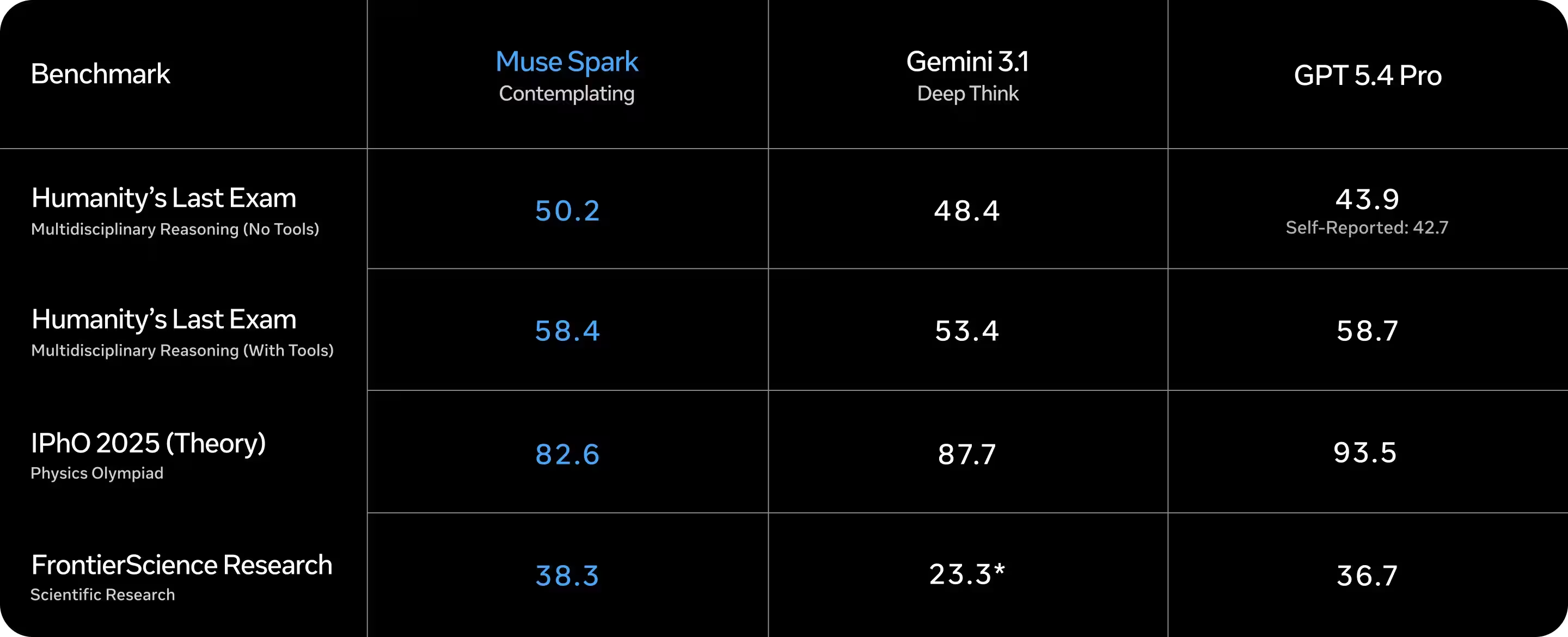
The early benchmark results are eye-catching. Meta says the model reaches 58 percent on Humanity’s Last Exam and 38 percent on FrontierScience Research, both of which are designed to test advanced reasoning under pressure. Those are the kinds of scores that help turn a product announcement into a serious competitive warning.
The bigger story here is not just that Meta has a new model. It is that the company is reorganizing its AI strategy around a more ambitious, more integrated system, one that blends reasoning, multimodal input, and agentic execution into a single platform. The race for the smartest AI model is getting crowded fast, and Meta clearly wants a seat at the front of the table.

“I love exploring gadgets, apps, and trends that redefine how we connect, work, and play in a digital world.”

Discussion
Leave a Comment