
3 Minutes
Google’s Gemini is getting a lot more visual, and for anyone trying to make sense of science or math, that is a very big deal. Instead of staring at flat text answers or static diagrams, users can now ask Gemini to generate interactive 3D models and simulations that actually let them explore how things work.
The new capability marks a clear shift in how Google wants its chatbot to handle complex explanations. Rather than simply describing a concept, Gemini can now create functional simulations that make abstract ideas feel much easier to grasp. Think of it as moving from a textbook sketch to something closer to a live lab demo.
That opens the door to all kinds of practical uses. You can visualize a physics system, rotate a molecule, or study how the Moon orbits Earth without being locked into one fixed image. In the Moon example, Gemini can even provide sliders for variables like initial velocity and gravity strength, letting users see how those changes affect orbital stability in real time.
How to trigger the new Gemini visuals
Google says the feature is available when users begin a prompt with phrases like “Show me” or “Help me visualize,” and select the Pro model. From there, Gemini can generate interactive models based on the topic you want to explore.
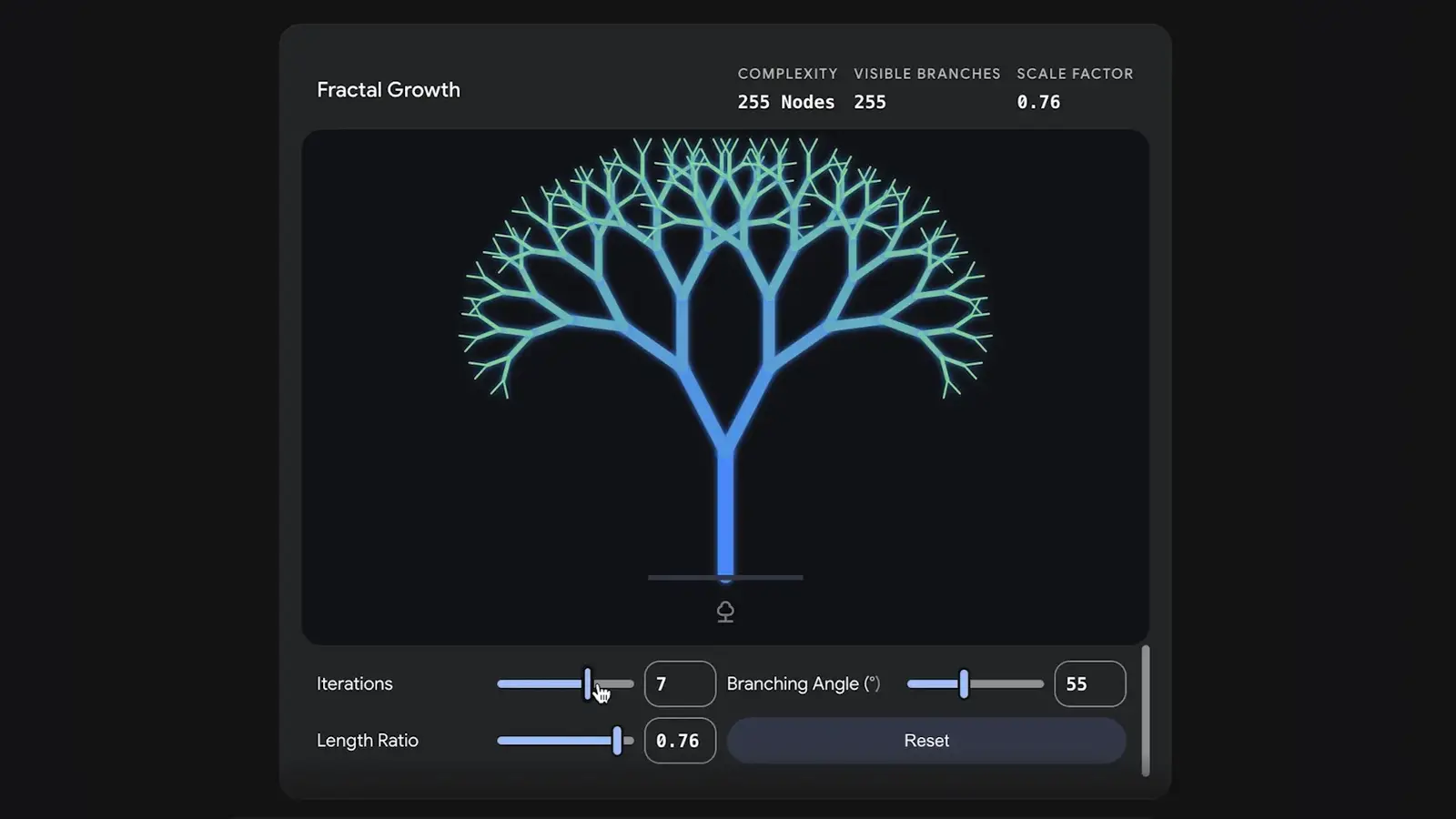
Try something like “Visualize how fractals work,” and Gemini can produce a dynamic display of fractal growth. Users may then adjust settings such as branching angle, length ratio, and iteration count to see how the pattern evolves.
Science classes should benefit most, especially in subjects where the visual side matters. Ask Gemini to “Show me how a double slit experiment works,” and the chatbot can build an interactive simulation where wavelength, wave speed, and slit separation can be changed on the fly. That makes it easier to understand how the interference pattern shifts as the variables change.
According to Google, support for 3D simulations and models is rolling out to all users, with Education and Workspace accounts excluded for now. The new tools expand on the learning features Google has already been layering into Gemini over time.
That push is not new. Last year, Gemini gained the ability to generate interactive, clickable diagrams in Biology, Physics, Chemistry, and Mathematics, giving students a more hands-on way to explore complicated ideas. Users could tap specific parts of a diagram to get deeper explanations and jump into related subtopics.
Now, with 3D models and interactive simulations, Gemini is becoming less like a chatbot that answers questions and more like a visual learning assistant that helps users see the answer in motion.
Source: neowin



Leave a Comment