
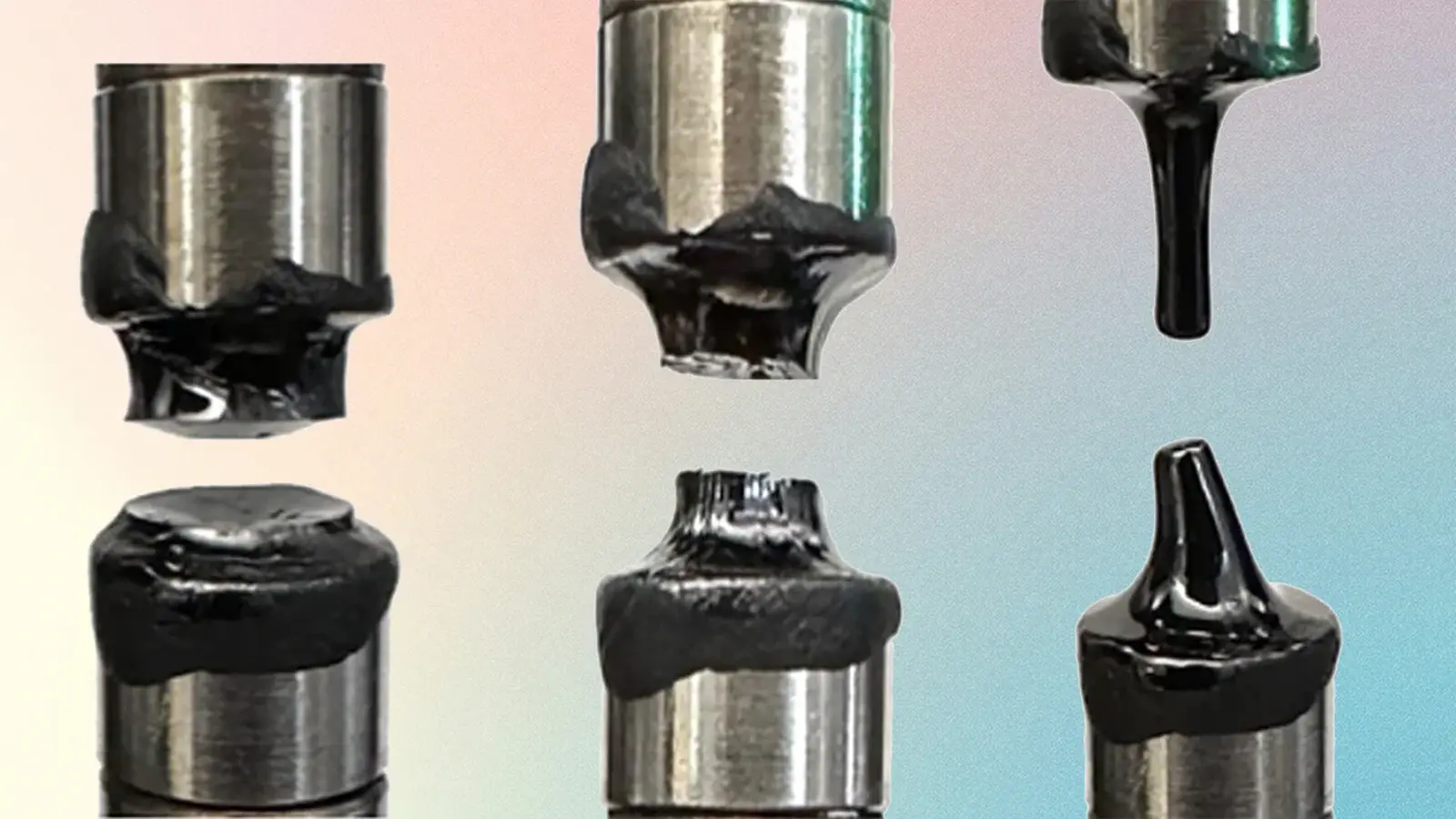
For years, liquids have seemed like the easy part of physics. They pour, they spread, they stretch. They do not, at least in the everyday sense, crack. But that assumption just took a hit.
Researchers have now shown that some simple liquids can reach a breaking point and fracture suddenly, much like solids under stress. The finding opens a new chapter in fluid mechanics, where the line between flowing and breaking turns out to be thinner than anyone expected.
A snap no one expected
The discovery came out of experiments led by Drexel University scientists working with ExxonMobil. Their goal was straightforward: observe how highly viscous liquids behave under strong force. What happened instead was a startling crack and a loud snapping sound that, by the researchers’ own account, made them think the equipment had failed.
“The fracture caused a very loud snapping noise that actually startled me,” said chemical engineer Thamires Lima of Drexel University. The team repeated the tests several times, checking and rechecking the setup before accepting that the liquid itself was the source of the break.
That caution mattered. In science, the strange result is often the one that exposes something real. Once the researchers confirmed the effect, they realized they were not looking at a faulty instrument. They were looking at a physical phenomenon that had not been properly documented before.
How the experiment worked
The setup was simple in principle but demanding in practice. Liquid samples were placed between two metal plates and subjected to increasing force while a high-speed camera recorded what happened. Under those conditions, one tar-like hydrocarbon blend abruptly fractured when pulled with a force concentrated over a tiny area, roughly the kind of stress you might imagine from a heavy bag hanging off a fingernail-sized point.
The same behavior later appeared in styrene oligomer, another thick, viscous liquid with a similar consistency. That repetition was crucial. It suggested the effect was not a one-off oddity, but a genuine mechanical response tied to the nature of dense liquids.
The key variable appears to be viscosity, which describes how easily a liquid flows. Thicker liquids do not distribute stress in the same way as runny ones. Instead, force can build up in a more localized and dramatic manner, making it possible for the liquid to fail rather than simply deform.
In other words, the liquid does not just keep stretching forever. At a certain threshold, it gives way.
The hidden breaking point inside a flow
The most striking part of the discovery is that the force required to trigger the fracture seemed to remain roughly the same even when the liquid’s viscosity changed. Slower deformation did not necessarily protect the sample. Once a critical stress was reached, the liquid cracked.
That is the real shift here: a flowing liquid can behave like a brittle material once enough stress per unit area is applied.
Scientists have long known that some liquids can crack under special conditions, especially if they are cooled enough or altered chemically. But this work points to something broader. The researchers believe the behavior may apply to many simple liquids, possibly including familiar substances such as water and oil, if the conditions are right.
That possibility matters well beyond the lab. A deeper understanding of liquid fracture could help explain and improve processes where precise fluid control is essential, from inkjet printing to soft robotics, and even to industrial fiber spinning.
Why the cracks move so fast
Once the fracture began, it moved with astonishing speed, between 500 and 1,500 meters per second. That is fast enough to rule out any slow, visible tearing and points instead toward a rapid internal process.
The speed fits a long-standing idea in physics known as cavitation. In cavitation, extreme stress can cause a tiny vacuum bubble to form inside a liquid. That bubble then expands or collapses in a way that helps split the fluid apart. The concept has been discussed for decades, but this experiment offers fresh evidence that something very similar may be happening here.
That still leaves a hard problem. These events happen so quickly that watching them in detail is difficult. The fracture is over almost before it can be properly studied. Even so, the result gives scientists a concrete starting point for future work, and that is no small thing.
The next challenge is to learn how common this behavior really is. Does it appear in other viscous fluids? Does it happen under less controlled conditions? Could the same mechanism affect manufacturing systems that rely on stable liquid flow?
Expert Insight
“This is one of those findings that changes the vocabulary of a field,” said Dr. Elena Morales, a fictional materials physicist and science communicator. “We tend to think of liquids as endlessly adaptable, but this study suggests they can fail in a sharply defined way. That has real consequences for any technology that pushes fluids close to their limits.”
She added that the practical value could be immediate: “If engineers understand when a liquid will fracture, they can better predict clogging, breakage, and flow instability in manufacturing systems.”
For now, the broader message is simple. Liquids still have secrets. As experimental tools become more precise, scientists keep finding that materials we thought we understood are carrying extra layers of behavior beneath the surface.
What looked like a routine fluid experiment turned into evidence that simple liquids can snap under the right conditions. That is a small sentence with a big implication. The physics of flow may be far less smooth than it seemed.

“The cosmos has always fascinated me. I write about space missions, astronomy, and the technologies pushing humanity beyond Earth.”

Discussion
Leave a Comment