
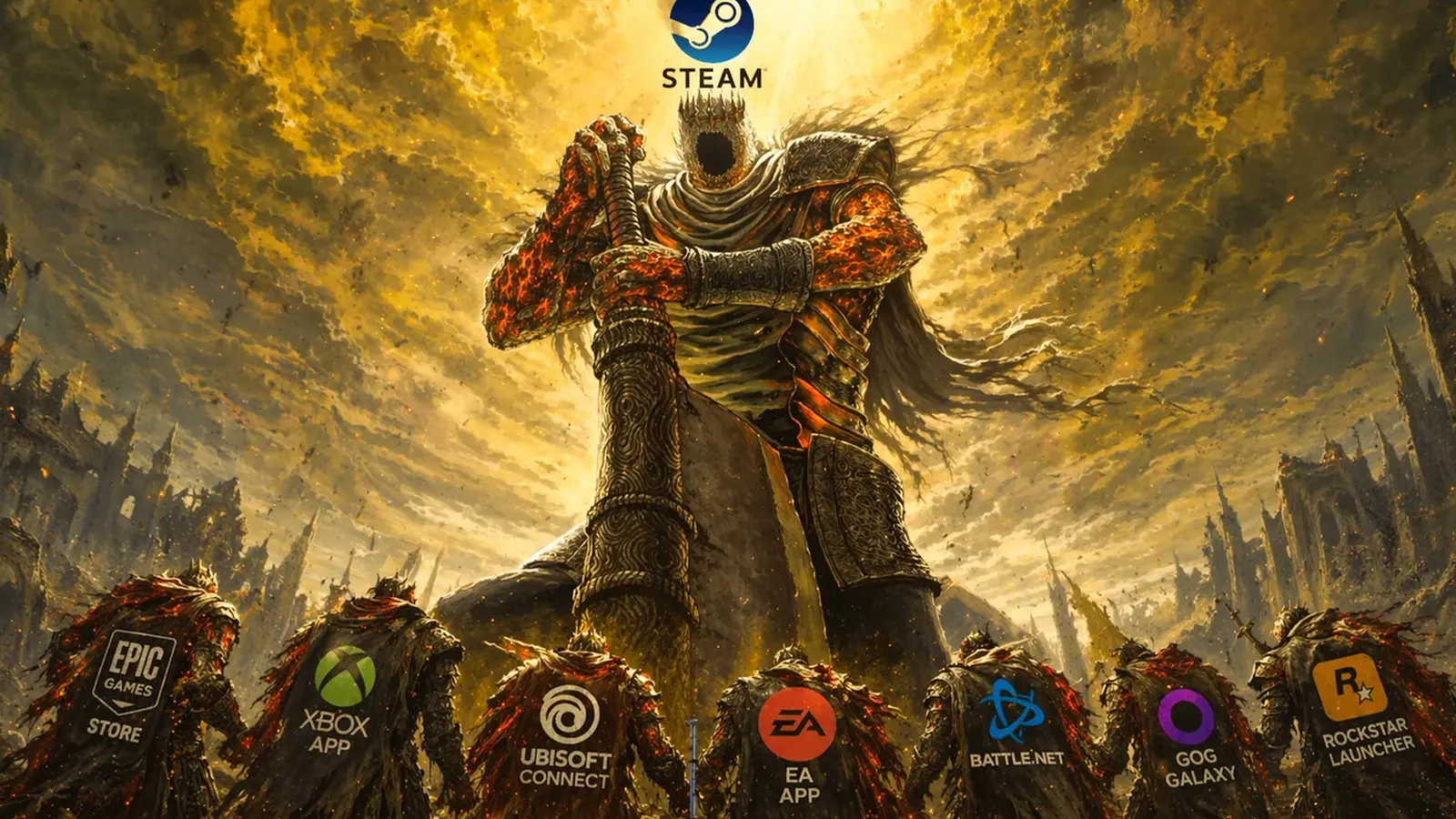
Open almost any gaming PC and there it is: the blue Steam icon, sitting on the desktop like it owns the place. In a way, it does. What began as just another launcher has become the default storefront for PC gaming, the place players instinctively open, even when alternatives are waving discounts in their faces.
That would normally sound like a problem. A company with that much control over distribution usually invites outrage. But Steam has pulled off something unusual. It has become so useful, so familiar, and so deeply woven into PC gaming habits that many players barely question its dominance.

The monopoly nobody seems eager to fight
By most estimates, Steam controls around 70 to 80 percent of the PC digital distribution market. That is not a comfortable lead. It is near-total market power. The platform also keeps the familiar 30 percent revenue cut, with smaller rates for higher-volume sales, a model that has drawn criticism from developers for years.
In a previous GDC survey, only 6 percent of developers said Steam earned its 30 percent fee. That is not a flattering number. It looks exactly like the kind of setup that would trigger a major backlash in almost any other industry. Yet in PC gaming, the reaction has been far more complicated.
Steam looks like a monopoly on paper, but in practice it behaves like the platform most players trust to get the job done.
Epic Games Store entered the market with a far lower 12 percent cut and a steady parade of free games, including major releases. Microsoft also lowered its Windows Store fee to 12 percent in 2021. On paper, those moves should have shifted the balance. Add Xbox app integration, Game Pass subscriptions, and publisher launchers from the likes of Ubisoft and Electronic Arts, and the market starts to look crowded.
And yet the behavior of players has barely changed. People claim free games on Epic. They install other launchers when a title forces them to. They use Game Pass for a specific release and move on. But when it comes time to buy games, build a library, and settle into a routine, Steam remains the default choice.
That is the part rivals still have not solved.
Steam has had its own bruising moments, of course. Before 2015, the lack of a refund system was a genuine sore spot, until Valve introduced the now-standard two-hour refund policy. The paid mods experiment for The Elder Scrolls V: Skyrim triggered an immediate backlash and was quickly rolled back. Developers still grumble about discoverability, visibility, and the 30 percent cut.
But the pattern is always the same. A controversy flares up, Valve responds, and the storm fades. No mass exodus follows. Players complain, then stay. That cycle has repeated so often it has become part of Steam’s identity.

Why gamers keep coming back
The simplest answer is also the strongest one: Steam works.
Not just as a store, but as a complete PC gaming ecosystem. Downloads are fast. Updates are reliable. Outages are rare. The client is not the lightest app on your computer, but it is stable and predictable, which is more than can be said for several competing launchers that still struggle with basic usability.
Then there is the feature set, and this is where Steam quietly pulls away from the pack. Cloud saves have been standard for years. Achievements are deeply integrated. The Steam Workshop turned modding from a technical headache into something even casual players can use with a few clicks.
Remote Play lets users stream games to other devices or play alongside friends without everyone owning the same title. Controller support is flexible and surprisingly deep, giving players the kind of input customization many platforms barely attempt.

Over time, those features stop feeling optional. They become part of the baseline.
Steam Chat is also seeing fresh attention as a Discord alternative, especially as Discord’s verification requirements have become more intrusive for some users. That is another place where competitors struggle. The Epic Games Store may offer better terms for developers, but it still lacks the kind of ecosystem depth that makes Steam feel complete. The Xbox app is excellent for subscriptions, but it does not provide the same sense of ownership or permanence.
Other launchers feel like tools. Steam feels like a home.
Sales matter too, and Steam has turned discount season into an event. The Summer Sale and Winter Sale are more than store promotions. They are gaming rituals. Players wait for them. They plan around them. They treat them with the kind of anticipation usually reserved for major holiday events.
Deep discounts, wishlist alerts, and the old flash-deal culture have trained players to associate Steam with value. For many, buying at full price feels almost wrong when a sale is probably around the corner. That habit has been reinforced for years.

The platform’s community layer is just as powerful. Steam reviews directly influence purchasing decisions. User tags, guides, forums, and discussion hubs turn each game page into something alive, not just a static listing. Players help other players, and that social loop strengthens the entire platform.
Then there is library lock-in, which sounds harsher than it is. Many users have spent years building massive Steam libraries. Moving away is not technically difficult, but it feels messy and inconvenient. Everything is already there, neatly organized, updated, and ready to go. Why start over?
That convenience is hard to give up.
The Steam Deck only tightened the grip. By turning the Steam library into something portable, Valve pushed the ecosystem beyond the desktop. Proton compatibility has made it easier to run many games across different systems, adding another layer of flexibility. For plenty of players, Steam is no longer just where their PC games live. It is where their games live, period.
It also helps that Valve is not a typical public company chasing quarterly headlines. As a privately owned company, it has more room to experiment, absorb mistakes, and avoid the kind of aggressive monetization that alienates users fast.
And then there is Gabe Newell. Few executives in tech or gaming enjoy that kind of goodwill. He is widely seen as approachable, practical, and unusually grounded for someone leading a platform of this size. That perception matters more than companies like to admit.
The comparison with Nintendo is telling. Nintendo is adored for its games and often criticized for pricing, online services, and hardware decisions. Players tolerate the friction because the core experience is worth it. Steam sits at the other end of that emotional spectrum. It is not loved in the same nostalgic way, but it earns trust by getting out of the way.
It avoids friction. It delivers value. It makes life easier.

That is the real reason Steam survives scrutiny: it behaves less like a gatekeeper and more like the path of least resistance.
For gamers, that is enough. It is fast, familiar, packed with features, and usually the best place to find a deal. For developers, the picture is more complicated. In an Atomik Research survey, more than 50 percent of developers reportedly viewed Steam as a monopoly. That split explains the paradox neatly. Steam can feel frustrating from one side and indispensable from the other.
Both reactions make sense.
Steam has every trait of a monopoly, at least on paper. But for most players, it does not feel like one in the way that matters. Valve did not win by trapping users. It won by making the alternative feel less complete. That may be the most impressive part of all.

“I love exploring gadgets, apps, and trends that redefine how we connect, work, and play in a digital world.”

Discussion
Leave a Comment