

JEDEC’s next-generation UFS 5.0 standard is almost ready—and it promises to dramatically boost mobile storage speeds while cutting power use. Here’s what the new spec means for smartphones, wearables, and edge devices.
What UFS 5.0 brings to mobile devices
UFS 5.0 is a significant step up from the current UFS 4.0/4.1 family. JEDEC says the standard can hit a theoretical peak bandwidth of 10,800 MB/s (about 10.8 GB/s), with up to 6,400 MB/s per lane. For comparison, UFS 4.x tops out around 5,800 MB/s overall and 2,900 MB/s per lane—so we’re looking at roughly double the throughput in ideal conditions.
Speed and efficiency: why it matters for AI on phones
Faster storage isn't just a specs race. Mobile AI workloads—on-device models, real-time inference, and local caching—benefit directly from higher sustained bandwidth and lower latency. UFS 5.0 also targets energy efficiency, which helps sustain heavy workloads without draining battery life or overheating thin phone chassis.
Beyond raw speed: security and signal gains
UFS 5.0 adds practical improvements too. Inline Hashing improves data integrity and security, while integrated link equalization and PHY noise isolation make system integration easier and boost signal quality. Those hardware-level upgrades reduce design headaches for OEMs and help maintain consistent performance across different device environments.
Compatibility and where you'll see it first
JEDEC says UFS 5.0 will be backward compatible with UFS 4.0 and 4.1 hardware, which should simplify adoption. That said, compatibility doesn’t guarantee identical bandwidth—device-level implementation, controller tuning, and thermal constraints will affect real-world throughput. Some recent flagship chipsets, like Qualcomm’s and MediaTek’s top-tier silicon, could support the new interface in future revisions.
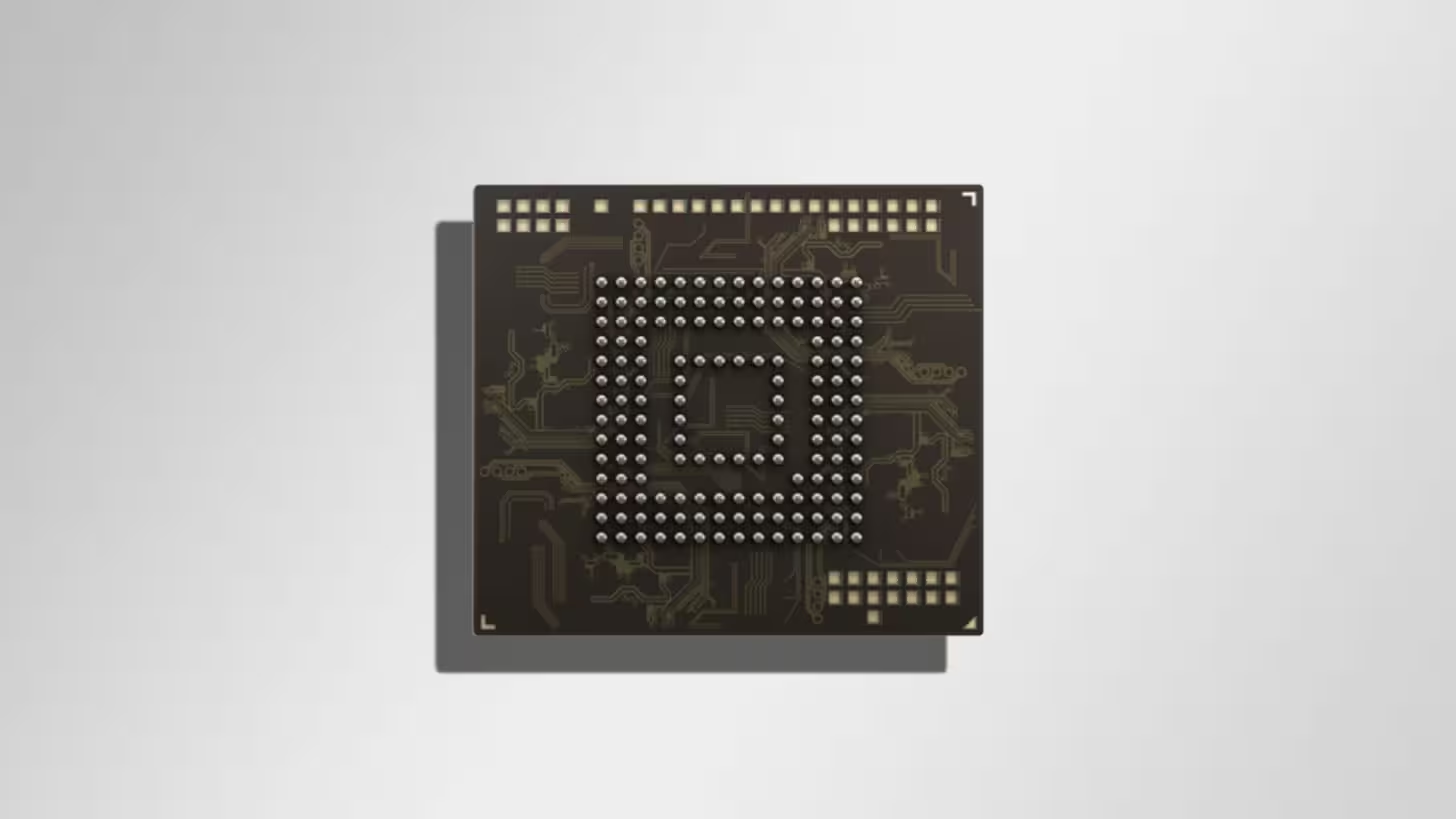
- Target devices: smartphones, tablets, wearables, automotive systems, edge servers, and gaming consoles.
- Security: Inline Hashing for stronger on-device data protection.
- Signal integrity: integrated link equalization and PHY-to-memory noise isolation.
When will UFS 5.0 land in consumer phones?
Don’t expect it in 2026 flagships. Industry chatter and early timelines point to first product samples from Samsung, Micron, and SK hynix in Q4 2026, with commercial smartphone launches more likely in 2027. Samsung is reportedly developing UFS 5.0 solutions, but mass adoption will depend on flash makers ramping production and OEMs validating performance under real-world conditions.
In short: UFS 5.0 promises NVMe Gen5‑class bandwidth for embedded mobile storage, plus security and integration improvements. The next year will see more advancements in UFS 4.x while the industry prepares for a full UFS 5.0 rollout in 2027.

“I love exploring gadgets, apps, and trends that redefine how we connect, work, and play in a digital world.”

Discussion
Leave a Comment