
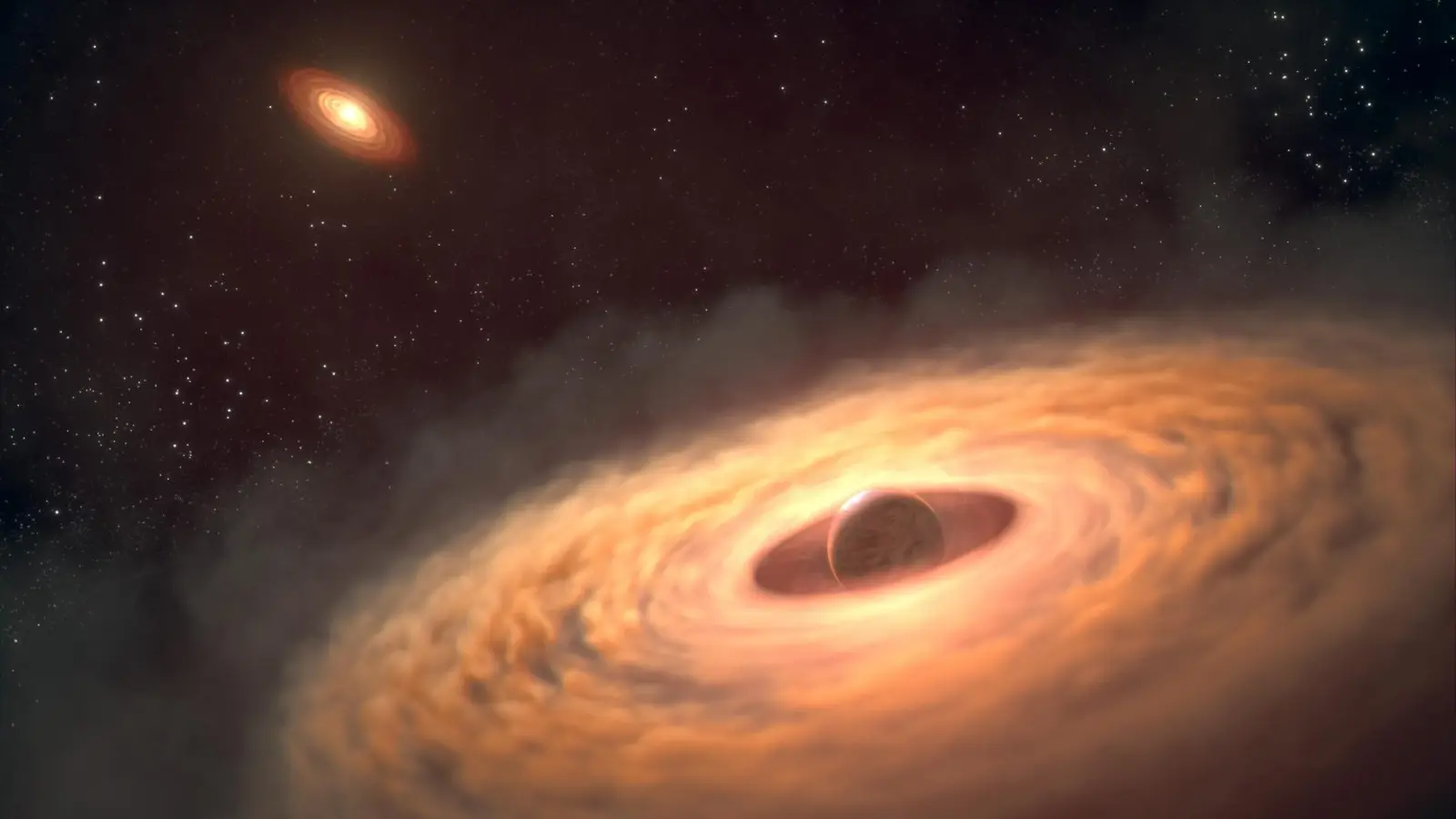
NASA’s James Webb Space Telescope has captured the first direct glimpse of a carbon-rich disk circling a young, massive exoplanet — a structure that may be forging new moons. Located roughly 625 light-years away, the system around CT Cha b gives astronomers a rare laboratory for studying how moons and planets assemble in the earliest stages of a solar system.
A hidden workshop for moons: what Webb actually saw
Webb's Mid-Infrared Instrument (MIRI) made medium-resolution spectroscopic observations of CT Cha b and its surroundings, revealing a circumplanetary disk with an unexpectedly carbon-rich chemistry. Although no moons were directly imaged, the composition and physical conditions inside the disk match theoretical expectations for a moon-forming environment — a scaled-down version of the protoplanetary disks that give birth to planets around stars.
The young host star is barely 2 million years old and still accreting material from its circumstellar disk. CT Cha b orbits far from its star — roughly 46 billion miles away — and is itself surrounded by a much smaller disk that appears chemically distinct from the star’s larger, water-bearing disk. That chemical contrast hints at rapid and localized processing of gas and dust during the earliest stages of planet and satellite formation.
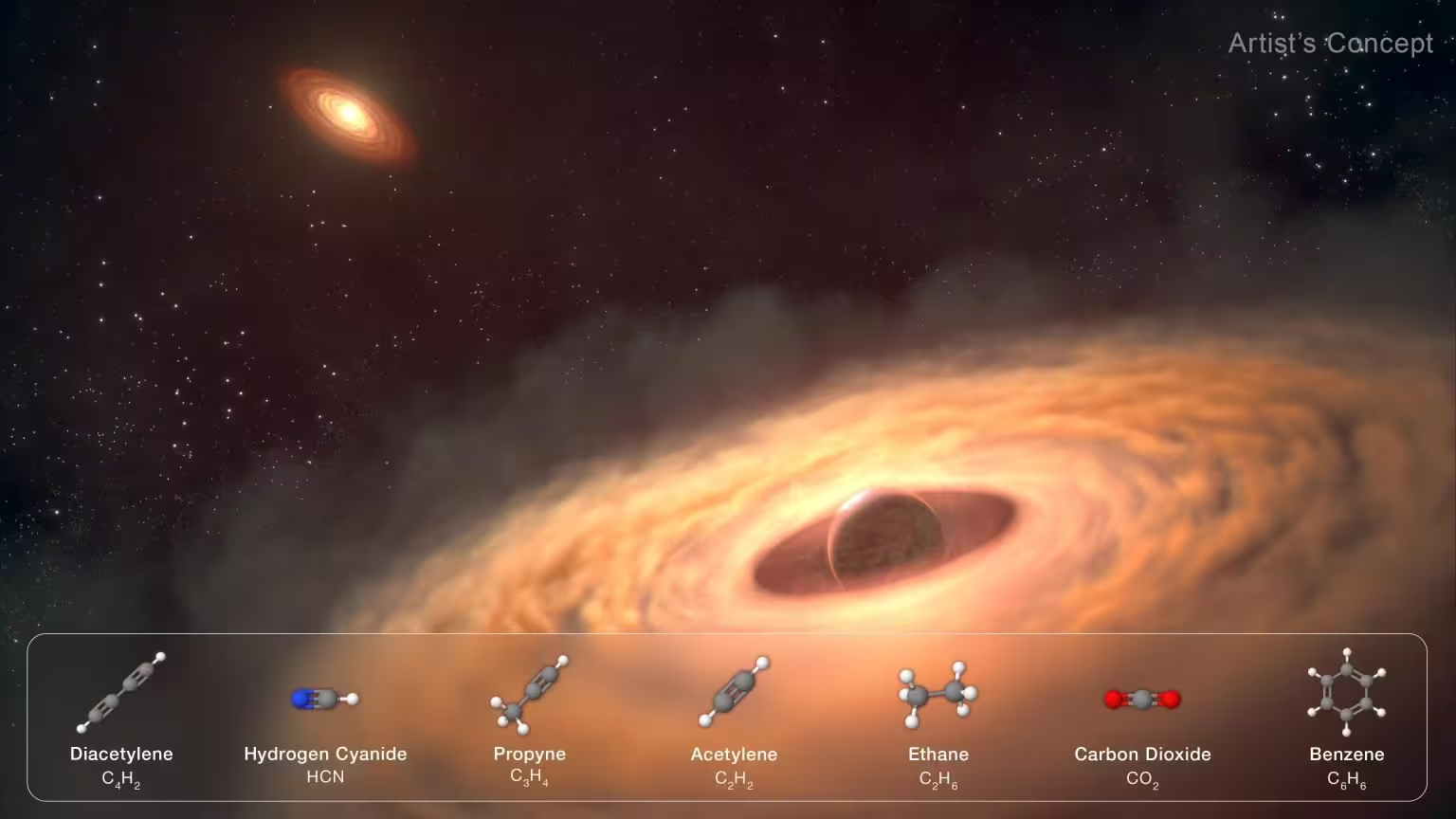
An artistic rendering of a dust and gas disk encircling the young exoplanet, CT Cha b, 625 light-years from Earth. Spectroscopic data from NASA’s James Webb Space Telescope suggests the disk contains the raw materials for moon formation: diacetylene, hydrogen cyanide, propyne, acetylene, ethane, carbon dioxide, and benzene. The planet appears at lower right, while its host star and surrounding circumstellar disk are visible in the background. Credit: NASA, ESA, CSA, STScI, Gabriele Cugno (University of Zu00fcrich, NCCR PlanetS), Sierra Grant (Carnegie Institution for Science), Joseph Olmsted (STScI), Leah Hustak (STScI)
How spectroscopy unraveled the disk’s chemistry
Spectroscopy splits light into its component wavelengths, allowing astronomers to identify molecular fingerprints in faint sources. In this case, Webb’s MIRI instrument measured mid-infrared emission at the planet’s location and — after careful subtraction of the much brighter host star — revealed a suite of carbon-bearing molecules inside the circumplanetary environment.
Extracting the planet’s signal was technically demanding. CT Cha b is faint and sits in the glare of its young star, so researchers applied high-contrast data-processing techniques to isolate the disk spectrum. The archival Webb data showed initial hints of molecules, which motivated a dedicated reanalysis and a year-long effort to tease out the weaker features. That persistence paid off: the team reported detecting seven carbon-based species, including acetylene (C2H2), benzene (C6H6), ethane, diacetylene, propyne, hydrogen cyanide, and carbon dioxide.
These molecules are important because carbon-rich chemistry underpins the solid-building blocks of moons and minor bodies. In contrast, the larger circumstellar disk feeding the star is dominated by water vapor and shows far less of the carbon chemistry seen inside the circumplanetary disk. The divergence suggests that disks around planets can chemically evolve on surprisingly short timescales and along different pathways than the material around the star.
Why this matters: moon formation and planetary systems
The discovery offers an observational bridge to long-standing theories of how large moons — like Jupiter’s Galilean satellites — formed. For decades, planetary scientists have proposed that big moons condensed inside flattened circumplanetary disks while their host planets accumulated mass. Evidence from our own solar system is indirect: the co-planar orbits and compositions of moons such as Ganymede and Callisto point to formation inside a disk billions of years ago.
CT Cha b’s disk provides a live example of those early conditions. If moons are more common than planets across the galaxy, as some models predict, then circumplanetary disks like this one could be widespread. That increases the odds that habitable — or at least volatile-rich — moons exist around exoplanets, especially where water ice and complex organics coexist. Detecting carbon-bearing molecules in a young moon-forming disk suggests that the organic chemistry needed for complex solids is already present very early on.
Comparisons with the early Solar System
Studying CT Cha b lets researchers compare an active moon-forming environment with models of our Solar System’s infancy. While the Sun’s protoplanetary disk left behind only faint archaeological clues after 4.5 billion years, Webb can observe analogous systems still under construction. Observations like these help constrain timescales for accretion, the temperature and density structure within circumplanetary disks, and the chemical pathways that lead from gas to ice to rock.
Expert Insight
“Seeing carbon-rich molecules inside a circumplanetary disk is like finding the raw ingredients on a kitchen counter before a cake is baked,” says Dr. Maria Alvarez, an astrophysicist who studies planet and moon formation at the Institute for Exoplanetary Science (commentary provided for context). “Webb gives us both the chemistry and the physical clues — temperature, density, and how material is moving — so we can test whether the recipes we’ve been using on paper actually produce the moons we see in our own system.”
Dr. Alvarez adds that differences between the planetary and stellar disks emphasize the importance of local conditions: “Even within a single young system, chemistry can diverge quickly. That matters for the diversity of moons and small bodies that could emerge.”
Mission details and the road ahead
This result comes from careful analysis of Webb’s MIRI medium-resolution spectrograph data and was reported in a peer-reviewed journal. The team combined spectral extraction, high-contrast imaging techniques, and chemical modeling to identify molecular signatures and estimate the physical conditions in the disk.
Follow-up work is already planned. The research team intends to use Webb to survey more young giant planets and search for additional circumplanetary disks with diverse chemical fingerprints. Expanded samples will help determine how common carbon-rich disks are, how their molecule inventories change with time or host-star environment, and which physical processes — such as accretion heating, irradiation, or grain growth — drive chemical evolution in these compact disks.
Beyond spectroscopy, future observations with imaging instruments and complementary facilities (ground-based millimeter arrays, for instance) can map dust distributions and search directly for forming moons or clumps of solid material. If researchers can detect gravitational signatures or localized dust concentrations consistent with nascent satellites, they could directly watch moon embryos grow.
Implications for habitability and exomoon science
Moons can expand the realm of habitability in planetary systems. Large moons might retain atmospheres, host subsurface oceans, or regulate climates through tidal interactions. Establishing how and where moons form — and whether they inherit volatile-rich, organic-laden compositions — is therefore central to assessing their potential to support life or prebiotic chemistry.
Webb’s detection of complex carbon molecules inside a circumplanetary disk is an early but critical step toward that longer goal. By revealing that key organics appear very early in a moon-forming environment, the observations raise the possibility that some exomoons could host the chemical precursors to life, even if the moons themselves never become independently habitable worlds.
As Webb continues to probe young planetary systems, astronomers will refine models of disk chemistry and dynamics, survey the diversity of circumplanetary environments, and, perhaps within this decade, directly detect the first forming exomoons.

“My work centers on sustainability, energy, and environmental science — examining how innovation can lead to a greener future.”

Discussion
Leave a Comment