
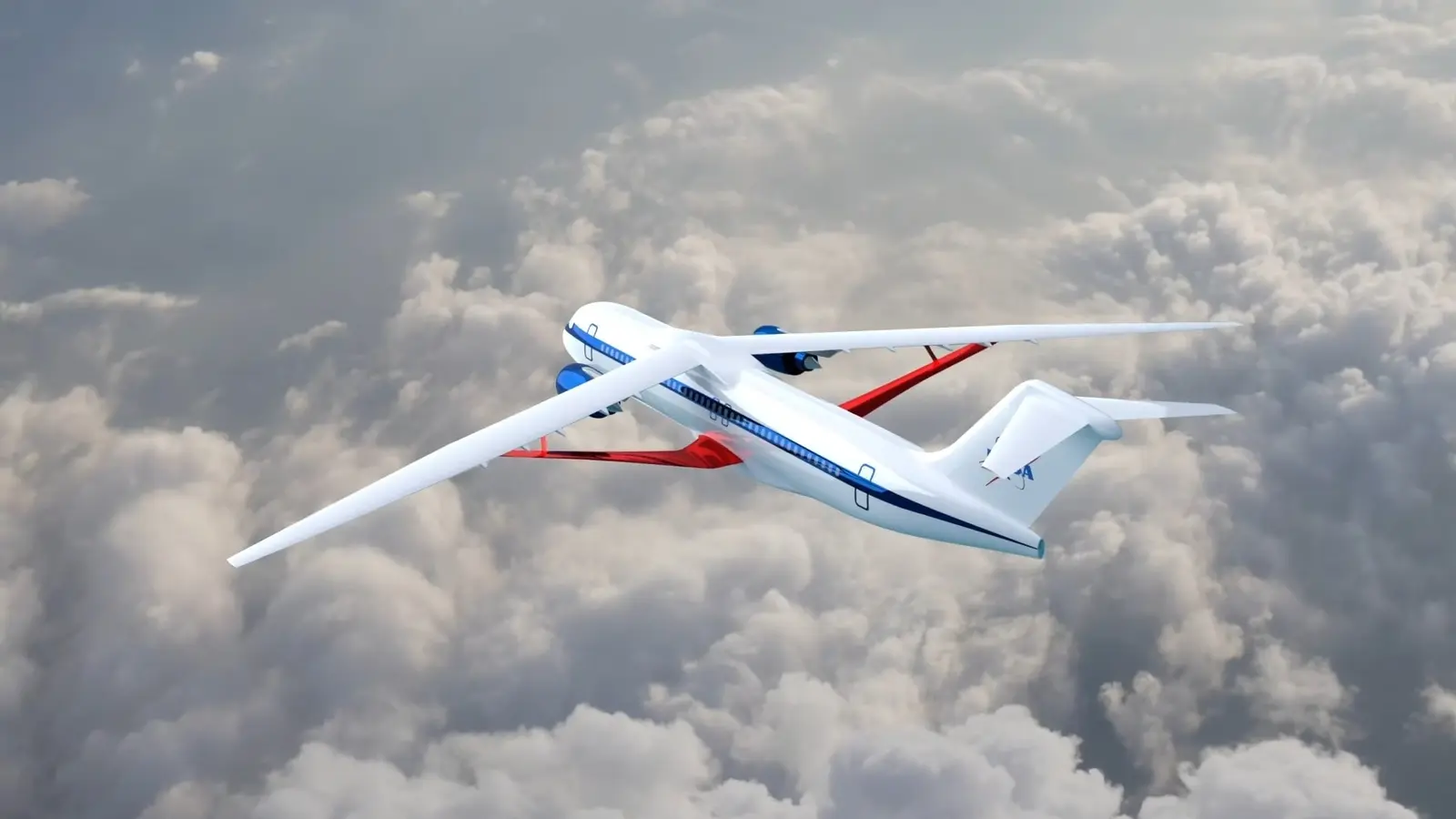
Airliners may all look broadly familiar from the terminal window, but that does not mean aerospace engineers have stopped trying to reinvent the wing. Boeing and NASA have just pushed one of their most intriguing ideas a little further, completing a fresh round of wind tunnel testing on a next generation wing concept that could eventually change how passenger jets fly and how much fuel they burn.
The concept is called a truss braced wing. At first glance, it still resembles the classic layout people expect from a commercial aircraft: a long fuselage with wings extending from each side. Look closer, though, and the difference becomes obvious. The wings are slimmer and supported by diagonal struts connecting them back to the body of the aircraft. Those extra structural links are designed to help the wing handle loads more efficiently while unlocking aerodynamic gains that a conventional setup struggles to deliver.
That matters because better lift and lower drag are the holy grail of modern aircraft design. If engineers can build a wing that produces lift more efficiently, a future jet could use less fuel across key phases of flight. In an industry under growing pressure to cut emissions and operating costs at the same time, even modest improvements can ripple across entire fleets. A bigger leap would be something else entirely.
A familiar jet shape, reworked with a bold idea
This latest testing campaign took place in Farnborough, England, at a QinetiQ facility, where Boeing and NASA used what is known as a semispan model. In simple terms, that means half an aircraft. It is a standard way to study airflow and structural forces in a controlled environment without needing a full scale prototype.
The model was far from basic. Engineers fitted it with systems that allowed them to mimic high lift devices and moving control surfaces, including slats and flaps. That meant researchers could simulate critical low speed scenarios such as takeoff and landing, not just steady cruise conditions. Those moments are especially important because they place very different demands on a wing, and any real world design has to perform across the entire flight envelope, not only in ideal conditions.
The truss braced wing itself is not some overnight sketch. Its roots go back to Boeing’s SUGAR research programme, short for Subsonic Ultra Green Aircraft Research, a long running effort aimed at exploring cleaner and more efficient aircraft designs for the 2030 to 2035 era. In other words, this is part of a much bigger attempt to rethink the future of commercial aviation without abandoning the practical realities of passenger transport.

There has been a change in direction, though. Boeing and NASA had been considering an MD 90 conversion as a research aircraft to take the concept beyond models and into flight testing. That plan was paused in spring 2025 after Boeing stepped back from the effort for reasons that were not made public. Even so, the wider research programme is very much alive, and these wind tunnel results show the idea has not been shelved.
For now, both teams are still working through the data, so hard performance figures have not been released. Still, NASA has already signalled that the concept appears promising enough to support the case for lower fuel consumption in future aircraft. That is a careful way of saying the early signs are encouraging, even if nobody is ready to promise a revolution tomorrow.
And yet, revolution is exactly the word hovering over this project. NASA has suggested that for an aircraft in the size class of a passenger jet, a truss braced wing would represent a dramatic redesign. That sounds right. Commercial aviation tends to move slowly for good reason. Safety, certification, airport compatibility, maintenance, and airline economics all make radical change hard to push through.
So no, travelers are unlikely to board truss braced airliners anytime soon. But that is what makes tests like this interesting. They reveal where the industry is placing its long bets. Sustainable aviation fuel gets much of the public attention. Electric aircraft grab headlines. Hydrogen keeps sparking debate. Quietly, wing design may end up being one of the most important battlegrounds in the effort to make future passenger aircraft cleaner and more efficient.
Sometimes the biggest shift in aviation does not come from tearing up the whole blueprint. It comes from keeping the airplane recognizable, then changing the part that does the real work once it leaves the runway.

“I love exploring gadgets, apps, and trends that redefine how we connect, work, and play in a digital world.”

Discussion
Leave a Comment