
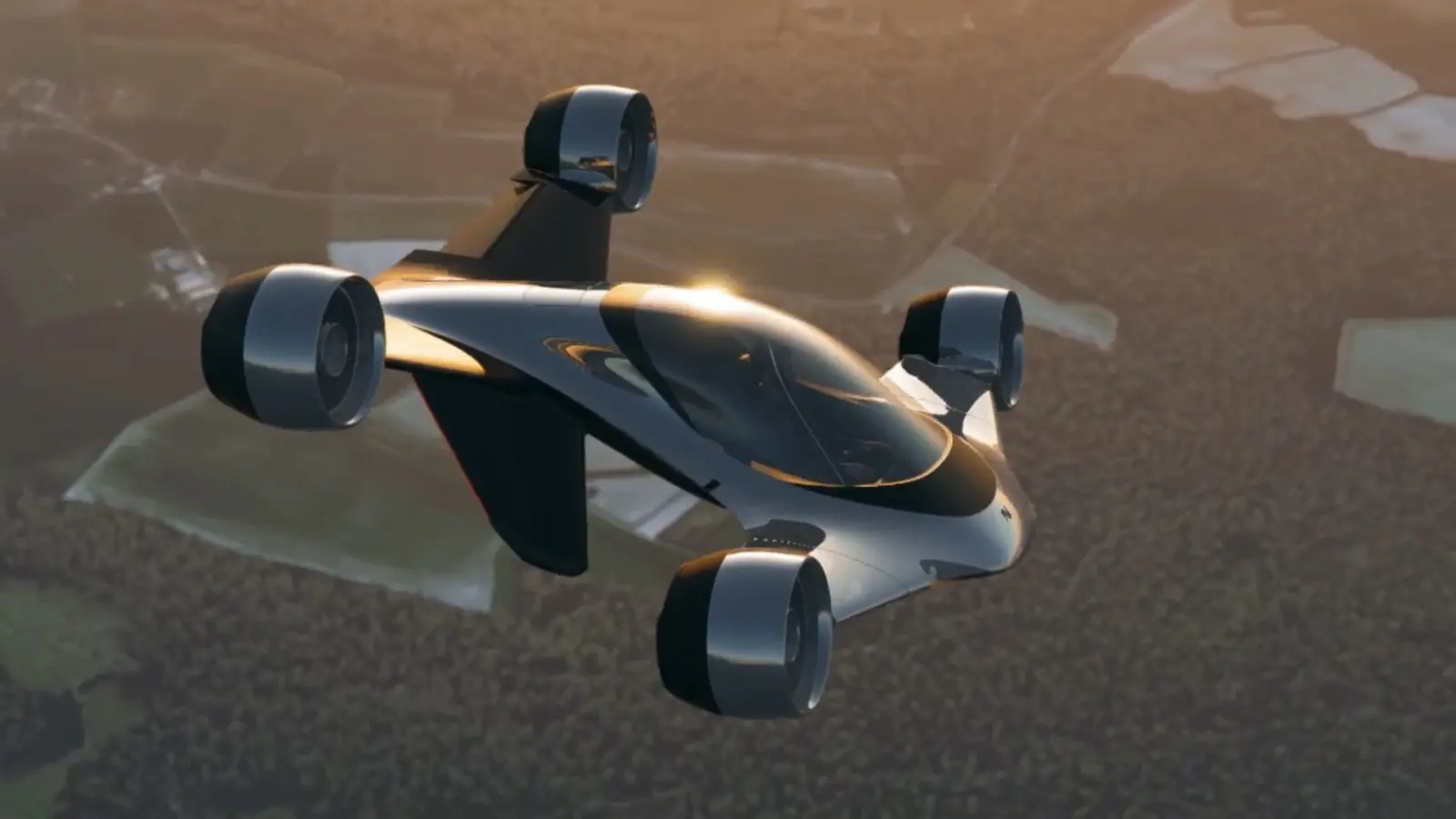
Most aircraft startups promise the future. Very few dare to make it look this close. London-based AltoVolo, still barely two years old, says its Sigma is now on track to become a full-scale demonstrator before the end of the year, a serious milestone for a company trying to carve out space in one of aviation’s most crowded and most speculative races.
But Sigma is not chasing the same dream as every other VTOL project. This is not a flying taxi built around urban shuttle runs and packed passenger cabins. AltoVolo is going after something more niche, and arguably more provocative: a compact personal aircraft for two people, one pilot and one passenger, designed to lift off from places that sound more like lifestyle brochure copy than aviation infrastructure. Think driveways, rooftops, even yachts.
Its footprint is a big part of the pitch. Sigma measures just over 4 meters long, 4.8 meters wide, and 1.9 meters tall. Folded down to a width of 2.2 meters, it occupies roughly the kind of space you would associate with a road car rather than a conventional aircraft. That compact packaging is central to AltoVolo’s argument that personal vertical flight only makes sense if the machine is small enough to live with, not just marvel at.
There is another twist here, and it matters. Sigma does not rely on a purely electric setup, which instantly separates it from a huge slice of the VTOL sector. Instead, AltoVolo is developing a hybrid powertrain, although the company has not disclosed its full technical makeup. What it has disclosed are the performance claims: a cruising speed of up to 354 kph, a top speed of 467 kph, a payload of 270 kg, and a maximum range of 805 km in hybrid mode. In all-electric operation, that range drops to around 402 km. Hover endurance is quoted at up to 45 minutes, while the aircraft’s ceiling stands at 3,000 meters.

Why AltoVolo changed course
The most revealing part of the project may be what AltoVolo abandoned. Earlier in Sigma’s development, the company had explored electric ducted fans and closed rotors instead of the open rotor layouts seen on many rival designs. On paper, that probably looked sleek, modern, maybe even inevitable. In testing, it apparently turned into a liability. AltoVolo says the closed-rotor approach added too much weight, complexity, and fragility, while failing to deliver where it counted most.
That decision seems to have reshaped the aircraft. The revised propulsion setup, built around open rotors and a tilting system, is said to have doubled hover time compared with the earlier configuration, from 18 minutes to 45. The company also claims lower propeller loading, better transition behavior between vertical and forward flight, and meaningful weight savings. In a category where every kilogram matters and every design compromise shows up in the air, those are not small gains.
AltoVolo also insists that the propeller hardware itself is not off-the-shelf. The system uses in-house designed components that the company says outperform commercially available alternatives. That is a bold claim, but if it holds up, it could become one of Sigma’s defining technical advantages. The quieter operation certainly helps the story. AltoVolo says the aircraft produces around 70 dB at 100 meters, which it describes as roughly 80 percent quieter than a typical helicopter. For any machine expected to rise from a residential property without immediately becoming a neighborhood scandal, noise is not a side note. It is the whole social license.
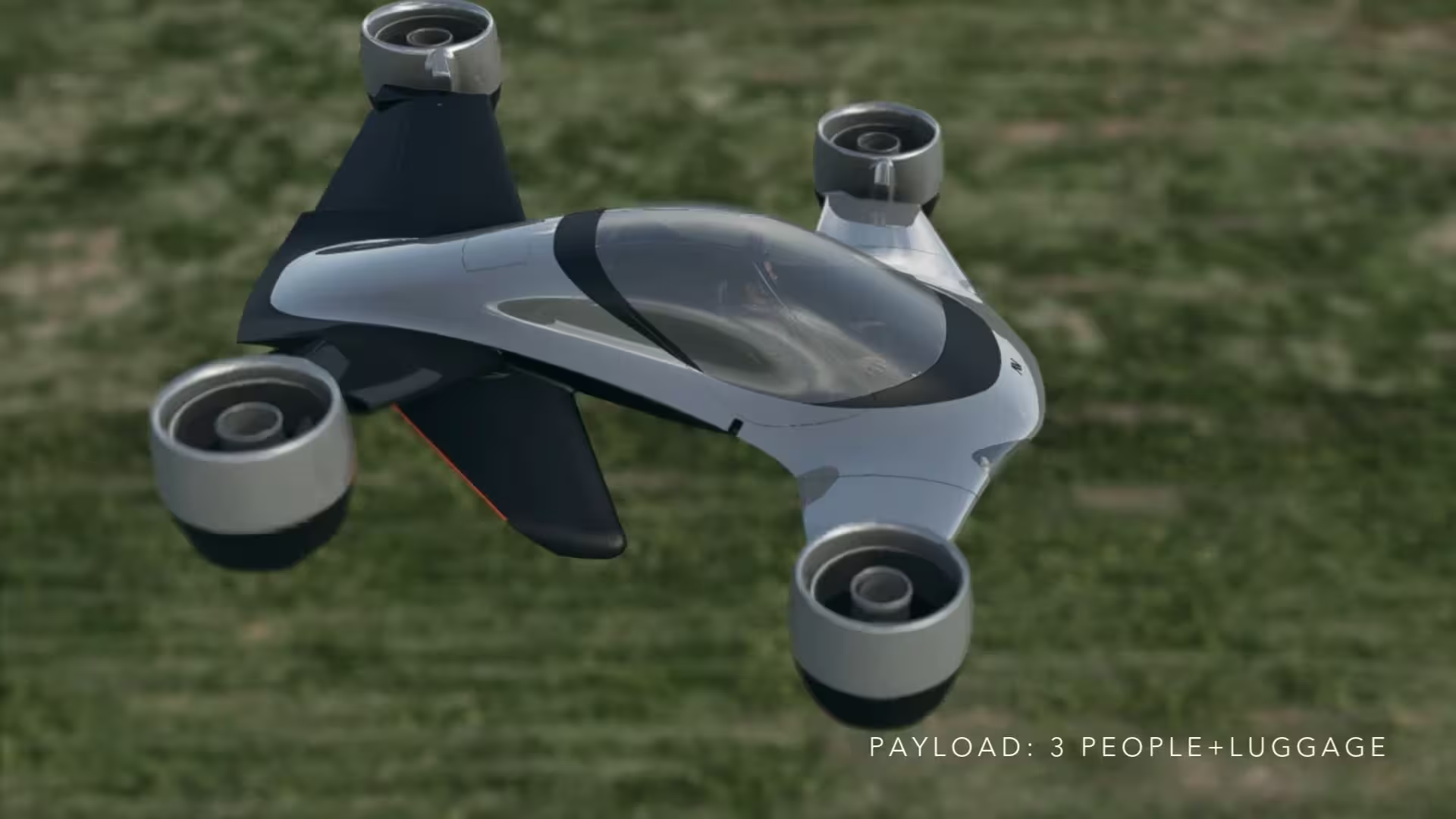
The company calls Sigma the world’s first HyperTOL, short for Hybrid Performance Take-off and Landing. Marketing term? Of course. But it also hints at the category AltoVolo wants to own: not urban air mobility, not a luxury helicopter replacement in the usual sense, but something in between, a high-speed personal aircraft with vertical capability and a hybrid backbone that avoids some of the limits still weighing down battery-only flight.
There is still a long runway ahead. AltoVolo says Sigma is aiming for full type certification and is initially targeting buyers with a Sport Pilot certificate, who would need around 25 hours of additional training to fly it. Safety provisions on the planned production aircraft include triple-redundancy flight controls and a ballistic parachute designed to deploy at just 15 meters above ground in an emergency.
The business reality, though, remains the familiar one. Sigma is not a certified product yet, and AltoVolo is still seeking investment as it pushes toward the next stage. Public appearances are planned, but details have yet to be announced. Even so, pre-orders are already open. The listed price is £863,200, which converts to roughly €1.01 million at current exchange rates. The first 100 units will be sold as the Launch Edition, though AltoVolo has not yet explained what, if anything, will distinguish those aircraft beyond the badge.
That leaves Sigma in a fascinating place. It is still a promise, yes, but no longer just a sketch wrapped in startup vocabulary. If AltoVolo gets its demonstrator airborne on schedule, this tiny British company could shift from outsider curiosity to one of the most closely watched names in personal vertical aviation.

“I cover automotive innovation, electric vehicles, and the future of mobility — where technology meets sustainability.”

Discussion
Leave a Comment