
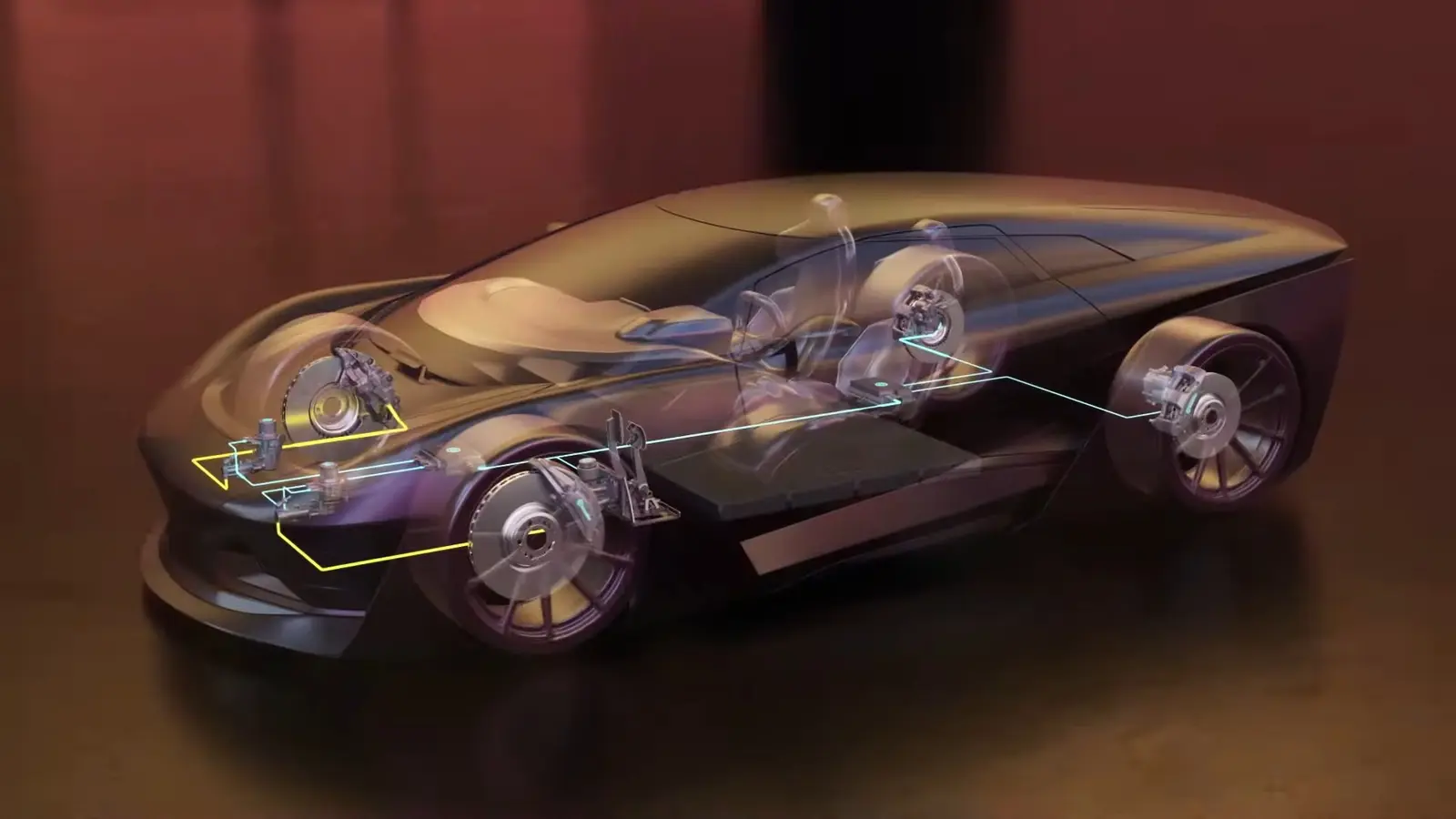
Brakes have spent decades doing the same basic job in the same basic way, and that is exactly why Brembo Sensify feels so disruptive. While cars have become rolling computers packed with sensors, software, and over the air updates, the braking system has largely remained rooted in hydraulic logic. Brembo now says that era is starting to shift.
The Italian supplier has officially begun series production of Sensify for an unnamed major global automaker, a move that turns what once sounded like a future facing concept into a real production technology. And if it performs on the road the way Brembo promises on paper, this could become one of the most important changes to braking hardware in years.
At its core, Sensify replaces the traditional hydraulic setup with an electronically controlled system. In a normal brake layout, pressing the pedal creates pressure in brake fluid lines, and that pressure travels to the wheels, where pads clamp onto discs to slow the vehicle. It is a proven formula, but it is also old school in the most literal sense.
Sensify takes a different route. The pedal is no longer mechanically linked in the conventional way. Instead, it acts more like an input device, sending the driver’s braking request to an electronic control unit. That controller then tells actuators at each wheel exactly how much braking force to apply. Each wheel can be managed independently, which opens the door to much finer control than a conventional hydraulic system can usually deliver.

Why this matters more than it first seems
This is not just a story about removing brake fluid. It is really about changing braking from a mostly mechanical system into a software defined one. Brembo says Sensify still preserves the pedal feel drivers expect, which is crucial, because nobody wants a brake pedal that feels vague or artificial. At the same time, the system is designed to deliver more precise responses in changing road conditions, with faster and more targeted control at each corner of the car.
That has obvious safety implications, but the benefits go further. With no traditional hydraulic circuit, maintenance could be reduced. The system also uses fewer components, which may help free up packaging space and simplify vehicle integration. Brembo says the pedal setup can be adapted for both left hand drive and right hand drive vehicles, and even the brake response itself can be tuned to suit different applications or driver preferences.
There is another big reason the industry will be watching closely. Sensify has been developed as a flexible platform, which means it is not limited to one type of vehicle. Brembo says it can work across passenger cars, vans, internal combustion models, hybrids, and EVs. It is also designed to integrate with advanced driver assistance systems and autonomous driving features, where precise wheel by wheel brake control becomes especially valuable.

For electric vehicles, the timing makes sense. Modern EVs already blend regenerative braking with friction braking, and managing that handoff smoothly is one of the trickiest parts of making an electric car feel polished. A system like Sensify could help make that transition cleaner and more efficient, while also reducing drag torque and brake disc wear.
Brembo first unveiled Sensify in 2021, and it was originally expected to reach the market earlier. Now that production has begun, the company says more contracts are already signed, with potential output reaching hundreds of thousands of units annually. That suggests this is not a niche experiment. It looks much more like the opening move in a wider shift.
Brembo CEO Daniele Schillaci has framed the system as part of a broader push toward safer mobility and the next generation of software defined vehicles. That ambition is easy to understand. When every wheel can be controlled independently and braking behavior can evolve through software updates, the brake system becomes something much smarter than a simple mechanical safeguard.
Still, there is a difference between smarter and infallible. Brembo talks about shaping a zero accident future, and that is the sort of phrase the car industry loves. It also deserves a dose of realism. Better technology can reduce risks, improve response, and support drivers in ways older systems never could. But roads are messy, human behavior is unpredictable, and accidents rarely stem from one variable alone.
That does not make Sensify any less significant. If anything, it makes the achievement easier to appreciate. This is not a miracle cure for every danger behind the wheel. It is something more believable and, in some ways, more important: a genuine rethink of how cars stop, built for an era when software matters as much as steel and friction.

“Cars are evolving faster than ever. I cover electric vehicles, smart mobility, and the future of transportation worldwide.”

Discussion
Leave a Comment