
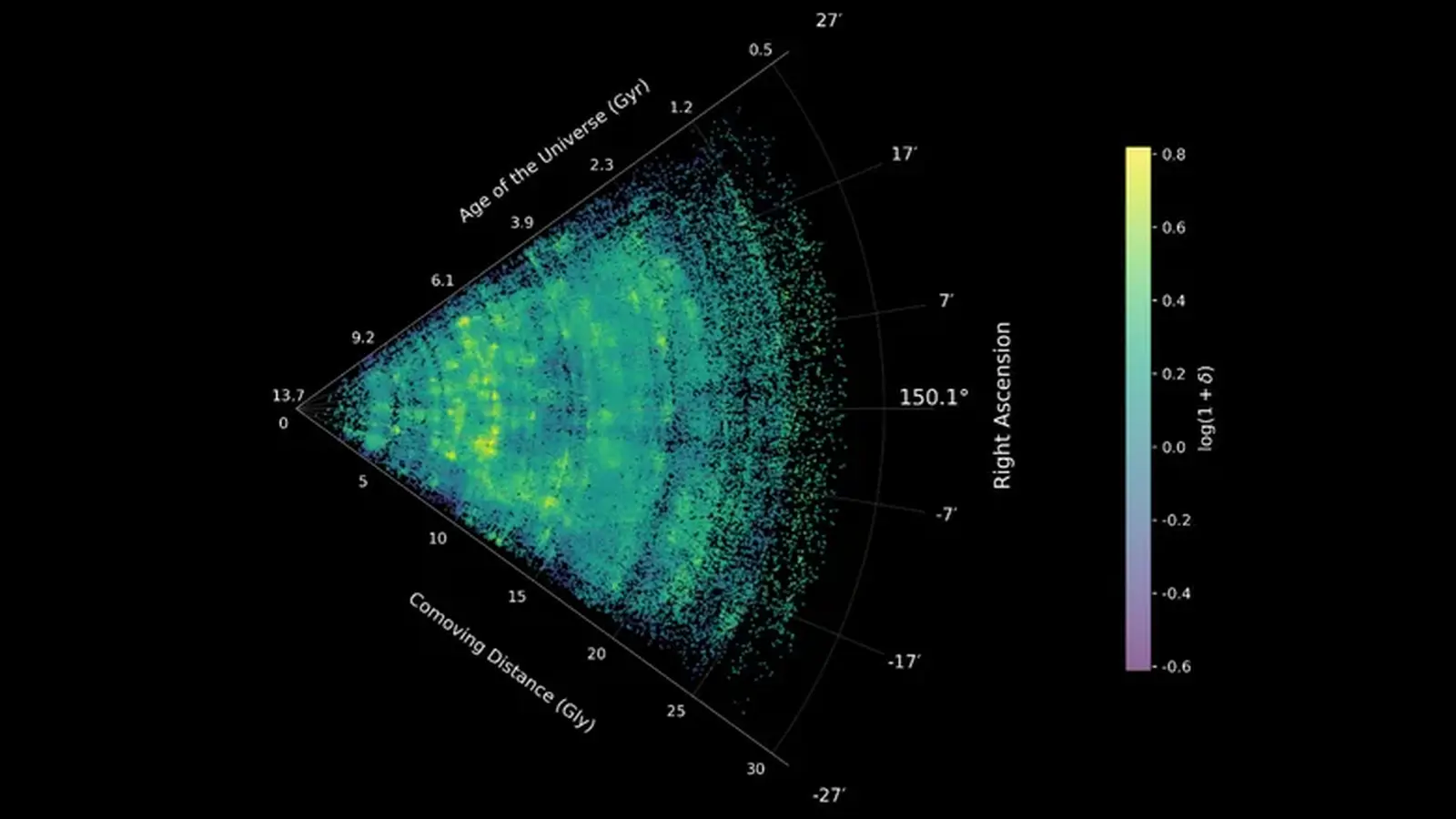
Space images from the James Webb Space Telescope usually stop people in their tracks for one simple reason: they look unreal. But this time, the real story is even bigger than the image itself. Astronomers have used Webb to produce the most detailed view yet of the cosmic web, the enormous network of dark matter, gas and filaments that ties galaxies and clusters together across the universe.
This vast framework is not some abstract theory sitting quietly in astronomy papers. It is the hidden scaffolding of the cosmos, the structure that shaped where galaxies formed, how they evolved and how matter gathered over billions of years. Researchers from the University of California, Riverside and Carnegie Observatories used Webb’s extraordinary sensitivity to peer back to a period when the universe was only a few hundred million years old, pushing into territory that earlier instruments could barely touch.
That is where the breakthrough really lands. What once appeared as a single blurred structure now breaks apart into a far richer landscape, with finer details suddenly visible. According to Bahram Mobasher, a professor at UCR and one of the study’s investigators, the leap in depth and resolution is dramatic enough to reveal features that had effectively been washed out in previous observations.
Webb is giving astronomers something they have wanted for years: a way to follow the relationship between galaxies and the larger structures around them across cosmic time. Instead of looking at isolated systems, researchers can now track how galaxies behave inside clusters and along filamentary lanes stretching through the universe, from its early history to the nearby cosmos.
What the universe looks like when the blur disappears
Lead author Hossein Hatamnia says the findings open the door to studying galaxy evolution inside these large scale structures from the time the universe was about a billion years old all the way to the present era. That matters because galaxies do not grow in isolation. They are shaped by their surroundings, by the density of matter around them and by the invisible web that channels material from one region of space to another.
In practical terms, this new cosmic web map helps scientists test long standing ideas about how the universe assembled itself. Dark matter remains unseen directly, yet its gravitational pull leaves fingerprints on the arrangement of visible matter. By mapping these patterns with greater precision, astronomers can sharpen models of cosmic evolution and better understand how today’s universe came to look the way it does.
The James Webb Space Telescope was built to look deep into the early universe, and this result shows exactly why that capability matters. Pretty pictures may grab the headlines first. Fair enough. But underneath the visual spectacle, Webb is quietly redrawing one of the most important maps in modern astronomy.

“My work centers on sustainability, energy, and environmental science — examining how innovation can lead to a greener future.”

Discussion
Leave a Comment