
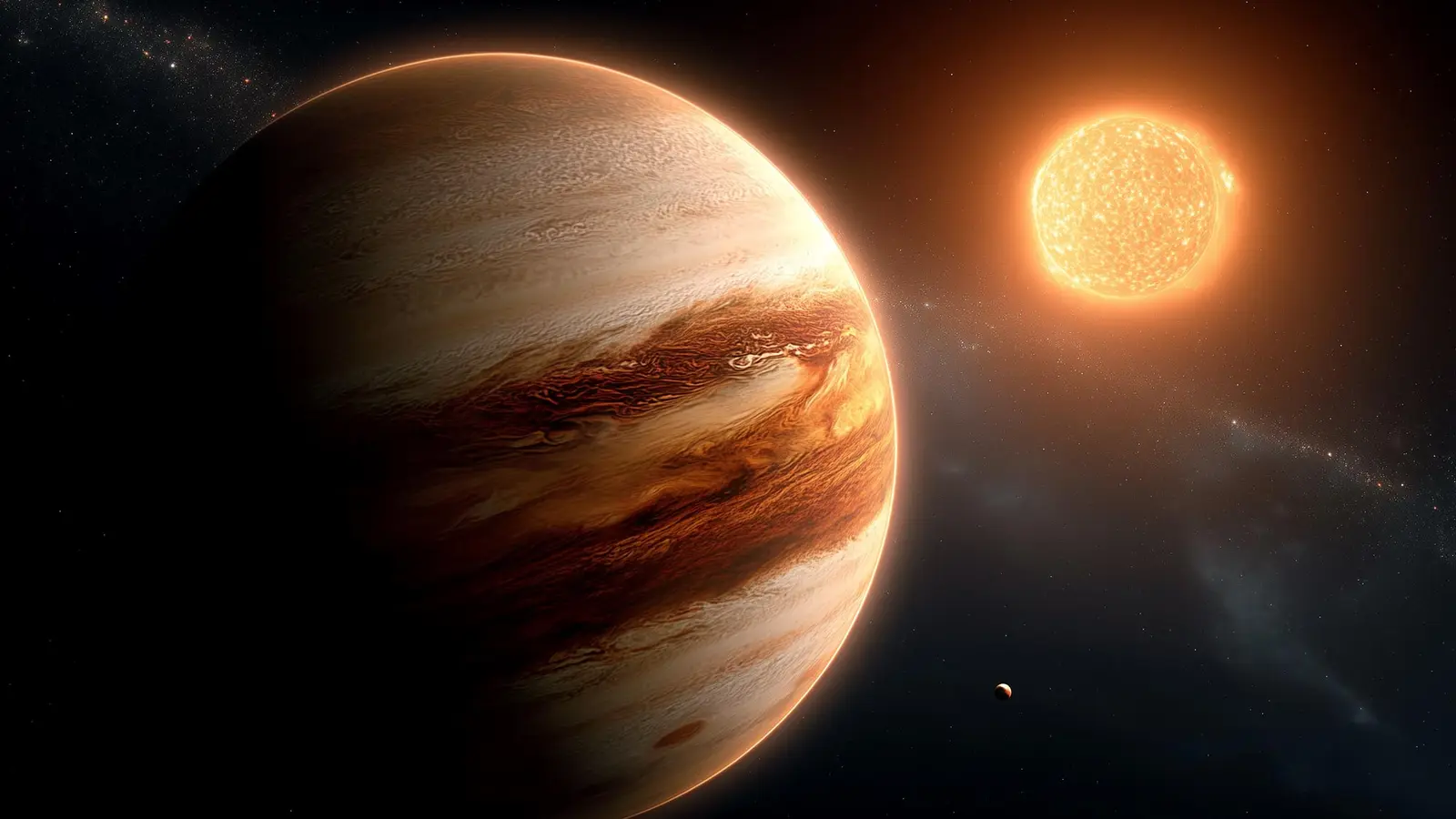
Astronomers have discovered three Earth-sized planets tightly orbiting a nearby binary star system, overturning assumptions about where rocky worlds can form and survive. Located roughly 190 light-years away, TOI-2267 hosts an arrangement never seen before: two transiting planets around one star and a third transiting the companion.
A binary system that breaks the rules
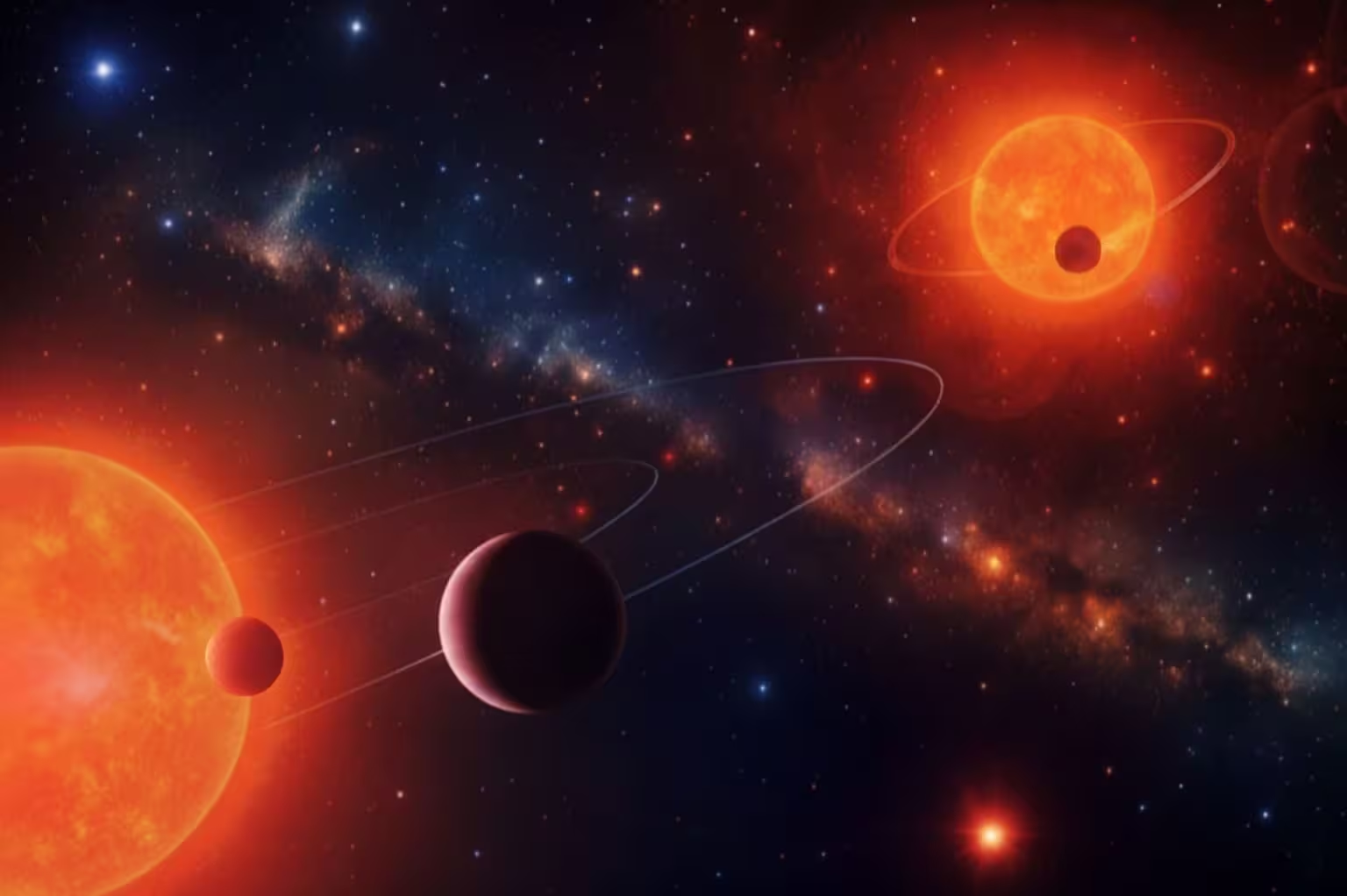
Binary stars—two stars gravitationally bound and orbiting each other—create complicated gravitational environments that long discouraged astronomers from expecting stable, closely packed planetary systems. Yet the new discovery reported in Astronomy & Astrophysics shows three small, rocky planets orbiting both components of TOI-2267 in short, compact orbits. The result challenges textbook expectations and forces a rethink of planet formation theory in multi-star systems.
“Our analysis shows a unique planetary arrangement: two planets are transiting one star, and the third is transiting its companion star,” says Sebastián Zúñiga-Fernández of the ExoTIC group at the University of Liège, lead author of the study. “This makes TOI-2267 the first binary system known to host transiting planets around both of its stars.”
How the planets were found and confirmed
The initial signals came from NASA’s TESS (Transiting Exoplanet Survey Satellite), which detects tiny dips in starlight when planets pass in front of their host stars. But the story of TOI-2267 started with a dedicated search by teams at the University of Liège and the Instituto de Astrofísica de Andalucía (IAA-CSIC), who applied their in-house detection pipeline, SHERLOCK, to the data. They flagged two of the planets early and mobilized ground-based assets to follow up.
Ground-based telescopes proved decisive. Robotic observatories such as SPECULOOS and TRAPPIST—developed and operated under leadership from ULiège—played a central role by performing precise, time-sensitive photometry on the faint, cool stars in the system. An intensive, multi-observatory campaign then confirmed the planetary nature of the transit signals and helped constrain their sizes and orbital periods.
Why this system matters for planet formation
Finding three Earth-sized planets in a compact binary system provides a rare natural laboratory. Rocky planets are thought to form in protoplanetary disks of gas and dust, where gravitational interactions, migration, and resonances sculpt final orbits. In binary systems, those processes are more complex: the gravitational pull of a companion star can truncate disks and excite planetesimal orbits, making accretion and survival more difficult.
“This system is a true natural laboratory for understanding how rocky planets can emerge and survive under extreme dynamical conditions,” observes Francisco J. Pozuelos, co-leader of the study and researcher at IAA-CSIC. The presence of transits around both stars suggests nature can assemble compact planetary architectures even when theoretical models predict instability.
What astronomers will study next
The discovery opens urgent questions: What are the planets’ masses and densities? Do any retain atmospheres? Could tidal forces or past migration explain their current positions? Upcoming observations with powerful facilities such as the James Webb Space Telescope (JWST) and next-generation ground telescopes will target precise mass measurements and, where possible, atmospheric signatures. Spectroscopic and radial-velocity data will be crucial to determine composition and long-term stability.
Why collaboration made this possible
TOI-2267 highlights the synergy of space-based surveys and focused ground-based networks. TESS provides broad, time-domain coverage to flag candidates; specialized software like SHERLOCK refines searches; and robotic telescopes optimized for small, cool stars confirm and characterize findings. Combined, these tools can extend the census of small exoplanets into environments once considered hostile.
Expert Insight
“Discoveries like TOI-2267 remind us that planetary systems are more diverse than our early models predicted,” says Dr. Maya Herrera, a fictional but representative exoplanet scientist. “Binary systems introduce dynamical complexity, but that complexity does not preclude the formation of Earth-size worlds. With JWST and giant ground-based telescopes, we now have the capability to probe their atmospheres and composition—and that will tell us whether these planets are dry rocks, water-rich super-Earths, or something else entirely.”
As astronomers refine models of planet formation and stability, TOI-2267 will serve as a benchmark system. Its rare configuration—planets transiting both stars—offers a direct test of theories and a compelling target for future, high-precision observations.

“The cosmos has always fascinated me. I write about space missions, astronomy, and the technologies pushing humanity beyond Earth.”

Discussion
Leave a Comment