
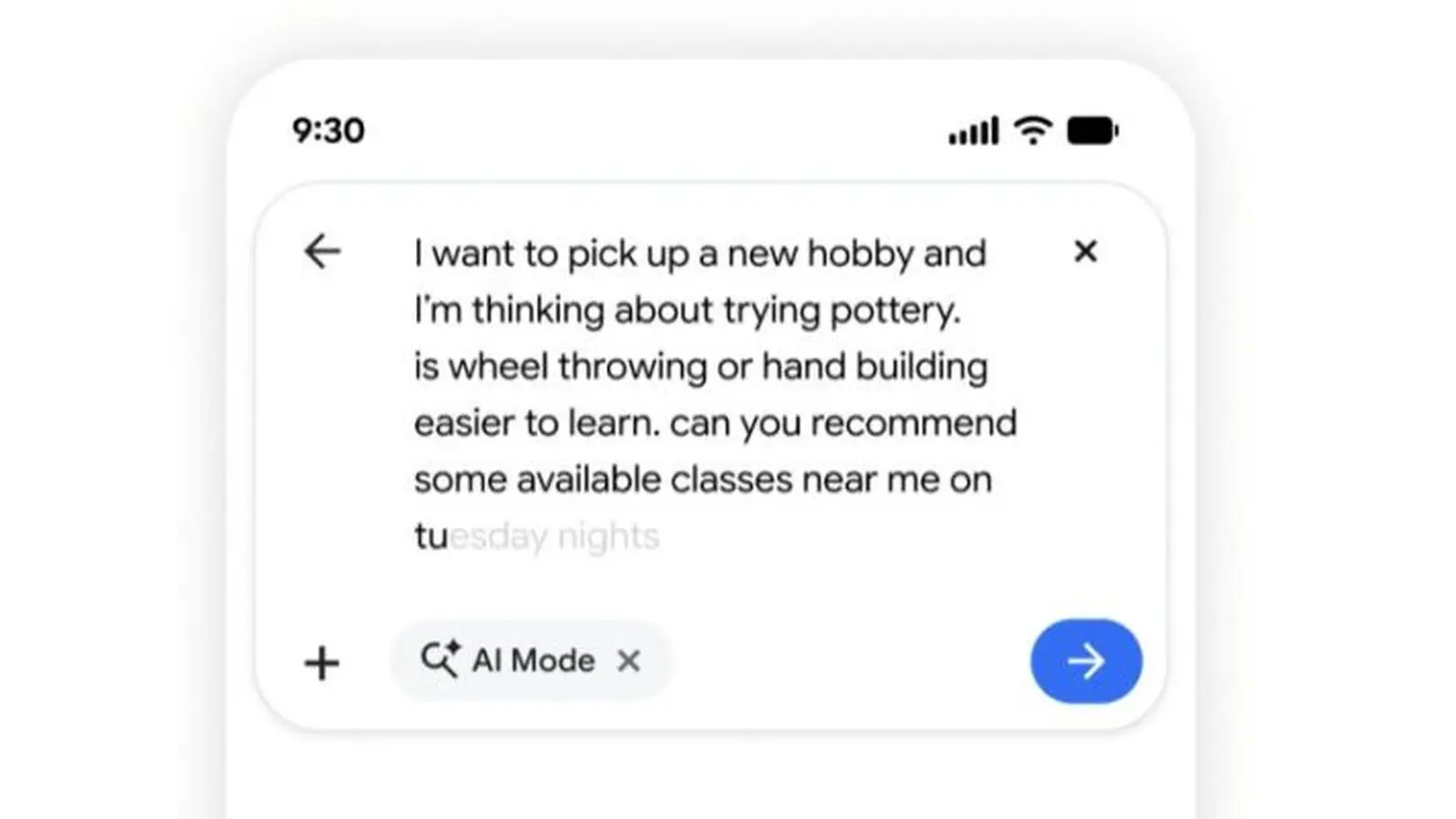
Google did not show up at I/O 2026 with another small AI tweak. It showed up with a plan to remake Search from the input box outward.
The most visible shift is also the most symbolic. For the first time in more than 25 years, Google has redesigned the search box itself. As users type, the field now expands to handle longer, more natural questions, a clear sign that Google no longer expects people to search in clipped keywords alone. The company is pushing Search toward conversation, context, and multimodal input all at once.
That means a query is no longer limited to text. Users can now attach images, files, videos, and even open Chrome tabs directly inside Search. On top of that, the new AI suggestions go beyond classic autocomplete. Instead of merely guessing the next word, Google is trying to predict the actual intent behind the question.
This redesigned search experience is already rolling out in every country and language where AI Mode is available, and Google says it will be free to use.
Search that keeps working after you leave
The more consequential update sits a little deeper. Google is introducing what it calls information agents, and they could change how people use Search day to day. The easiest way to think about them is as a far more capable successor to Google Alerts. But unlike the old alert system, these agents are meant to run continuously in the background, scanning the web and sending back synthesized updates when something important changes.
The apartment hunting example makes the idea easy to grasp. Instead of manually searching for new listings every few hours, a user can describe what they want once and let the agent track the web for matches. When something relevant appears, Search surfaces it automatically. It is a shift from active searching to delegated searching, and that may be one of the biggest philosophical changes Google has made in years.
There is more. Google is also rolling out Generative UI, a feature designed to build custom visual responses for more complicated questions. Rather than returning a wall of links or a plain summary, Search can generate interactive tables, graphs, and even simulations when the topic demands it. For users researching data-heavy subjects, that could make results pages feel less like a directory and more like a live workspace.
Mini apps push that idea even further. These are persistent project spaces inside Search for ongoing tasks such as planning a move, organizing research, or tracking a home renovation. In practice, Google seems to be turning Search into a tool people return to not just for answers, but for managing longer projects over time.
Not all of these upgrades will be equally accessible at launch. Generative UI is expected to arrive this summer at no cost, but information agents and mini apps will initially be reserved for Google AI Pro and Google AI Ultra subscribers. In other words, some of the most ambitious pieces of the new Google Search AI strategy will begin life behind a paywall.
Google also confirmed that AI Overviews now support direct follow-up questions that flow straight into AI Mode, removing much of the friction between a traditional search results page and a full AI conversation. That handoff matters. It makes Search feel less like a one-off query tool and more like an assistant that can stay with the user as the question evolves.
AI Mode itself, first introduced last year, has now crossed 1 billion monthly users worldwide and runs globally on Gemini 3.5 Flash. That scale helps explain why this update feels different from the smaller changes Google has made over the past two years. This is no longer an experiment layered onto Search. It is quickly becoming the product.
The rollout will happen in stages. The new search box is live now. The rest arrives later this year. But the direction is already obvious. Google Search is being rebuilt to do more, remember more, and increasingly act on your behalf.

“I cover emerging technologies, digital innovation, and the intersection of tech and everyday life. My goal is to make complex trends accessible and inspiring.”

Discussion
Leave a Comment