
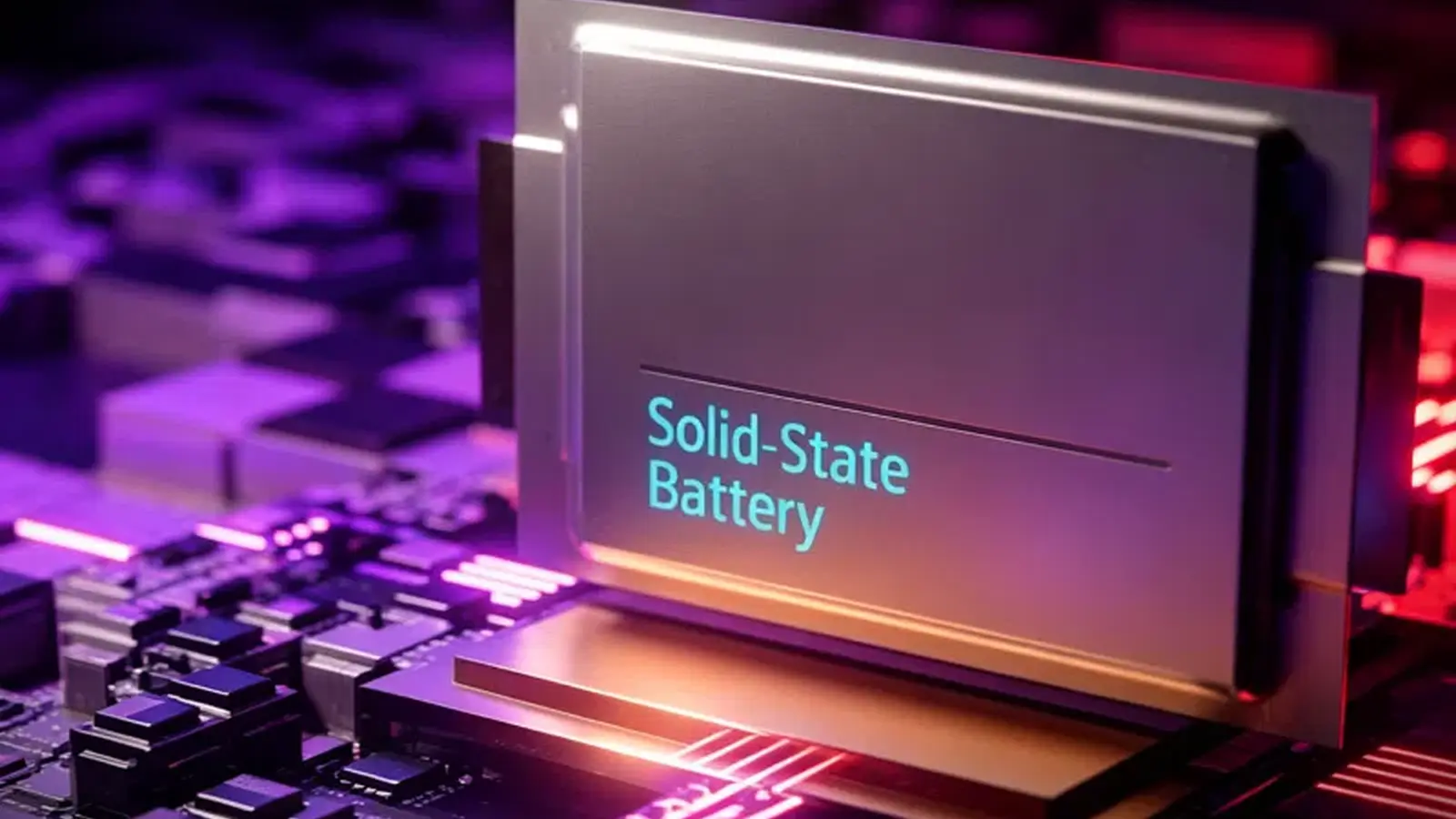
China has built a formidable lead in the solid-state battery race, yet even in Beijing the mood is far from relaxed. A new industry analysis warns that the country, despite commanding one of the biggest research pipelines and patent portfolios in the field, could still lose ground as the US, Europe, Japan, and South Korea push harder on policy, manufacturing, and intellectual property.
That tension says a lot about where the battery industry is right now. Solid-state batteries are no longer a futuristic talking point reserved for lab presentations and investor slides. They are moving into a decisive industrial phase, the point where scientific promise starts colliding with scale, supply chains, and brutal commercial reality.
On paper, China looks powerful. It holds roughly 35% of the global solid-state battery patent landscape, the highest share in the segment. In electrolyte-related filings, its position is even stronger, with about 39% of worldwide patents. Research output has surged at remarkable speed too. In 2015, China produced just 21 solid-state battery papers. By 2023, that number had exploded to 562, putting the country at the top globally.
Leading institutions such as the Chinese Academy of Sciences, its Institute of Metal Research, and Tsinghua University have become central players in solving one of the sector’s toughest technical headaches: solid-solid interface engineering. That matters because the interface between battery materials is one of the biggest bottlenecks standing between impressive prototypes and viable mass production.
Patents tell a more complicated story
Scratch beneath the surface, though, and the global pecking order becomes less straightforward. As of November 2025, solid-state battery technologies accounted for 16,429 patent filings worldwide, spread across 6,321 unique patent families. China and Japan are nearly neck and neck in total applications, with 3,341 and 3,225 respectively. The United States follows with 2,355, while South Korea has 1,544.
But total volume is only part of the picture. Japan still appears to hold the deepest technological influence, contributing around 37% of global patent filings, compared with roughly 30% for China. More telling still is who controls the most valuable corporate patent positions. Among the world’s top 30 institutions for solid-state battery and electrolyte patents, 17 are Japanese, seven are Chinese, five are South Korean, and one is European. The top 10 is entirely dominated by Japanese and South Korean players.
Toyota remains the elephant in the room. The company is identified as the single largest corporate patent holder in solid-state batteries, responsible for about 40% of global patents in the sector. That kind of concentration matters. It suggests that while China is producing huge volumes of research and filing aggressively, the most strategically entrenched IP positions are still heavily clustered elsewhere.
Chinese firms are not standing still. CATL, BYD, and SVOLT rank among the most active recent patent applicants, and Chinese entities filed more than 500 applications in 2023 alone. Still, one of the report’s sharpest warnings is about overseas patent deployment. Chinese companies are filing fewer international patents than rivals in Japan and South Korea, which have built broader protection across the US, Europe, Southeast Asia, and India.
That gap could become expensive later. In advanced batteries, winning the science is one thing. Winning the right to sell globally is another.
From lab promise to pilot lines
The commercial timeline is beginning to come into focus. According to the report, the industry is shifting from pilot-scale work toward limited small-batch production. Early manufacturing is expected around 2027, with wider commercialization targeted for 2030.
Recent disclosures suggest the pace is picking up. Chinese researchers have presented a solid-state battery prototype with an energy density of 451.5 Wh/kg and a claimed charging time of just three minutes. If that kind of performance can be reproduced outside the lab, it would turn heads across the electric vehicle industry and well beyond it.
Ganfeng Lithium, backed by Changan, has reported a solid-state battery delivering 1,100 cycles at 400 Wh/kg, while aiming for 500 Wh/kg in future production-focused designs. CATL, for its part, has revealed patent work involving fluorine-containing lithium compounds and sulfide electrolyte systems, both aimed at improving thermal stability and fast-charging capability.
Gotion High-tech is also pushing forward. The company has completed the design of a 2 GWh all-solid-state battery production line, while a 0.2 GWh pilot line is already running and vehicle testing is underway.
For now, electric vehicles remain the biggest target market, and China’s existing EV battery sector gives domestic players a serious launchpad. CATL leads installations with 29.06 GWh and a 47.2% share in the latest available period. BYD follows with 10.49 GWh and 17.1%, while Gotion ranks third at 4.05 GWh and 6.6%.
Yet the opportunity is widening fast. Solid-state batteries are increasingly being discussed for humanoid robots, electric vertical take-off and landing aircraft, consumer electronics, and stationary energy storage. In other words, this is no longer just an EV story. Any sector chasing high energy density, safety, and compact battery design is watching closely.
The engineering challenges, however, remain stubborn. Developers are still exploring three main electrolyte pathways: sulfide, oxide, and polymer. None has emerged as the uncontested winner. Each comes with trade-offs in conductivity, durability, manufacturability, and cost. Researchers are also still grappling with lithium dendrite growth, ion transport behavior, interface stability, and battery failure mechanisms.
So yes, China has scale. It has momentum. It has papers, patents, pilot lines, and some of the biggest battery companies on the planet. But the solid-state battery race is not being decided by headlines or filing counts alone. It will be decided by who can turn fragile breakthroughs into manufacturable products, lock down key markets with international patents, and ship at scale before rivals do.
One final sign of how seriously China is taking the next phase: the country’s first national solid-state battery standard, called Terms and Classification, is now open for public consultation. The draft would formally divide batteries into liquid, hybrid solid-liquid, and fully solid-state categories.
That may sound bureaucratic. It is not. Standards are often the quiet signal that a technology is preparing to leave the lab and enter the real economy.

“I cover emerging technologies, digital innovation, and the intersection of tech and everyday life. My goal is to make complex trends accessible and inspiring.”

Discussion
Leave a Comment