
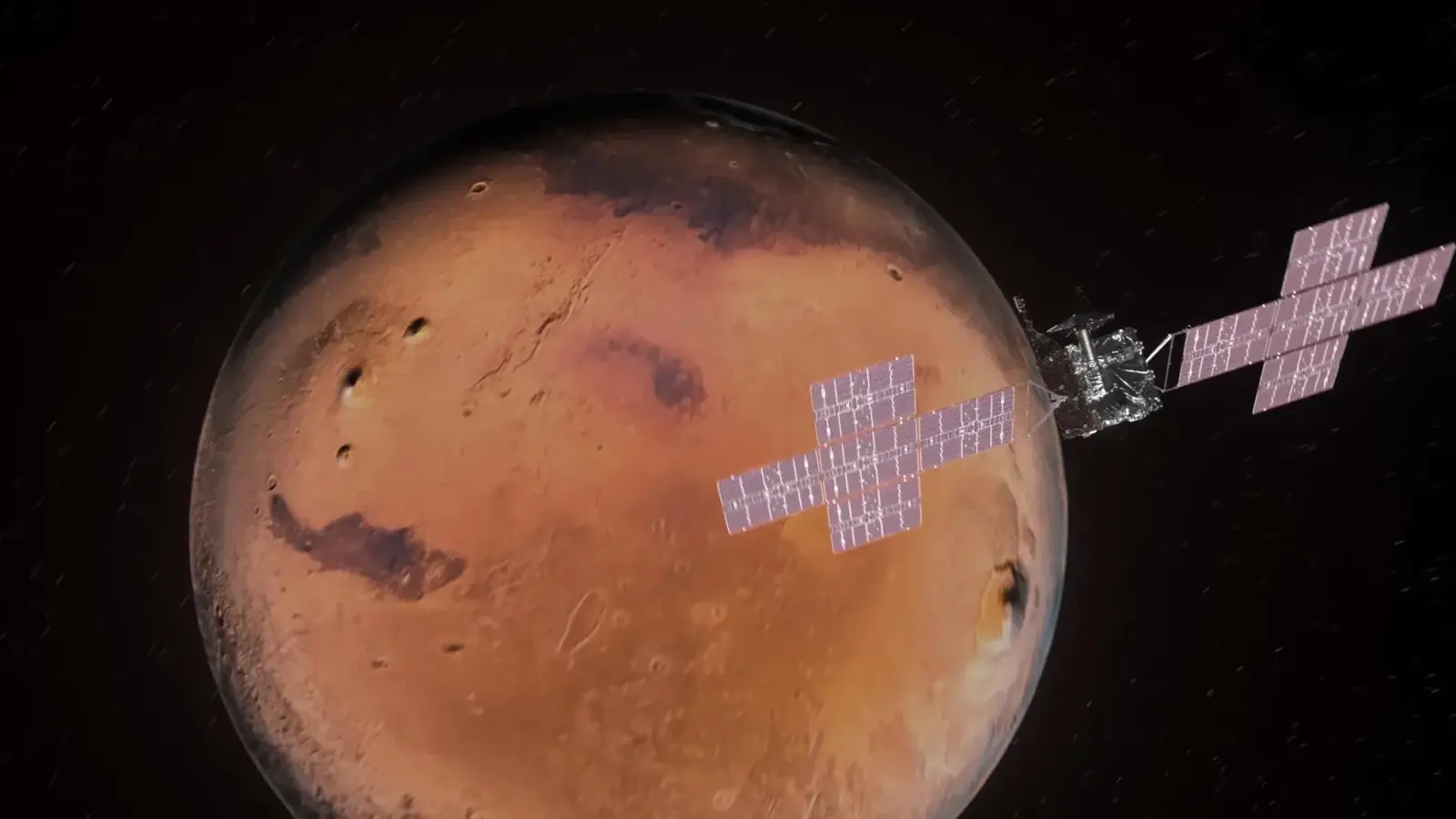
It skimmed past Mars as if taking a breath. At 2,864 miles above the surface, NASA’s Psyche spacecraft rode the planet’s gravity like a racer tucking into a slipstream, stealing speed without burning fuel and adjusting course for a rendezvous three years away with a strange, metal-rich asteroid.
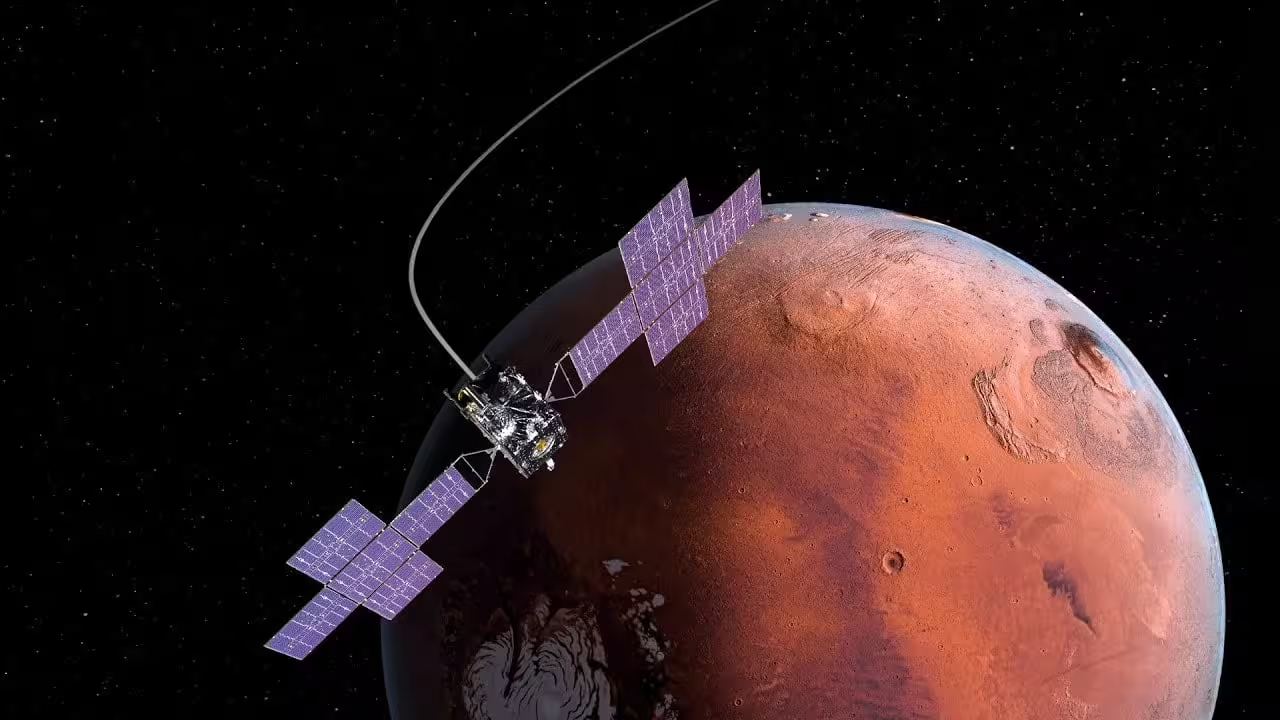
NASA’s Psyche spacecraft just pulled off a dramatic close flyby of Mars, skimming only 2,864 miles above the planet to get a powerful gravitational slingshot toward one of the solar system’s strangest worlds — the metal-rich asteroid Psyche.
How a planet can act like a rocket
Gravity assists are an elegant trick. Rather than expending precious propellant, mission teams use a planet’s motion and mass to change a spacecraft’s speed and trajectory. It sounds simple; in practice it demands precise timing and flawless navigation. On May 15, 2026, Psyche passed Mars at the prescribed altitude and attitude. Engineers monitored the Doppler shifts in radio signals relayed through NASA’s Deep Space Network in real time to confirm the maneuver worked exactly as planned.
The payoff was immediate. According to navigation lead Don Han at NASA’s Jet Propulsion Laboratory, the flyby gave Psyche roughly a 1,000-mile-per-hour boost and tipped its orbital plane about 1 degree relative to the Sun, nudging the spacecraft onto the direct path that will carry it into the main asteroid belt.
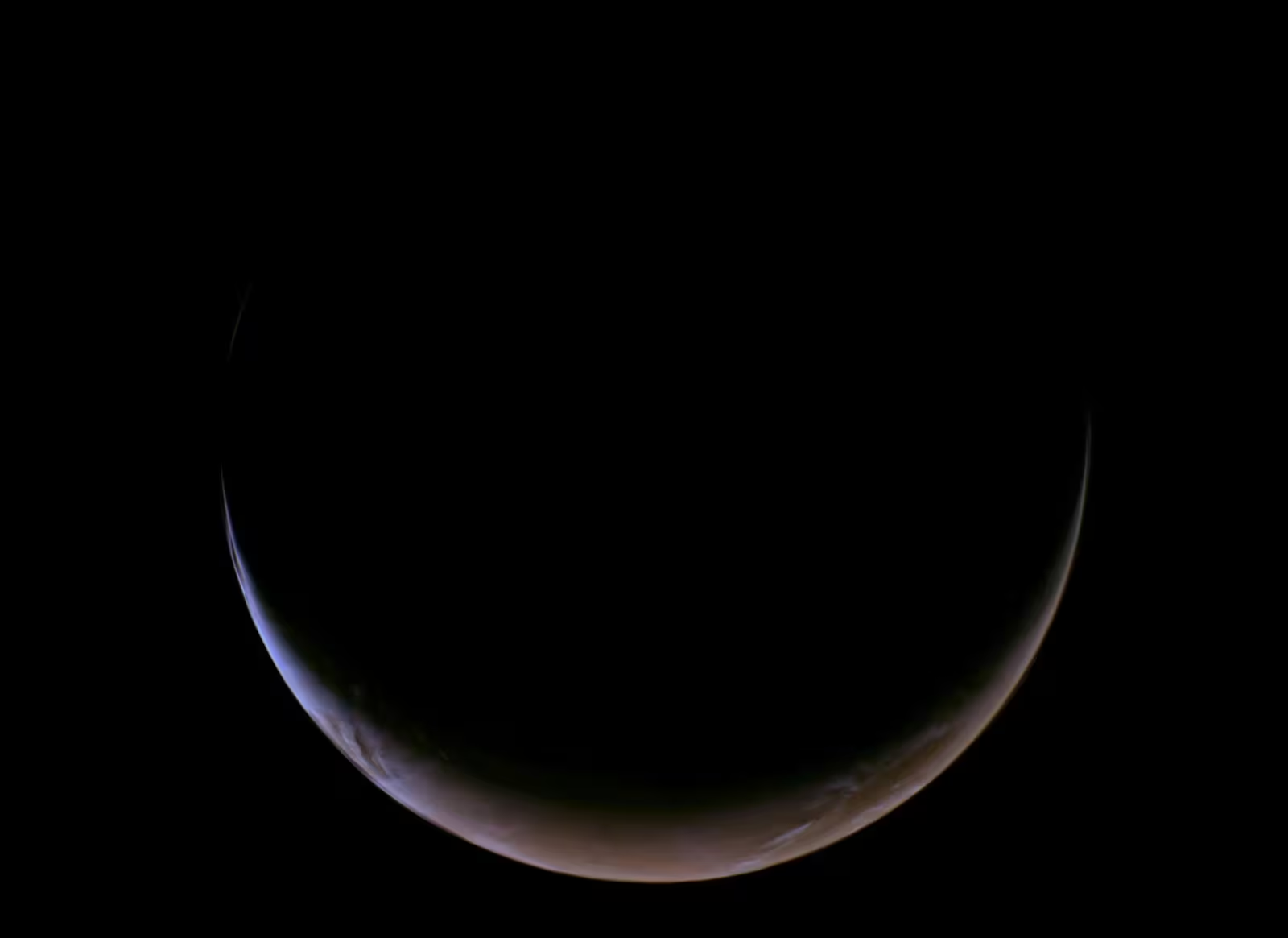
This view of a crescent Mars was captured on May 15, 2026, at about 5:03 a.m. PDT by NASA’s Psyche mission as it approached the planet for a gravity assist. The image has been processed into a natural-color view using red, green, and blue data from the multispectral imager instrument.
Instrument checks and unexpected vistas
Engineers used the encounter not just for momentum but for rehearsal. All of Psyche’s science instruments were powered up and exercised: the multispectral imager, magnetometers, and the gamma-ray and neutron spectrometer. Calibrations during close approach provided essential performance baselines the team will rely on once the spacecraft reaches the asteroid.
Those calibrations also produced images with real scientific value. Because Psyche approached Mars from a steep angle relative to the Sun, the planet presented as a narrow crescent. The spacecraft’s multispectral imager recorded that crescent extending farther around the limb than models predicted. Scattered sunlight through Mars’s dusty atmosphere produced the effect, offering a clear reminder that even routine engineering checks can yield atmospheric science.

This is the first view of a nearly “full Mars” as seen by NASA’s Psyche spacecraft shortly after its closest approach to the planet on May 15, 2026. The view extends from the south polar cap northwards to the Valles Marineris canyon system and beyond.
As Psyche swept from the nightside of Mars into daylight, the instruments rapidly photographed surface features. The mission captured its highest-resolution views so far of the southern polar cap and broad regional scenes showing wind-sculpted streaks and large impact basins. Those images are valuable both for instrument teams fine-tuning image-processing pipelines and for planetary scientists comparing the new data with decades of Mars observations.

This is the highest-resolution view of the water ice-rich south polar cap of Mars captured by NASA’s Psyche mission after it made its close approach with the planet for a gravity assist. The cap is more than 430 miles (700 kilometers) across.
What Psyche seeks and why it matters
Psyche the spacecraft is bound for Psyche the asteroid, a roughly 173-mile-wide body in the main asteroid belt. Many researchers suspect this object may be the exposed metallic interior of a planetesimal—an embryonic world stripped of its outer rock by collisions early in solar system history. If that hypothesis holds, the asteroid offers an unprecedented window into planetary cores otherwise hidden beneath thousands of kilometers of rock.
Once Psyche arrives, planned operations include a phased campaign of orbital surveys at progressively lower altitudes. The magnetometers will map any remnant magnetism, the gamma-ray and neutron spectrometer will probe elemental composition, and the multispectral imager will map geology and surface textures. Together, those measurements can test whether Psyche is indeed iron-nickel metal, a mixture of metal and rock, or something more complex.
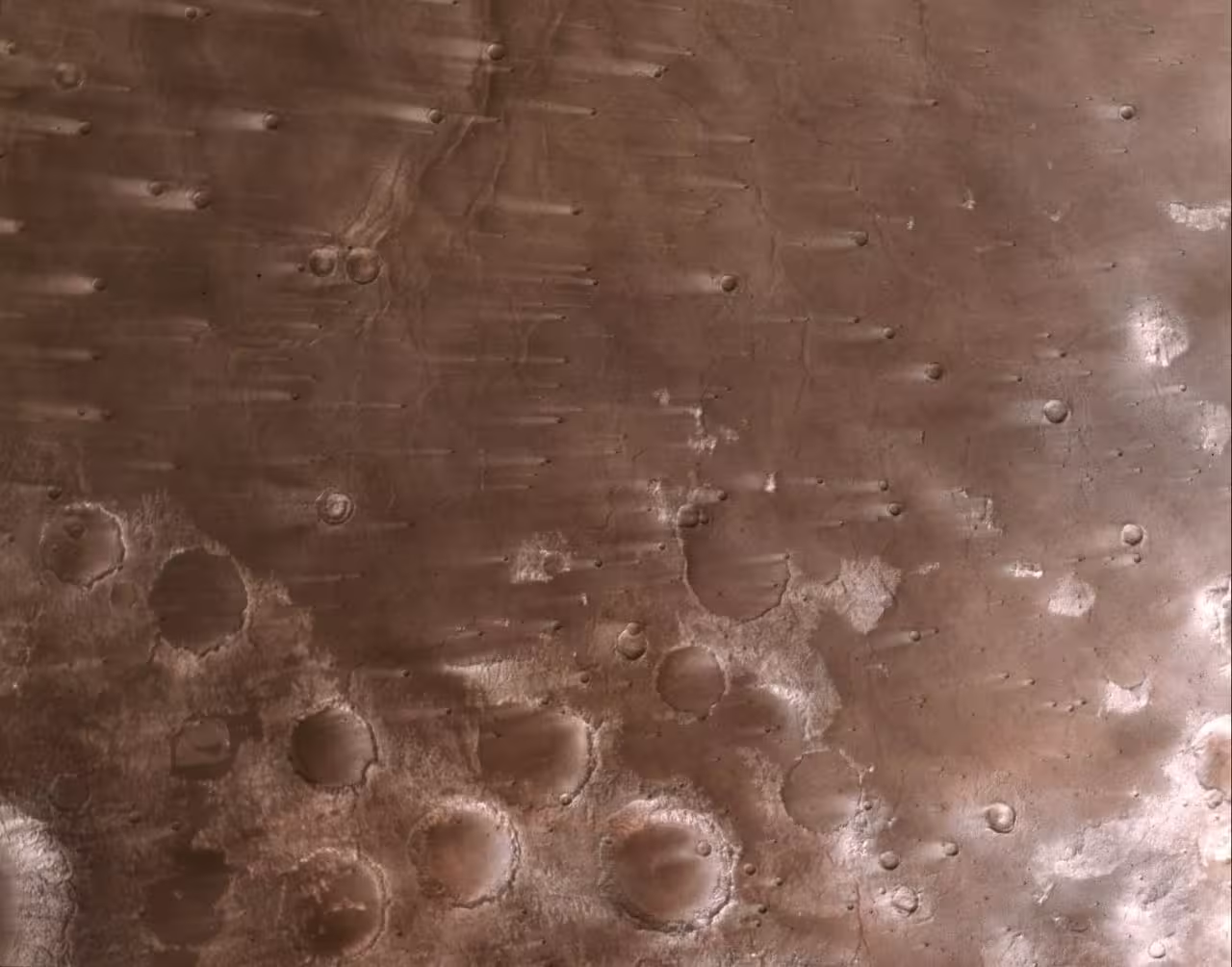
This view of the Martian surface shows streaks that have formed due to wind blowing over impact craters in the Syrtis Major region. The wind streaks extend to about 30 miles (50 kilometers) long, and the large craters near center-bottom of the scene average around 30 miles in diameter.
Beyond pure discovery, Psyche’s science has broader implications. Understanding the composition and structure of a planetary core analogue would inform models of planetary differentiation—the process by which dense metals sink and lighter silicates rise during planet formation. That’s central to questions about Earth’s own formation, its core-driven magnetic field, and how terrestrial planets evolve across the galaxy.
Testing technology on the way
The mission’s spacecraft platform, supplied by Intuitive Machines, carries a high-power solar electric propulsion system that will be restarted after the Mars assist to continue the cruise through the asteroid belt. Solar-electric propulsion trades thrust for efficiency, enabling missions that would be prohibitive with chemical rockets alone. The Psyche team has used the Mars encounter to exercise operations and to verify navigation strategies that will be critical for precise orbital insertion around the asteroid in 2029.

Captuрed by Psyche’s multispectral imager instrument, this is an enhanced-color view of the large double-ring crater Huygens (upper right; about 290 miles, or 470 kilometers, in diameter) and the surrounding heavily cratered southern highlands.
Verification came from the Deep Space Network and onboard telemetry. Doppler tracking confirmed the spacecraft’s post-flyby trajectory matched predictions. That kind of certainty is essential when small deviations now could translate into large targeting errors three years downrange.
Expert Insight
"A gravity assist is an economy of motion," says Dr. Mira Alonso, a mission systems engineer who has worked on deep-space navigation. "You borrow momentum rather than carrying it. For Psyche, Mars provided a precise and fuel-free turn that preserved propellant for science once the spacecraft arrives at the asteroid. But the true value of the encounter was the cross-check: sensors, communications, and operations all performed together under real conditions."
Jim Bell, imager lead at Arizona State University, emphasized the dual benefit of the flyby: refining imaging pipelines and collecting serendipitous science. "We got far more crescent-phase atmospheric data than expected," he said, noting collaborations with other Mars missions that supplied context and extra calibration points.
Principal investigator Lindy Elkins-Tanton remarked on the mission timeline, "We’re grateful to Mars for giving our spacecraft a critical gravitational slingshot farther into the solar system. Onward to the asteroid Psyche."
About the mission and partners
Psyche is led by Arizona State University, with flight operations and engineering managed by NASA’s Jet Propulsion Laboratory, a division of Caltech in Pasadena. The spacecraft bus was provided by Intuitive Machines, and imaging hardware was developed in collaboration with Malin Space Science Systems. Psyche is the 14th selection in NASA’s Discovery Program, with mission oversight from the Marshall Space Flight Center and launch services managed by Kennedy Space Center.

NASA’s Psyche mission is a deep space expedition to explore the asteroid Psyche, a rare metal rich object in the asteroid belt that may be the exposed core of an ancient failed planet.
Conclusion
The Mars flyby was more than a navigational success. It was a systems test, a scientific opportunity, and a vivid reminder of how interplanetary missions knit together engineering and discovery. Psyche has used Mars to change its fate — trading a brief brush with the Red Planet for the chance to study what lies beneath the surfaces of worlds. Arrival at asteroid Psyche in August 2029 will open a new chapter in our attempt to read the early history of planetary building blocks.

“My work centers on sustainability, energy, and environmental science — examining how innovation can lead to a greener future.”

Discussion
Leave a Comment