

A new study from the University of California, Berkeley reports a dramatic lifespan boost in frail, aged male mice after treatment with a two-drug combination targeting distinct aging pathways. The result—up to a 73% life extension from the time treatment began—highlights both promising anti-aging biology and the complexities of sex-specific responses.
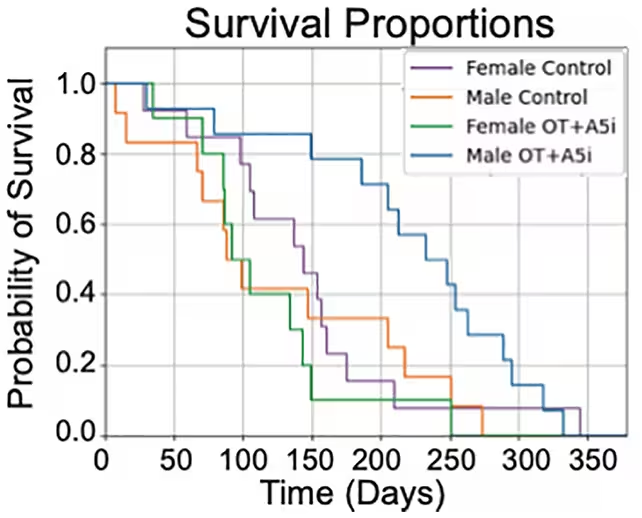
Treated male mice lived longer than controls, though the same effects weren't there for females.
Two-pronged approach: oxytocin meets an Alk5 inhibitor
The therapy combined oxytocin (OT), a natural hormone and neurotransmitter associated with social bonding, reproduction, muscle repair and tissue regeneration, with an Alk5 inhibitor (A5i), which dampens activity in the transforming growth factor beta (TGF-beta) signaling pathway. TGF-beta tends to become overactive with age, contributing to chronic inflammation and tissue decline.
Researchers treated 25-month-old mice—roughly equivalent to 75-year-old humans—already showing frailty. Males receiving both OT and A5i not only lived significantly longer than untreated controls but also showed measurable improvements in physical performance, blood protein biomarkers, and short-term memory tests. These changes indicate an increase in healthspan as well as lifespan: the mice were not just living longer, they were functioning better.
Why only males responded: the sex difference puzzle
Curiously, the lifespan and functional gains were limited to male mice. Female mice did not show the same lifespan extension, although the researchers noted an intriguing reproductive effect: OT+A5i treatment at late middle age appeared to rejuvenate fertility in females. That hints at sex-specific biology—hormonal milieus, immune differences, and reproductive signaling—that can alter how aging pathways respond to interventions.
Sex differences in anti-aging research aren’t new: many longevity therapies behave differently in males and females across species. The Berkeley team suggests testing females at younger ages and exploring dose and timing variations to better understand the divergent outcomes.
Scientific context and experimental details
The study targeted two separate, age-related mechanisms simultaneously: supporting regenerative processes through oxytocin while blocking excessive TGF-beta signaling with an Alk5 inhibitor. Oxytocin is already used clinically to induce and manage labor, meaning its safety profile is relatively well characterized in that setting. Alk5 inhibitors are under investigation in oncology, which may speed safety assessments when repurposing them for aging research.
Key experimental notes:
- Subjects: 25-month-old C57BL/6 mice (frail, older adults).
- Treatment: combined OT and A5i given after the animals displayed age-related frailty.
- Outcomes measured: survival/lifespan from treatment start, physical tests, blood protein markers, and short-term memory tasks.
- Results: up to 73% life extension from treatment onset in males and a 14% increase in median lifespan across the cohort.
Implications for human aging therapies
The findings provide proof of principle that concurrently modulating regenerative and pro-inflammatory signaling can restore function and extend life in aged mammals. But translating this to humans faces important hurdles: side effects, dosing, long-term safety and the striking sex-dependent response seen in the mice.
Adjusting aging pathways can create trade-offs. Reducing one harmful process might disrupt another balance in the body. That’s why regulators and clinicians will demand thorough assessments of adverse effects before considering clinical trials focused on longevity or healthspan.
One practical advantage for researchers: oxytocin’s established clinical use and Alk5 inhibitors’ presence in cancer research may accelerate safety profiling for repurposing these molecules. Still, the leap from mice to humans is large—both biologically and ethically—and will require careful, incremental studies.
What this study adds to aging research
Beyond the headline result, the paper underscores several priorities for geroscience: combining interventions that act on different aging hallmarks, testing sex-specific protocols, and measuring both lifespan and functional healthspan outcomes. The study also offers candidate biomarkers and behavioral tests that future trials could adopt when assessing anti-aging interventions.
Expert Insight
“This work is a compelling example of targeted, combinatorial geroscience,” says Dr. Elena Morales, a fictional geriatric biologist and science communicator. “It shows that dialing two knobs at once—support for repair plus containment of chronic inflammatory signals—can restore resilience in very old animals. But the male-only survival effect warns us that one-size-fits-all therapies are unlikely. We need nuanced, sex-aware strategies for human translation.”
As populations age worldwide, studies like this offer valuable roadmaps: they reveal promising targets, illuminate biological complexities, and remind us that effective longevity medicine will require both precision and caution.

“My work centers on sustainability, energy, and environmental science — examining how innovation can lead to a greener future.”

Discussion
Leave a Comment