
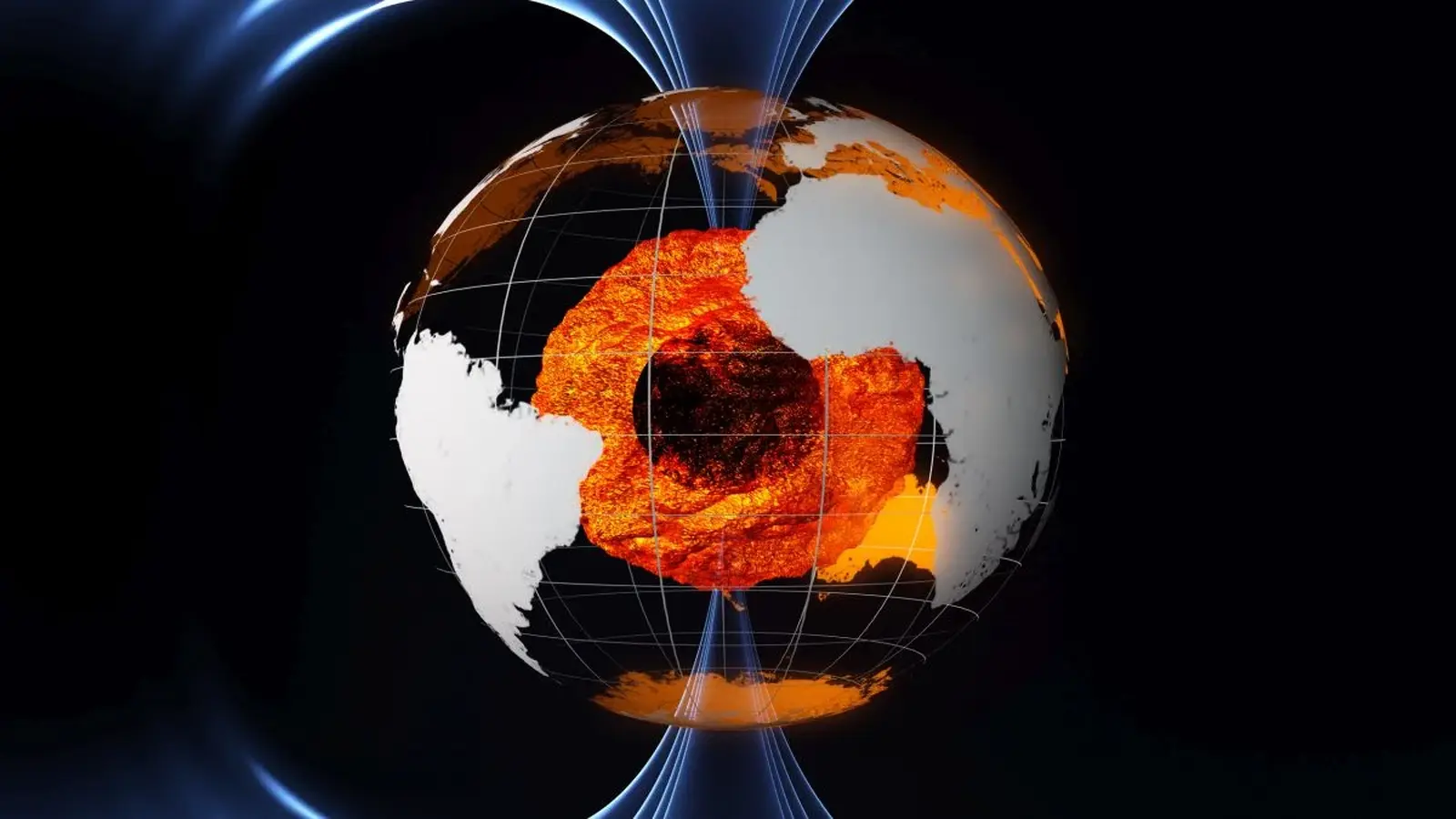
Something unexpected stirred nearly 3,000 kilometers beneath the Pacific Ocean in 2010: a portion of the molten outer core that typically drifts westward abruptly switched course and began moving east. The shift was detected not by drilling or direct sampling — no technology reaches that deep — but by careful reading of the magnetic field above us.
Earth's magnetic field is generated in the outer core, 2,900 kilometers (1,800 miles) below sea level.
Reading the invisible: satellites as stethoscopes
Satellites track the magnetic field that the churning, conducting iron of the outer core pumps into space. Changes in that external field are the only practical everyday clues to the core's motion. From 1997 to 2025, a continuous archive of satellite data revealed a surprising pattern: a large-scale flow beneath the Pacific that flipped direction around 2010.

A visualization of Earth's external magnetic field. (ESA)
Before 2010, the region behaved like much of the outer core — a slow westward sweep embedded within a dominant circulation pattern scientists call the eccentric planetary gyre. After 2012, however, the same patch of core exhibited a strong eastward flow. It did not look like a fleeting eddy. The signal represented roughly five percent of the outer core's surface flow and showed a broad, wave-like structure rather than narrow zonal bands you see on gas giants.
What the data say
Researchers reconstructed the pattern by combining nearly three decades of magnetic observations. Their analysis suggests the eastward motion strengthened through the 2010s, peaked around 2020, and then began to subside. That trajectory raises immediate questions: was this a short disturbance, a repeating oscillation, or the start of a new dynamic regime in the core?
Scientists are cautious. The outer core is a turbulent place. But the observed reversal is larger and more coherent than small-scale turbulence would suggest. It implies that forces or interactions inside Earth can reorganize flow on regional and perhaps hemispheric scales.
Converging signals from the deep interior
Other geophysical records show noteworthy anomalies around the same years. The length of Earth’s day — which oscillates on a roughly 5.8-year rhythm linked to angular momentum exchange between mantle and core — experienced a disruption that began around 2010 and persisted until 2014. Seismic observations also hinted at subtle changes in inner core behavior. And in 2017, satellites observed geomagnetic jerks: abrupt glitches in the field that have been tied to rapid changes deep in the core.
Taken together, these independent lines of evidence point to a period of heightened dynamical activity within Earth's deep interior. They do not prove a singular cause, but they strengthen the case that the 2010 flow reversal was not an isolated curiosity.
Why this matters
At first glance, the idea of molten iron shifting direction far below the crust might seem academic. It is not. The geodynamo that generates Earth's magnetic field depends on large-scale flows in the outer core. The field protects our atmosphere and shields life from energetic particles streaming from the Sun and beyond. Better knowledge of core dynamics helps improve forecasts of the magnetic environment and, by extension, models of space weather impacts on satellites, navigation, and power systems.
We should be clear. This reversal poses no direct hazard to people on the surface. The changes operate over long spatial and temporal scales. Still, understanding their drivers improves our predictive capabilities and sharpens our picture of how planetary magnetic fields behave in general.
Mechanisms under consideration
Several processes could produce a regional reversal in outer core flow. Thermal or compositional anomalies at the core–mantle boundary could redirect flow patterns. Electromagnetic coupling between inner and outer core regions might trigger reorganizations. Large-scale waves or instabilities within the liquid iron can propagate and reshape circulation. At present, researchers weigh these options against the satellite and seismic constraints.
Elisabetta Iorfida of the European Space Agency’s Swarm mission notes that continuing satellite observations are revealing finer details of these processes. She emphasizes that multi-decadal monitoring is needed to determine whether such events repeat and how they influence the long-term evolution of the field.

Outer core flow under the Pacific (center-right in each map) in 1999 (top) and 2016 (bottom). (ESA)
Expert Insight
"We are seeing that the deep interior is not a clockwork machine but a living system with episodes of reorganization," says Dr. Miguel Andrade, a geophysicist at the Institute for Planetary Physics. "The 2010 event gives us a rare opportunity to connect magnetic, seismic, and rotational data in a coherent storyline. With improved models and new data, we may soon resolve whether this was a transient hiccup or part of a longer cycle."
Implications for research and technology
Practical outcomes follow from improved core models. More accurate magnetic field maps aid satellite navigation and communications. Better forecasts of geomagnetic variability help manage risks to power grids and technologically sensitive infrastructure. From a scientific perspective, these observations push theorists to refine geodynamo simulations until they reproduce sudden reorganizations like the one inferred beneath the Pacific.
Tools matter. Swarm and other magnetic missions act like a fleet of sensitive stethoscopes. Combining satellite magnetometry with seismic arrays, geodetic measurements, and advanced numerical models is the way forward. Each dataset constrains different aspects of deep Earth behavior and together they build a coherent picture.
Conclusion
The 2010 reversal of a section of Earth's outer core flow under the Pacific is a potent reminder that our planet's interior remains dynamic and, in some respects, poorly charted. It shows the value of continuous satellite monitoring, cross-disciplinary data synthesis, and robust modeling. In the years ahead, researchers will watch whether the eastward surge fades, recurs, or transforms into a new pattern — and with each observation, our understanding of Earth's magnetic heart will deepen.

“My work centers on sustainability, energy, and environmental science — examining how innovation can lead to a greener future.”

Discussion
Leave a Comment