
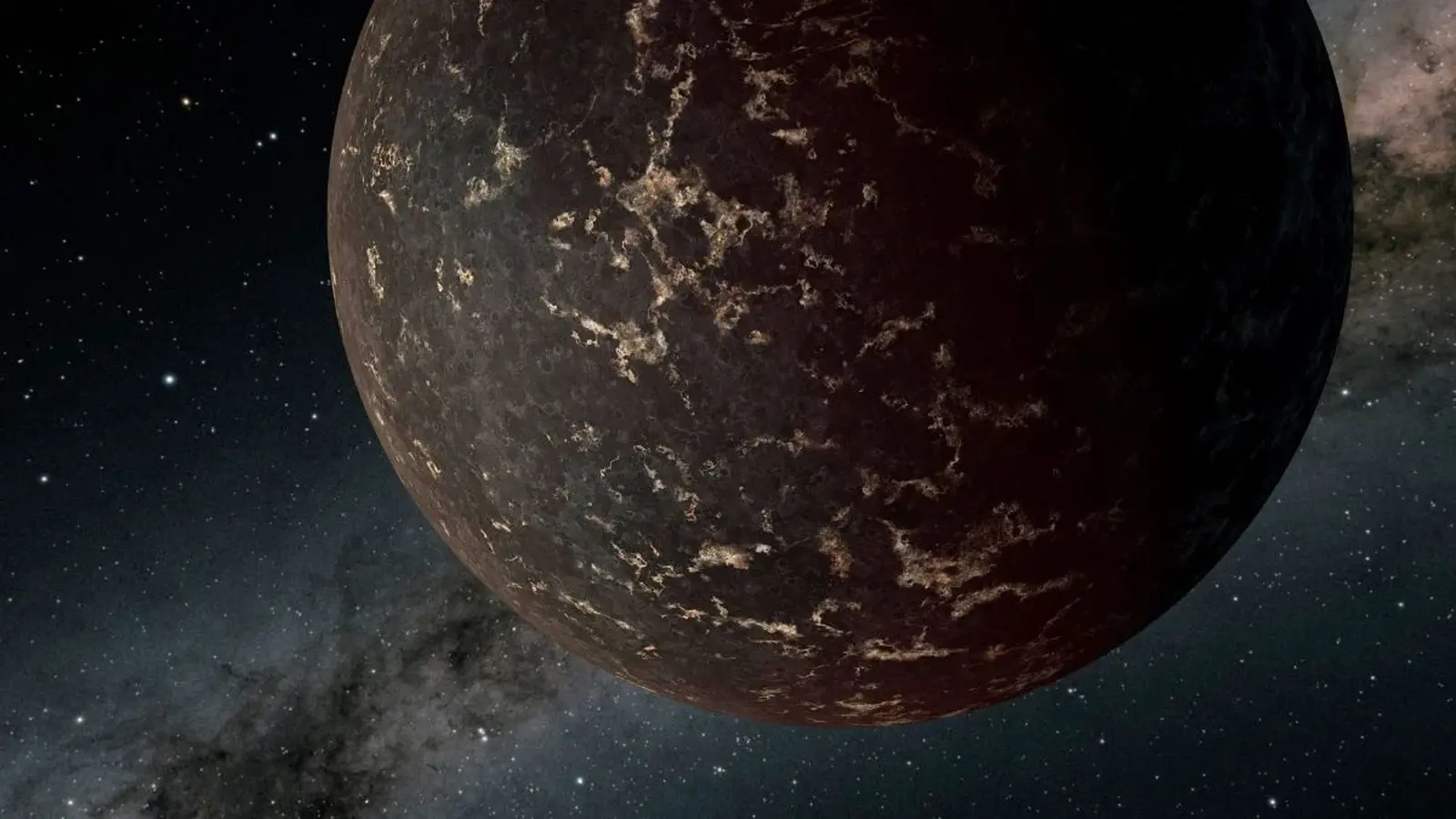
Imagine standing on the edge of a world where the sky never changes and the sun never sets for half its surface. The James Webb Space Telescope has turned that imagination into data: a scorched, airless planet orbiting a nearby red dwarf, a rock that might look and behave more like our Moon or Mercury than like Earth — yet it is about 30 percent larger than our home.
LHS 3844b was discovered in 2018 and lies roughly 50 light-years away. It races around a small red dwarf in an 11-hour orbit, so close that the star would appear enormous from the surface. The planet sits at about three stellar diameters from its host. Tidal locking is inevitable: one hemisphere bakes in perpetual daylight, the opposite side is locked in endless night. Daytime temperatures exceed 1,000 Kelvin, well over 1,300 degrees Fahrenheit.
Reading a world in heat: the spectral fingerprint
Webb’s Mid-Infrared Instrument, MIRI, cannot image this planet like a photo. Instead it reads a spectrum — the pattern of infrared light the surface emits. Every mineral and molecule leaves a distinct mark on that light. By comparing the planet’s spectrum to laboratory references and to data from NASA’s earlier Spitzer Space Telescope, astronomers can infer the likely makeup of the surface.
The team’s latest analysis points toward a surface dominated by basaltic or mantle-like material: rocks rich in magnesium and iron, similar to lunar basalt or to the deeper layers of Earth’s interior. That’s an important distinction. A basaltic signature suggests either freshly solidified lava flows and recent geological resurfacing, or an ancient, ground-down landscape of pulverized rock with no protective atmosphere to slow space weathering.

The infrared spectrum of the dayside of LHS 3844 b, based on recent observations by the James Webb Space Telescope and an earlier observation by NASA's Spitzer Space Telescope, fit to different surface compositions.
Two paths: active planet or ancient relic
Which scenario is correct? There are two competing interpretations. One is that LHS 3844b has active geology — molten rock rising and cooling to form new basaltic slabs. On Earth, volcanic outgassing sends carbon dioxide and sulfur compounds into the sky; similar fingerprints would signal live volcanism on an exoplanet. The other possibility is a dead, airless world: an old body whose surface has been ground into regolith by meteoroid impacts and relentless stellar radiation.
Crucially, Webb’s mid-infrared data do not show clear signs of volcanic gases in the planet’s dayside emission. That absence leans toward the inactive interpretation. Sebastian Zieba, a NASA Sagan Fellow at the Harvard & Smithsonian Center for Astrophysics, suggests that familiar Earth-like plate tectonics are unlikely to operate here, and the planet probably contains very little water.
Given the intense irradiation from the parent star and the planet’s close orbit, any primordial atmosphere would have been stripped away long ago. Without a gaseous envelope, surface materials are exposed to direct space weathering: micrometeorite impacts, high-energy photons, and charged particles can pulverize rock and alter spectral features.
Why this matters for exoplanet science
This result marks a methodological shift. We are moving beyond merely finding rocky exoplanets to reading their surfaces and histories. LHS 3844b is one of the first rocky worlds whose surface composition has been constrained by infrared spectroscopy. That capability opens a new window: we can now test whether plate tectonics, water retention, and volcanic activity — key processes on Earth — are common or rare on rocky exoplanets.
The implications reach beyond this single planet. Red dwarfs are the galaxy’s most common stars, and many small, rocky worlds orbit them tightly. If those worlds are typically airless and baked, habitability prospects dim. Conversely, if Webb eventually finds basalt overlain by hydrated minerals or gases indicative of ongoing volcanism, our ideas about habitability around small stars would need revising.
Expert Insight
"Spectra are stories written in light," says Dr. Elena Morales, an exoplanet spectroscopist (fictional but representative). "With Webb we can finally read chapters of a planet’s geologic past. For LHS 3844b the pages show heat and hardness rather than a hydrologic cycle. That tells us something fundamental about how small, close-in worlds evolve."
The team has already collected additional JWST observations aimed at teasing out subtle differences: grain size, surface roughness, and small mineralogical variations all change the shape of an infrared spectrum. Astronomers will use laboratory analogs and solar system comparisons — studies of the Moon, Mercury, and asteroid surfaces — to refine their models.
Conclusion
LHS 3844b reads like an extreme neighbor: larger than Earth yet barren, tidally locked and searing by day. Webb’s mid-infrared measurements favor a basaltic or mantle-like surface and show little evidence of an atmosphere or active volcanism. That combination points to a Mercury- or Moon-like destiny rather than an Earth twin. Still, the data are a beginning. Future observations and improved spectral models will sharpen our view of this scorched world and others like it, helping answer one of the biggest questions in planetary science: how common are Earth-like conditions in the galaxy?

“My work centers on sustainability, energy, and environmental science — examining how innovation can lead to a greener future.”

Discussion
Leave a Comment