
Picture a vacuum of night, an impact on Earth so violent it ejects rocks and dust into space. Tiny fragments hitch a ride across millions of kilometers. Some of them slow down, break apart, and billow across the upper atmosphere of a neighboring planet. Could those flecks carry the chemistry of life? The question is no longer purely speculative.
Panspermia—the idea that life or its ingredients can move between worlds on rocks, dust, or icy bodies—has moved from thought experiment toward testable scenario. For years scientists focused on the exchange between Earth and Mars. Now the renewed debate about potential microbes in Venus’s dense, acidic cloud decks has pushed researchers to ask whether Earth could be seeding Venus as well.
From impact to cloud droplet
At the Lunar and Planetary Science Conference in 2026, a team from Johns Hopkins University Applied Physics Laboratory and Sandia National Laboratories presented a detailed analysis of this possibility. They applied a framework called the Venus Life Equation, first introduced by Noam Izenberg and colleagues in 2021, to break the problem into parts that can be estimated. Think of it like the Drake Equation, but aimed at habitability suspended in a shroud of sulfuric acid and thick clouds.
How does terrestrial material actually survive such a voyage? The hurdles are brutal. Ejection from Earth exposes material to intense shock and heating. Once in space, fragments face vacuum, cold, and a constant rain of ionizing radiation. Then comes atmospheric entry at Venus: extreme shear, heating, and explosive breakup. Yet both laboratory experiments and studies of meteorites show that some organics and hardy microbes can survive ejection and interplanetary travel under the right conditions.
The team modelled what happens when an incoming meteorite or fireball reaches Venus. They used a semi-analytic approach sometimes called the pancake model to represent how a bolide fragments and spreads under aerodynamic stress. After an airburst, the fragments do not fall like solid projectiles; they fan out horizontally, creating a cloud of cells—small, dispersed volumes of material that could, in principle, remain aloft in Venus’s cloud layers for hours or days.

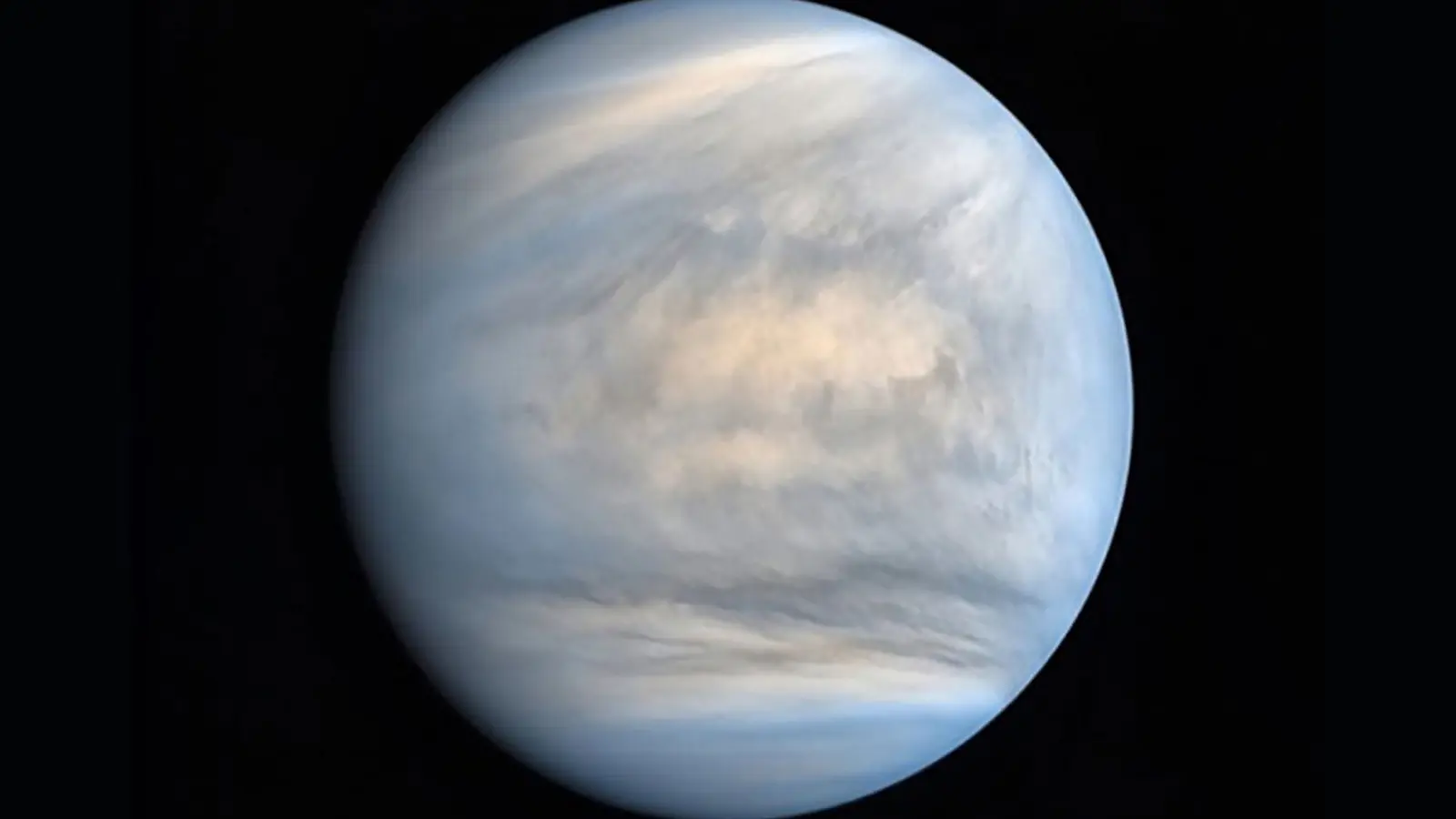
Some layers of Venus’ clouds support surprisingly hospitable temperatures and pressures. Researchers have proposed that microbes could survive within those clouds.
From those simulations the researchers estimated how many such cells could be delivered to Venus over geological timescales. The headline numbers are striking but cautious. The best-fit output suggests roughly 100 potentially viable cells disperse into Venus’s clouds from Earth each year. Stretch the uncertainties wide and the model allows for hundreds of billions of cells transferred over a billion-year span, with tens of billions remaining potentially viable depending on the assumptions.
Those numbers are not a proof. They are a map of likelihoods, each multiplied by uncertainties. The Venus Life Equation factors in origination, robustness, and continuity of habitable conditions. Each term carries wide error bars. Still, the work shows that the physical mechanism—impact ejecta travelling to and dispersing within Venus’s atmosphere—is plausible and might deliver biologically relevant material.
Why it matters and what comes next
Finding life in Venus’s clouds would be epochal. But establishing whether it is native to Venus or a transplant from Earth matters for interpreting any biosignatures. If Earth-to-Venus transfer is common, a detected microbe could be a distant relative of terrestrial life rather than evidence of independent origin. That distinction shapes how we design missions and where we target sampling: are we hunting native life or investigating an exchange network among inner solar system worlds?
The modeling also points to concrete experimental follow-ups. Laboratory survival studies under simulated Venus cloud chemistry, more detailed hydrodynamic simulations of bolide breakup, and refined estimates of impact rates on Earth combine into a program of research that can tighten the margins. Observational advances, such as probes capable of sampling cloud droplets directly, would provide the most direct evidence.
Expert Insight
"The numbers are provisional, but the physical pathway is clear," says Dr. Elena Korsakov, an astrobiologist at the Institute for Planetary Sciences. "We should think of Venus not as isolated, but as part of a network. Confirming whether Earth can seed Venus changes how we interpret any biosignature we find there. It forces us to be rigorous about origin hypotheses."
The study from Johns Hopkins Applied Physics Laboratory and Sandia does not close the book on Venusian life, nor on panspermia. Instead it opens new chapters: refining models, designing instruments, and planning missions that can sample the clouds where temperature and pressure briefly resemble benign conditions. The question is now practical. Can we build instruments sensitive enough to distinguish native chemistry from an interplanetary contaminant? Can we time observations to coincide with predicted delivery events?
Those are engineering and scientific challenges. They are also opportunities. If future probes sample cloud material and detect organic compounds or structures consistent with life, the context offered by these transfer models will be essential to any interpretation.

“My work centers on sustainability, energy, and environmental science — examining how innovation can lead to a greener future.”

Discussion
Leave a Comment