
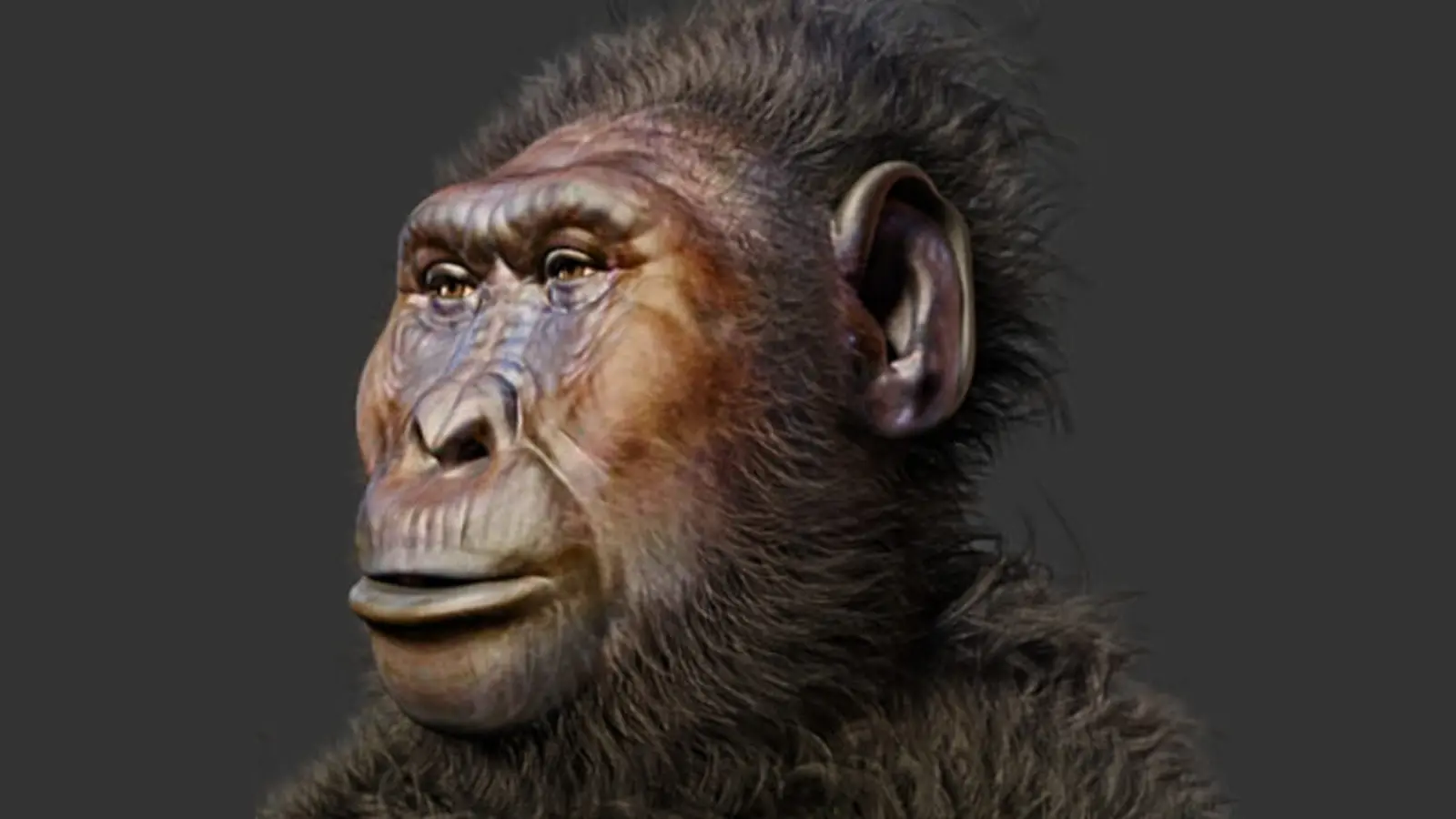
New fossils from Kenya are reshaping how scientists picture Paranthropus boisei — a 1.5-million-year-old hominin once dismissed as an evolutionary side act. The hand and foot bones, recovered at Koobi Fora on Lake Turkana’s eastern shore, show a surprising mix: fingers that resemble gorillas and feet that walk like humans. Together they rewrite assumptions about how this species moved, foraged and survived in ancient East Africa.
Rare, complete hand bones change the story
Scientists publishing in Nature describe the first unequivocal Paranthropus hand bones in the fossil record — a relatively complete set for this period. Until now, Paranthropus was known mainly from jaws and massive teeth, first identified by Mary and Louis Leakey at Olduvai Gorge in 1959 and nicknamed the "Nutcracker Man" for its huge chewing apparatus. Those teeth suggested a diet heavy in tough vegetation. The new discovery lets researchers link that signature skull anatomy to the limbs and hands that would have supported the animal’s daily life.
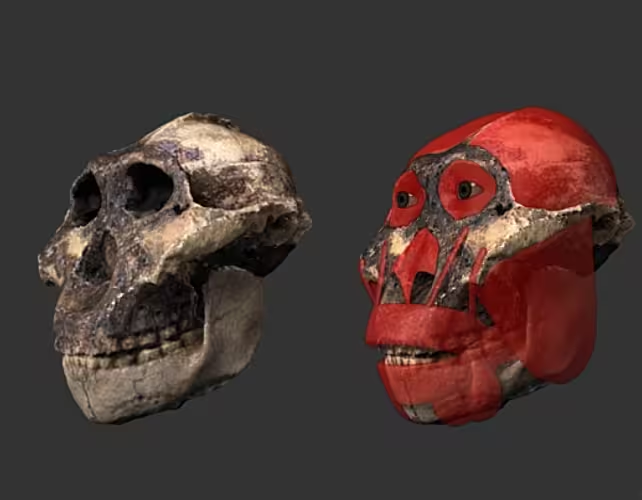
Paranthropus boisei skull and muscle reconstruction. (Cicero Moraes/Wikimedia commons/CC-BY-SA 4.0)
Strikingly, the hand bones present a paradox: they combine traits we associate with both humans and large apes. Finger proportions, robust phalanges and joint surfaces appear more gorilla-like — indicating a powerful grip. Yet the foot bones tell a different tale, showing clear adaptations for efficient bipedal walking, including an arched, rigid foot and an aligned big toe that would permit effective push-off.
A foot built for walking, hands built for power
Detailed analysis of the foot bones reveals features long considered hallmarks of modern human locomotion. The third metatarsal is twisted to help form a transverse arch; dorsal canting at the big-toe joint indicates a capacity to push off during strides; and an arched, relatively inflexible midfoot suggests energy-efficient walking. These traits show that by about 1.5 million years ago, Paranthropus could traverse open landscapes with a gait comparable to early Homo.
At the same time, the toes were not identical to ours. The big toe was shorter, and the smaller toes were straighter and stiffer than both ape and modern human feet, hinting at a slightly different walking mechanics — perhaps a heavier, steadier stride rather than the light, springy step of Homo sapiens. The hands, meanwhile, retained strong, curved finger bones and robust muscle attachment sites consistent with forceful grasping and manipulation without the delicate precision associated with Homo tool-use.
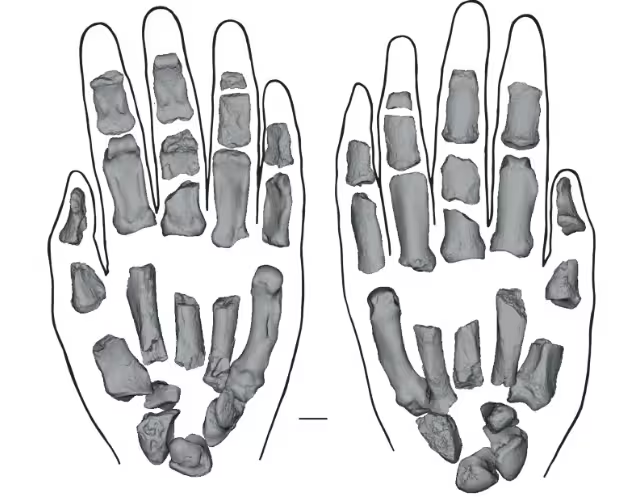
Palm (left) and back (right) views of Paranthropus hand bones. (Mongle, Nature, 2025)
What this tells us about behavior and ecology
These fossils complicate the simple narrative that Homo’s rise came from superior locomotion alone. Bipedalism — walking on two legs — was already a shared foundation across several hominin lineages. The difference between Homo and Paranthropus appears more behavioral than biomechanical: while Homo invested in larger brains, social cooperation and increasingly sophisticated tool use, Paranthropus evolved toward chewing power and robust grips. That suggests Paranthropus was well-adapted to its niche for over a million years, moving across mixed habitats, exploiting tough plant foods and using powerful hands for foraging tasks.
Scientists had long debated whether Paranthropus retained climbing specializations. The gorilla-like fingers could support occasional tree use — pulling or stabilizing the body — but there is no evidence this species was an arboreal specialist. Instead, the mosaic anatomy points to a versatile lifestyle: a confident biped on the ground that nevertheless maintained strong hands useful for gathering, processing, or carrying items.
Scientific background: Paranthropus and the hominin bush
Paranthropus first entered the fossil record in South Africa in 1938 when Robert Broom described what became Paranthropus robustus. P. boisei, the East African species, stood out because of its hypertrophied jaw and cheek teeth — adaptations that led researchers to conclude it ate highly fibrous plant material. For decades, comparisons between Paranthropus and Homo focused on cranial differences: brain size, tooth size, and dietary inference. Limb and hand anatomy were less well-known, making this Koobi Fora discovery especially valuable.
By placing robust jaws, hands and feet together in one individual or closely associated set, researchers can test long-standing assumptions about locomotion, foraging strategies and niche partitioning among contemporaneous hominins. The results emphasize evolutionary experiments: different lineages walking upright but diverging in how they used brains, bodies and environments to survive.
Implications for human evolution and future research
The Koobi Fora specimens encourage a reframing of Paranthropus not as a failed offshoot but as a long-lived specialist. This has implications for how paleoanthropologists model competition with early Homo, dietary reconstructions using microwear and isotopes, and functional studies of hand and foot anatomy. Future work will test whether these traits are typical across more Paranthropus individuals and whether regional or temporal variation reflects ecological change.
Expert Insight
Dr. Amina Okoye, a paleoanthropologist not involved in the study, comments: "What makes these fossils powerful is the link between skull and limb anatomy. We can finally stop guessing how Paranthropus might have moved or handled food. Its body tells a consistent story: a species built for strength, able to walk efficiently across the landscape but still equipped with hands for forceful manipulation."
Lead authors of the Nature paper note that such discoveries depend on exceptional preservation and careful stratigraphic work at sites like Koobi Fora. As excavation continues, researchers expect more partial skeletons that will refine our understanding of the varied ways early hominins adapted to a changing Pleistocene Africa.
Ultimately, the new fossils deepen a central message of paleoanthropology: human evolution was not a single ladder of progress but a branching bush of successful experiments. Paranthropus boisei walked upright beneath the same African sun as early Homo — but it chose a different path: endurance and chewing muscle over cunning and toolkit complexity. Both strategies worked for a time; only one lineage led to us.

“My work centers on sustainability, energy, and environmental science — examining how innovation can lead to a greener future.”

Discussion
Leave a Comment