
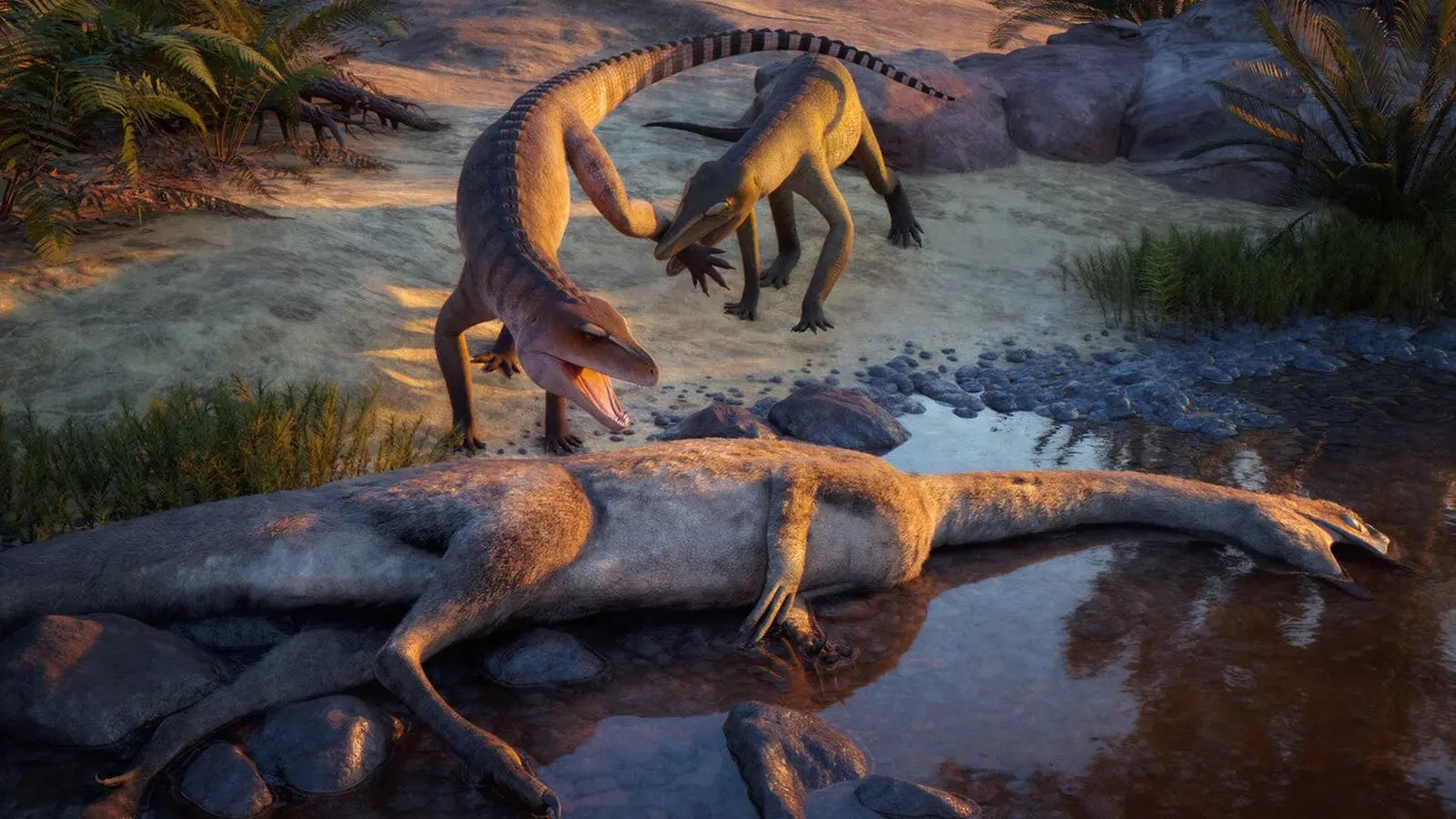
They might have been looking at one another when a sudden rush of mud ended both lives. Fossils like this are moments frozen, not just bones. At Ghost Ranch in northern New Mexico, two jackal-sized cousins of modern crocodiles were preserved side by side nearly 210 million years ago. One was long-snouted and gracile. The other, now identified as a new species, had a shorter snout and a more robust bite.
A frozen instant and what it tells us
The specimen that finally unmasked the newcomer had sat in museum collections for decades. Excavated in 1948 and later housed at Yale’s Peabody Museum of Natural History, the block looked at first like a double example of a known animal, Hesperosuchus agilis. Careful study changed that view. The short-snouted individual shows a distinct skull shape and muscle attachments implying a different feeding strategy. Where one animal appears built for speed and pursuit, the newly recognized species seems adapted to stronger bites and broader prey choices.
Why does this matter? Because the late Triassic was a competitive time. Two major reptile lineages were experimenting with body plans and lifestyles that would diverge for hundreds of millions of years. Small, bipedal early dinosaurs prowled one ecological track while proto-crocodilians explored a different set. Discoveries like this reveal that the path to modern crocodiles was not a single straight road but a branching story of functional innovation.

Photographs and anatomical drawings of the skull of Eosphorosuchus lacrimosa, viewed from the right/bottom (a, c) and the top/left (b, d).
How bone and technology expose a hidden species
The detective work combined classical paleontology with modern imaging. A Yale graduate student ran a computed tomography scan that peeled back layers of rock and matrix without damaging the fossil. The CT data allowed the team to separate and examine skull bones in three dimensions, revealing subtle shapes and joints that are hard to read on a surface-exposed specimen.
Those anatomical details mattered. The new animal, named Eosphorosuchus lacrimosa, shows a shorter rostrum, a bulkier skull and larger jaw-muscle attachments than Hesperosuchus. That configuration points to a lifestyle that may have included tougher or larger prey and different feeding mechanics. In short: two similar-sized, closely related predators were partitioning resources in the same environment rather than competing for exactly the same food.

Left hindlimb of Eosphorosuchus lacrimosa: pelvis (a), leg bones (b), ankle (c), and foot (d).
Ghost Ranch itself is special. The site preserves a dense assemblage of Triassic life—early crocodile relatives, lizard-like reptiles, fish and the small carnivorous dinosaur Coelophysis. Taphonomic conditions at the bone bed preserved entire slices of the ecosystem, so researchers can reconstruct not just individual species but how they might have interacted. Here, two different proto-croc forms died together, probably in a single catastrophic event such as a flash flood or mudslide. The scene gives paleontologists a rare snapshot: coexisting species, side by side, each already pursuing its own ecological niche.
The discovery also highlights the scientific value of museum collections. Specimens excavated decades ago still hold surprises when revisited with new techniques. CT scanning, digital modeling and renewed anatomical comparisons are tools that continue to reshape our understanding of early archosaur evolution.
Expert Insight
"This fossil is a window into the experiments evolution was running at the dawn of the Age of Reptiles," says Dr. Elena Ramirez, a paleontologist who studies vertebrate ecomorphology. "Finding two closely related predators with different skull builds in the same deposit tells us that early crocodile relatives were already diversifying ecologically. It pushes back the timing for when functional specialization became important in this lineage."
Such insights have broader implications. They inform models of predator-prey dynamics in ancient ecosystems, refine phylogenetic trees that map relationships among archosaurs, and guide fieldwork by indicating what kinds of fossils and deposit types are likely to preserve comparable snapshots. They also remind us that paleontology is as much about storytelling as it is about anatomy: every specimen adds a paragraph to an ancient narrative.
Conclusion
Eosphorosuchus lacrimosa is more than a name added to a catalog. It changes how scientists see early crocodilian relatives, showing that functional diversity emerged early and that even small predators occupied distinct niches. The find underlines two practical lessons for the field: first, that many discoveries remain hidden in existing collections; second, that combining fieldwork with modern imaging produces a clearer, richer picture of deep time. In the end, a block of rock and bone from Ghost Ranch taught us a new chapter about how crocodile ancestors experimented and split into the many forms that followed.

“The cosmos has always fascinated me. I write about space missions, astronomy, and the technologies pushing humanity beyond Earth.”

Discussion
Leave a Comment