
On some of the hottest known planets, the atmosphere seems to be fighting an invisible hand. Winds that should scream across these worlds instead appear to be tempered, as if some cosmic brake is holding back the storm.
When hotter does not mean faster
Hot Jupiters are the extreme athletes of planetary systems. They circle their stars at blistering distances, sometimes completing an orbit in less than a day, and many are locked so one face bakes in perpetual daylight while the other freezes in endless night. That temperature contrast should drive ferocious winds. The hotter the planet, the more energy available to accelerate atmospheric flows, and the faster those winds should blow.
Yet a team led by Julia Seidel at Côte d'Azur Observatory has found a puzzling pattern: across seven hot Jupiters, peak wind speeds decline as equilibrium temperature rises. The result, published in Nature Astronomy, flips the simple expectation on its head. Instead of hotter planets hosting more violent winds, some of the hottest worlds register the most sluggish flows.

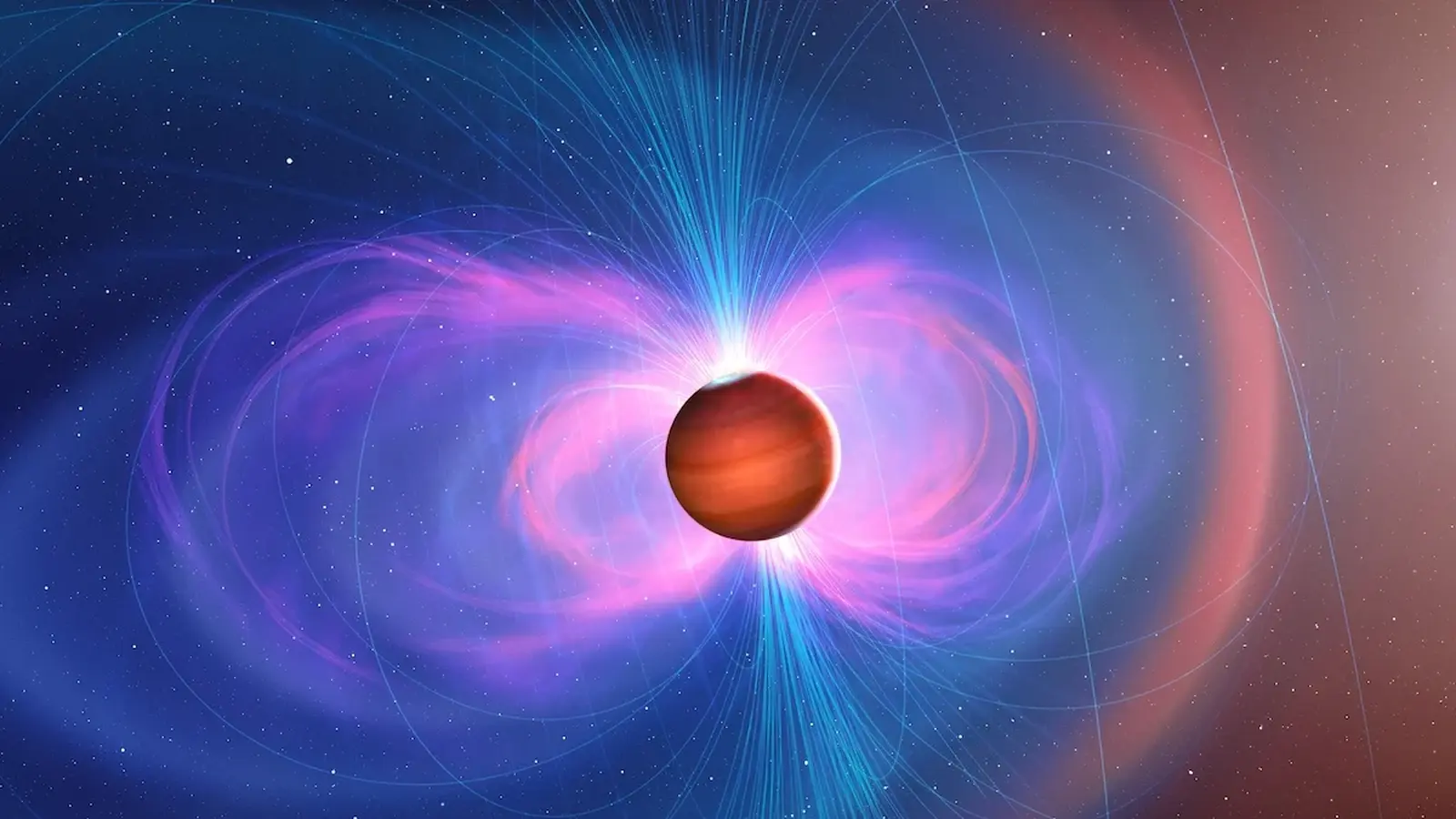
An artist's impression of a hot Jupiter.
The group used high-resolution spectrographs, MAROON-X on Gemini North and ESPRESSO on ESO's Very Large Telescope, to trace spectral signatures of vaporized metals, notably iron. Those spectral lines shift when winds push gas toward or away from us. The measured Doppler shifts reveal wind speeds that are still extraordinary by Solar System standards, between about 2 and 7 kilometers per second. To put that into context, Jupiter's fastest winds top out near 0.4 kilometers per second. But the critical pattern here is not the absolute speed; it is the inverse relation between temperature and wind velocity.
Magnetic braking as the leading explanation
Why would hotter planets have slower winds? The authors argue the likeliest culprit is magnetism. At the temperatures seen in hot Jupiters, atmospheric gases become partially ionized. Moving, ionized gas interacts with a planetary magnetic field and experiences a Lorentz force that can act like a brake on flows. Where the ionization fraction climbs with temperature, magnetic drag should grow stronger. That produces the counterintuitive trend the team observed.
The analysis also allowed the researchers to estimate field strengths. The inferred values are modest a few gauss, similar in order to Jupiter's global field. Because the method is indirect, the team stresses that follow-up measurements are needed, but if the pattern holds, the wind slowdown may be the clearest evidence yet for active magnetic fields on exoplanets.

An artist's impression of a hot Jupiter orbiting its star.
There are alternative explanations for reduced winds, including changes in atmospheric composition, radiative cooling, or complex three-dimensional circulation effects. However, those mechanisms would generally predict faster winds as temperature increases, not slower ones. That mismatch strengthens the magnetic hypothesis. As Vivien Parmentier of Côte d'Azur Observatory observed, the observations are counterintuitive, because hotter atmospheres should have more energy to power winds. The simplest reconciliation is an additional force increasing with temperature, one consistent with magnetic drag.
If confirmed, these slowed winds would be the clearest indirect sign of magnetic activity on planets beyond our Solar System.
Scientific context and wider implications
Detecting exoplanetary magnetic fields directly is extremely difficult with current technology. Radio emissions from magnetospheres are faint and rare. Using atmospheric dynamics as a proxy opens a new observational window. Magnetic fields play several critical roles: they shield atmospheres from stellar particles, influence atmospheric escape, and shape the structure of upper atmospheres where ionization matters. For planets that sit close to active stars, a protective magnetosphere could mean the difference between retaining a thick atmosphere and evaporating into a barren core.
The result also speaks to comparative exoplanetology. Studies have moved from characterizing single planets to looking for trends across populations. Finding a systematic link between temperature, wind speeds, and inferred magnetic fields is a step toward understanding how planetary magnetic environments vary with mass, rotation, composition, and stellar environment.
Expert Insight
Dr. Lena Ortiz, an atmospheric physicist at the European Planetary Institute who was not involved in the study, commented: "Using wind measurements as a proxy for magnetism is clever because it leverages the physics we can observe now. The caveat is complexity; many factors shape atmospheric motion. But this work gives a testable prediction. New observations, especially targeting planets spanning a wide temperature range, will either reinforce the magnetic interpretation or force us to refine our models."
What comes next
Confirming magnetic braking will require more data. Repeating wind measurements for a larger sample of hot Jupiters, and coupling those data to magneto-hydrodynamic models, can tighten constraints on field strength and geometry. Complementary approaches, such as searching for low-frequency radio signatures from star-planet interactions or looking for auroral emissions in infrared and visible bands, could provide independent confirmation.
The possibility of auroras on tidally locked hot Jupiters captures the imagination. As Bibiana Prinoth of ESO noted in response to the new findings, one can picture skies where charged particles guided by magnetic fields light up upper atmospheres into curtains of color, on a world half in day and half in night. That image underscores the deeper point: magnetic fields shape planetary environments in ways that go beyond abstract numbers, influencing whether an atmosphere survives and how it behaves.
Conclusion
The discovery that hotter hot Jupiters may host slower winds reframes how astronomers probe distant worlds. If magnetic fields are indeed braking atmospheric flow, we gain a valuable, if indirect, method to map magnetism beyond the Solar System. The next decade of observations will tell whether these tentative signatures hold up, and whether magnetism proves to be a common, influential property of exoplanetary systems.

“The cosmos has always fascinated me. I write about space missions, astronomy, and the technologies pushing humanity beyond Earth.”

Discussion
Leave a Comment