
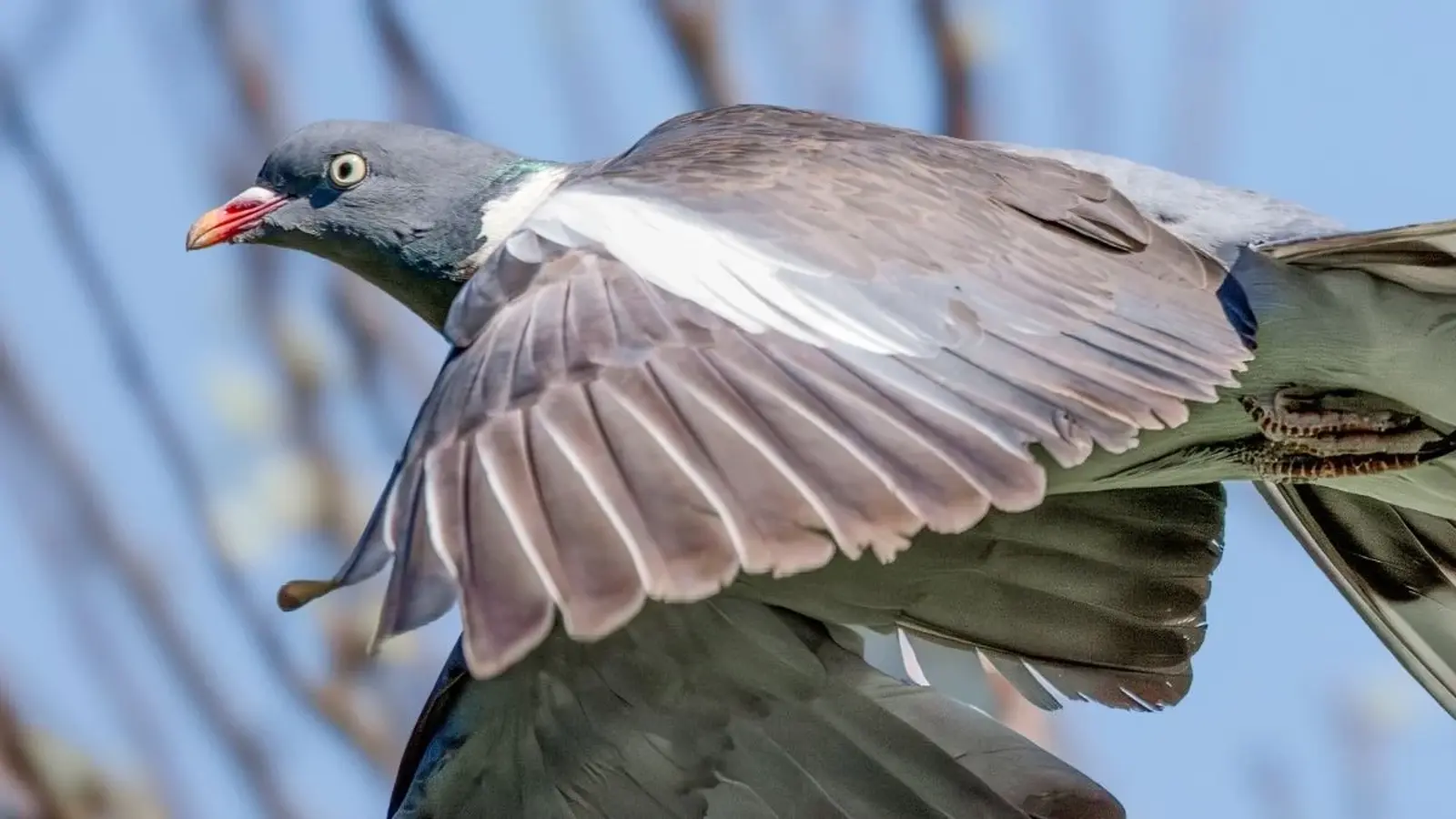
A pigeon lifts off from a rooftop and traces a steady arc toward the skyline, unfazed by clouds that blot out the Sun. How does a bird with no map and no GPS find its way across tens or hundreds of kilometres? Scientists may finally be closing in on an answer that upends assumptions about navigation in animals.
Homing pigeons carried human messages for millennia. They appear in Egyptian art as early as 1350 BCE, and until the telegram arrived they were among our most reliable long-distance messengers, delivering everything from business contracts to battlefield reports. Their knack for returning to a loft is legendary, yet the internal machinery that lets them orient so precisely has remained mysterious.

Swiss Army soldiers dispatch a message by carrier pigeon during World War I.
A surprising organ takes center stage
Researchers at the University of Bonn and the Max Planck Institute of Animal Behavior report evidence that the homing ability of pigeons may depend on a magnetically sensitive system tucked inside the liver. That system hinges on iron-rich immune cells called macrophages. These cells, the team proposes, behave like microscopic compass needles.
"What looks like a 'gut feeling' in bird navigation may actually have a physical basis," says Martin Wikelski, director at MPI-AB and a senior author on the paper. Immunologist Clivia Lisowski adds that the liver and spleen store iron because they process and break down red blood cells, making them logical places to search for magnetic properties.
The liver notion is counterintuitive. For decades, magnetoreception research focused on sensors in the beak, the inner ear, or in specialized photoreceptors in the eye. The idea that immune cells in the liver could carry magnetic information to the brain changes the playing field.
Microscopic wiring and quantum behaviour
Under the electron microscope the team found hepatic macrophages in close contact with nerve fibres. Those physical connections provide a plausible route for magnetic information to travel from liver tissue to the central nervous system. More striking is the magnetic behaviour of these cells. The macrophages contain iron particles that display superparamagnetism, a quantum property where tiny magnetic domains align with an external field but do not retain permanent magnetization when the field is removed.

An electron microscopy image of pigeon liver tissue shows a hepatic macrophage (blue) in contact with a nerve fiber (yellow), which enables them to transmit "magnetic" information to the pigeon brain.
Superparamagnetism is not a household term. In practical terms it means these iron-rich structures can respond to the Earth's magnetic field like compass needles do, without becoming permanently magnetised and without requiring large-scale ferromagnetic material. That makes them well suited to biological systems that need sensitivity and reversibility.
Testing the compass in the sky
Lab observations only go so far. The researchers designed a field test to see whether disrupting liver macrophages would impair homing. They released 34 homing pigeons 19 kilometres from their home loft at MPIAB. Eighteen birds received a dose of clodronate the day before release. Clodronate depletes macrophages, effectively severing the proposed magnetic sensor from its neural wiring.
Pigeons that were untreated returned within about 70 minutes. The clodronate-treated birds did not. Under sustained overcast conditions none of the treated birds made it home the same day, and their flight patterns showed random orientation. Crucially, when skies cleared the treated birds regained normal homing ability. On a clear day, pigeons treated with clodronate navigated as well as untreated birds, suggesting the liver-based system is especially important when solar cues are unavailable.
The experiment is elegant in its simplicity. Remove the putative sensor, hide the Sun, and watch whether navigation collapses. The pattern the team observed supports a model in which pigeons use multiple cues: visual landmarks and celestial cues when available, and an internal magnetic readout when they are not.
Broader implications and open questions
If immune cells can act as magnetic sensors in pigeons, might similar mechanisms operate in other species? The paper points to a long list of animals that navigate without obvious visual maps: migratory birds on nocturnal legs of their journeys, sharks that traverse featureless oceans, bats and mole rats navigating in the dark. Each would benefit from a compact, low-energy, robust magnetoreceptive device.
Several puzzles remain. How do macrophage signals integrate with other sensory information in the bird brain? What developmental and genetic programs produce these iron-rich structures? And how universal is this mechanism across avian species or across vertebrates?
Expert Insight
"The paper forces us to widen our view of where sensing can occur in an animal," says Dr Jessica Ramirez, neuroecologist at the Institute for Comparative Cognition. "We tend to look for sensors in traditional sensory organs. Finding a magnetic element in the immune system suggests nature uses every available tissue to solve hard problems like navigation."
Conclusion
This discovery does not close the book on magnetoreception. It opens a new chapter that links immunology, neurobiology and quantum physics in a living animal. The idea that hepatic macrophages with superparamagnetic iron can transmit directional information to the brain reshapes how scientists will approach animal navigation. Future studies will need to map the neural circuitry, identify molecular markers that specify magnetic cells, and test whether similar systems appear in other navigators of land, sea and sky. For now, the homing pigeon keeps its secrets, but one of them has moved from folklore into the laboratory.

“My work centers on sustainability, energy, and environmental science — examining how innovation can lead to a greener future.”

Discussion
Leave a Comment