
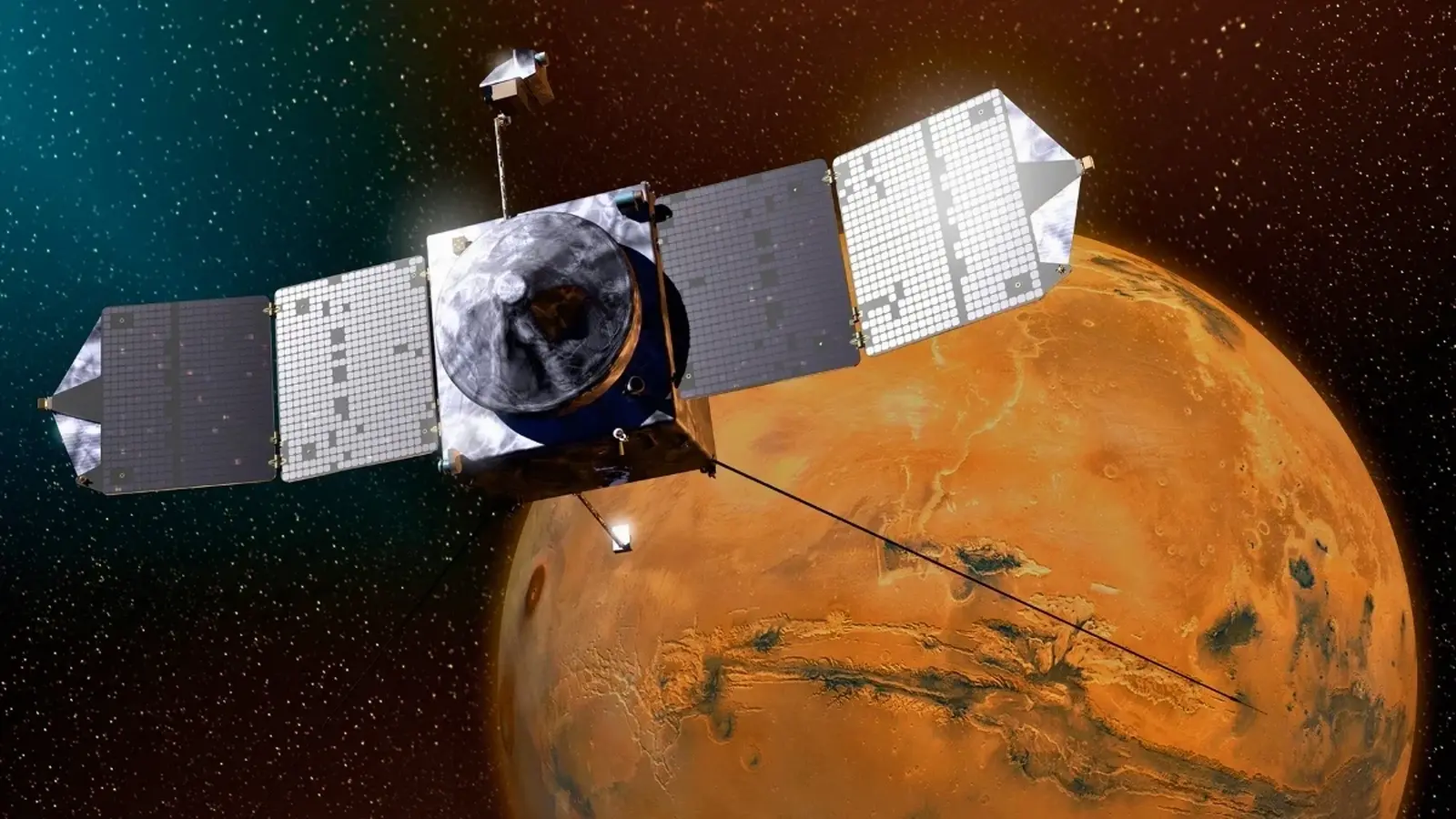
Silence stretched for six months before NASA reached a reluctant verdict: MAVEN, the longtime sentinel of the Martian atmosphere, will not return to life.
When the signal stopped
Launched in 2013, MAVEN arrived at Mars to answer a central question about the planet: how did Mars lose most of its atmosphere and, with it, the conditions that might once have supported water and habitability? Over more than a decade the orbiter watched the upper atmosphere, tracked solar storms, and measured how charged particles escape into space.
It went quiet in early December after slipping behind Mars on a routine pass. Telemetry later showed the spacecraft entered a rapid spin. That uncontrolled rotation altered its orbit and drained the batteries, leaving the orbiter unable to point its antenna or recover normal operations.
"The team really did experience the loss of a loved one with the end of the mission here," said NASA project manager Mike Moreau, describing the mix of grief and pride felt by engineers and scientists who kept MAVEN working long beyond its expected lifetime.
A review board convened by NASA concluded this spring that MAVEN is irrecoverable. Engineers expect the spacecraft to remain in Mars orbit for decades — estimates center on 50 to 100 years — before atmospheric drag causes reentry or impact, and officials say it poses no immediate hazard to other Mars assets.
Science left behind

Images showing the sudden appearance of a bright aurora on Mars during a solar storm in September 2017, using data from observations by the Imaging Ultraviolet Spectrograph instrument on MAVEN.
MAVEN did more than collect numbers. It captured dramatic aurorae produced by solar storms, helped document lightning-related phenomena, and even observed a passing interstellar comet. Its instruments, including the Imaging Ultraviolet Spectrograph, revealed how solar activity strips atoms from the upper atmosphere — a process tied directly to Mars’ long-term climate change.
Beyond headline discoveries, MAVEN served as a communications relay for surface missions, passing data between orbit and rovers such as Curiosity and Perseverance. NASA says four other orbiters, two American and two European, will cover essential relay duties so no rover science is lost.
"The team is certainly broken up about this," said Shannon Curry, MAVEN's lead scientist at the University of Colorado Boulder. "But we are incredibly proud of the science we've accomplished over the last decade."

Photos of Mars taken by MAVEN.
What comes next
Investigations continue to pin down the precise failure sequence. Meanwhile, the scientific legacy is clear: MAVEN transformed our view of Mars’ upper atmosphere and provided context for how planets lose air to space. Those lessons will inform future missions that study planetary atmospheres and the long-term habitability of worlds beyond Earth.

“The cosmos has always fascinated me. I write about space missions, astronomy, and the technologies pushing humanity beyond Earth.”

Discussion
Leave a Comment