
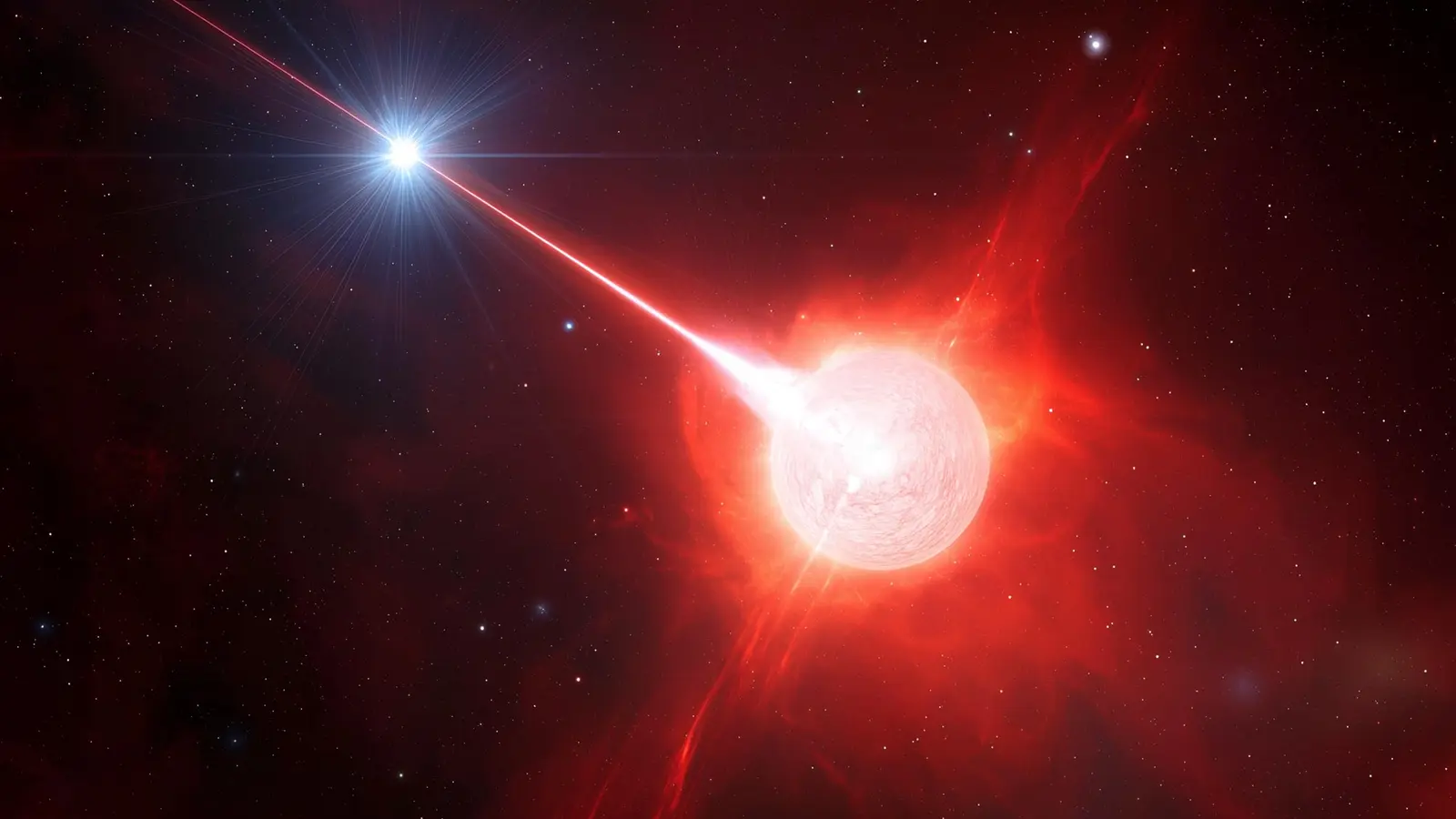
A star caught stealing. Not a scene from science fiction, but the precise image astronomers now use to describe a compact white dwarf siphoning gas from a nearby companion. That theft, it turns out, is the source of a class of repeating radio signals that has baffled observers for years.
When a pattern finally yields its origin
ASKAP J1745−5051 is an unassuming listing in a catalog. Yet it behaves like a cosmic metronome, flashing radio waves and X-rays on a strict 1.4 hour cycle. An international team led by researchers at the University of Sydney used the Australian Square Kilometre Array Pathfinder, ASKAP, to pin down what is happening. The culprit is a cataclysmic variable, a tight binary where a white dwarf pulls material from a red dwarf companion, heating the inflow and producing focused bursts of emission.

Accreting white dwarf illustration.
The discovery appears in Nature Astronomy and provides the strongest evidence yet connecting long-period radio transients to accreting white dwarfs. Until now, these slow, repeating radio events were rare sightings across the Milky Way and their origin was hotly debated. Were they odd pulsars, or something else entirely? ASKAP J1745−5051 supplies an answer for at least some of them.
Inside a tight, violent duet
White dwarfs are dense. Imagine a body roughly the size of Earth packed with nearly the mass of the Sun. Here, gravity wins. In ASKAP J1745−5051, that gravity tears gas from a bloated red dwarf. The stolen matter forms a stream that plunges toward the white dwarf, and in the process becomes superheated, generating X-rays.
But heating alone does not explain the precise radio pulses. The team argues that magnetic interactions play the decisive role. The two stars each carry magnetic fields, and where those fields meet the charged inflow, they can trap, accelerate, and channel electrons. The result is a beamed radio emission, focused in narrow directions and visible as repeating bursts when the beam sweeps past Earth. Crucially, the radio and X-ray peaks do not line up, indicating the emissions originate from distinct regions of the system.

CSIRO ’s ASKAP radio telescope on Wajarri Yamaji Country.
The orbital period, slightly more than an hour, imposes the rhythm. Every orbit reconfigures the geometry of the accretion stream and the field lines, producing the observed cadence. This geometry makes ASKAP J1745−5051 an excellent laboratory for studying how matter behaves under intense magnetic forces and strong gravity.
Why this matters for transient astronomy
Long-period radio transients have been a puzzle because their slow periodicity did not match expectations for ordinary pulsars, which typically spin much faster. The new data show that at least some of these transients are not neutron stars at all, but white dwarf binaries showing accretion-driven radio activity.
Professor Murphy, Head of School at the University of Sydney School of Physics and Chief Investigator at the ARC Centre of Excellence for Gravitational Wave Discovery, noted that similar systems had been suspected before, but this is the first where both stellar components and the accretion process are clearly observed. The system is only the second long-period radio transient known to produce regular X-rays, and the first in which researchers have confirmed the repeating mechanism.
Lead author Kovi Rose, a PhD student at the University of Sydney and CSIRO, summarized the result simply: "For the first time we have pinpointed the origin of these signals, confirming the source to be a cataclysmic variable, or an accreting white dwarf star." That identification gives astronomers a template, a Rosetta stone, for interpreting other rare radio transients across the galaxy.
ASKAP: wide coverage, unusual finds
Detecting objects like ASKAP J1745−5051 requires a telescope that can scan broadly and sensitively. ASKAP, operated by CSIRO from its site in Western Australia, combines wide-field imaging with good angular resolution, making it ideal for spotting transient events that might otherwise be missed. The instrument’s design lets teams spot repeating signals, tie them to sky positions, and follow up with X-ray and optical observatories.
The ASKAP radio telescope at Inyarrimanha Ilgari Bundara, the CSIRO Murchison Radio-astronomy Observatory on Wajarri Yamaji Country in Western Australia. Credit: Alex Cherney/CSIRO
With ASKAP and coordinated multiwavelength campaigns, astronomers can now ask better questions. How many long-period radio transients are accreting white dwarfs? Are there different subclasses, perhaps distinguished by magnetic field strength or mass-transfer rate? Each discovery helps define a population and refine models of magnetically driven emission.
Future observations and experiments
The team plans extended monitoring in radio, optical, and X-ray bands. Long-term datasets will reveal whether the emission pattern evolves, whether the accretion flow is steady or sporadic, and how magnetic topology changes across orbits. These measurements also improve estimates of system parameters, such as the white dwarf mass, the inclination of the orbit, and the magnetic field geometry.
There are experimental opportunities too. High-cadence optical photometry can test whether the accretion stream forms a full disk or a direct-impact flow. Sensitive X-ray spectroscopy will probe temperatures and densities near the accretion hotspot. Radio polarimetry can identify the magnetic processes at play by measuring the polarization properties of each burst.
Expert Insight
"This is a classic case of nature teaching us by counterexample," said Dr. Elena Martinez, an astrophysicist who studies compact binaries. “White dwarfs are often dismissed as less dramatic than neutron stars, but here they produce organized, pulsed radio emission that mimics some pulsar behaviors. By studying systems like ASKAP J1745−5051 we learn how magnetic fields sculpt accretion flows and create conditions for coherent radio emission.”
Conclusion
Finding a white dwarf that both devours a companion and broadcasts that activity in radio and X-rays is more than a tidy solution to a puzzle. It opens a new window on compact binaries, on the physics of magnetized plasmas, and on the diversity of transient radio sources in our galaxy. ASKAP J1745−5051 will serve as a benchmark. Observatories tuned to radio, X-ray, and optical wavelengths can now search with a sharper hypothesis: some mysterious, slow radio transients are not lone exotic pulsars, but intimate duets of stars, bound tightly and brilliant in their violence.
"Each discovery is another piece in a larger puzzle," Rose said. "We are only beginning to understand this new class of cosmic events."
The identification of ASKAP J1745−5051 underscores how coordinated surveys and targeted follow-up can turn odd detections into full-fledged astrophysical narratives. Expect more revelations as ASKAP and other facilities continue to scan the skies.

The ASKAP radio telescope at Inyarrimanha Ilgari Bundara, the CSIRO Murchison Radio-astronomy Observatory on Wajarri Yamaji Country in Western Australia.

“My work centers on sustainability, energy, and environmental science — examining how innovation can lead to a greener future.”

Discussion
Leave a Comment