
Under a clear Hawaiian sky the Keck Observatory trains some of the planet's most powerful eyes on worlds that are not our own. Tiny Doppler shifts hide inside their light. Those shifts carry a simple, stubborn secret: how fast a planet rotates.
The recent Keck study looked at dozens of gas giants and brown dwarf companions to test a question planetary scientists have debated for decades. Do heavier worlds always spin faster? Or does the physics of their birth sometimes slow them down? The answer, it turns out, is not obvious. The data point in one surprising direction: some giant planets spin more rapidly than more massive brown dwarfs once you control for size, mass, and age.
Reading rotation from a single spectral line
Rotation leaves a fingerprint. When a planet turns, light from the part of the atmosphere moving toward us is slightly blueshifted and light from the receding limb is redshifted. The combined effect broadens absorption lines in the planet's spectrum. Detecting such subtle broadening in faint, distant planets requires instruments with both high spectral resolution and the ability to separate the planet's light from the star's glare.
That is exactly what the Keck Planet Imager and Characterizer, or KPIC, does. It isolates planetary light and records the steep, narrow features produced in molecular absorption bands. From those features researchers infer rotation speeds, usually expressed as a projected equatorial velocity. The recent observational campaign used KPIC to measure rotation for a curated set of companions orbiting tens to hundreds of astronomical units from their stars. The sample included young gas giants and brown dwarfs at wide separations, objects that are crucial for testing formation theories.
Not just mass: magnetic braking and the spin story
At first glance you might expect a straightforward scaling: more mass, more angular momentum, faster spin. Nature refuses to be that tidy. The Keck measurements show that when age and radius are accounted for, some gas giants end up spinning faster than brown dwarfs that are substantially more massive. Why? The team points to magnetic interactions early in a world’s life.
Imagine a young, forming planet surrounded by a circumplanetary disk. If that body has a strong magnetic field, it can couple to the disk and transfer angular momentum away from the planet. The effect, sometimes called magnetic braking, can slow a massive object more efficiently than a lower-mass planet with a weaker field. The HR 8799 system provides a stark example: a roughly seven-Jupiter-mass gas giant rotates about six times faster than a 24-Jupiter-mass brown dwarf companion in the same system. Same neighborhood. Very different spins.
That observation suggests a lifecycle in which initial mass, magnetic field strength, and disk interactions conspire to set a planet's final rotation. The result echoes across scales. In our solar system Jupiter and Saturn are fast rotators and carry a large fraction of the system's rotational energy. But extrapolating that fact to other systems without measuring spin directly risks missing the role of magnetic and disk physics.
Methodology and sample
The research combined new KPIC measurements with previously published rotation data to assemble a larger comparative set. In total the curated sample spans dozens of companions and free-floating substellar objects, covering a wide range of masses and evolutionary stages. That breadth matters: correlations only emerge when you compare like with like.
- Direct KPIC observations targeted several gas giants and multiple brown dwarf companions at wide separations.
- Data reduction focused on extracting rotational broadening from molecular absorption lines.
- Results were analyzed after correcting for differences in radius and age to make fair comparisons.
These steps reduce bias. They also let researchers ask sharper questions: is planetary spin governed primarily by initial conditions in the birth disk, by mass-dependent magnetic torques, or by later-stage dynamical evolution? The evidence points toward a mix, with magnetic braking playing an outsized role for more massive substellar objects.
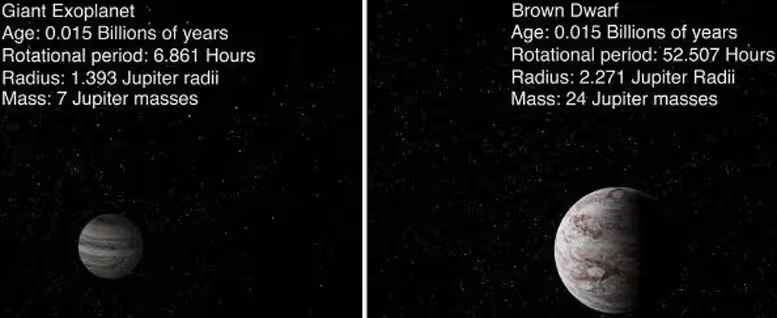
The gas giant exoplanet (left) and a more massive brown dwarf companion (right) in the HR 8799 system.
Future instruments and expanding the census
KPIC opened the door. The next step is to widen the doorway. Keck's planned HISPEC instrument, a high-resolution infrared spectrograph designed for exoplanet characterization, should come online in 2027. HISPEC will increase sensitivity, extend wavelength coverage, and raise spectral resolution. That means two key advances: spin measurements for smaller, cooler planets, and better simultaneous constraints on atmospheric composition.
Why does coupling spin with chemistry matter? Rotation affects atmospheric dynamics, heat redistribution, and cloud formation. Knowing both a planet's spin and its atmospheric makeup makes it possible to reconstruct elements of its formation pathway. Did it form inward and migrate outward? Was it born by gradual accretion in a disk or by a more rapid collapse that resembles star formation? Spin offers a new lever to pry that history loose.
Expert Insight
Dr. Elena Marquez, an astrophysicist who studies planetary formation, comments: "Rotation carries memory. It is a fossil imprint of how a world grew. These Keck results force us to rethink simple mass-to-spin assumptions. Magnetic fields and disk interactions matter in ways we did not fully appreciate. With instruments like HISPEC, we will be able to link rotation to atmospheric fingerprints and build a more complete narrative for how planets assemble."
Jason Wang, a co-author on the study, emphasized that lessons from KPIC are being folded into HISPEC's design, aiming to push spin measurements toward worlds more like our own Jupiter. The plan is to expand the catalogue of measured spins and to include free-floating planets whose isolated histories provide complementary constraints.
Conclusion
Spin is no longer a curiosity. It is a measurable property that encodes formation physics. The Keck campaign revealed a pattern: when you control for size, age, and mass, gas giants can outspin heavier brown dwarfs, likely because magnetic braking slowed the more massive objects during formation. That insight rewrites part of the planetary-formation playbook and points directly to future work. With improved instruments and larger surveys, astronomers will stitch together rotation, composition, and orbital architecture to produce a richer account of how planetary systems arise.

“My work centers on sustainability, energy, and environmental science — examining how innovation can lead to a greener future.”

Discussion
Leave a Comment