
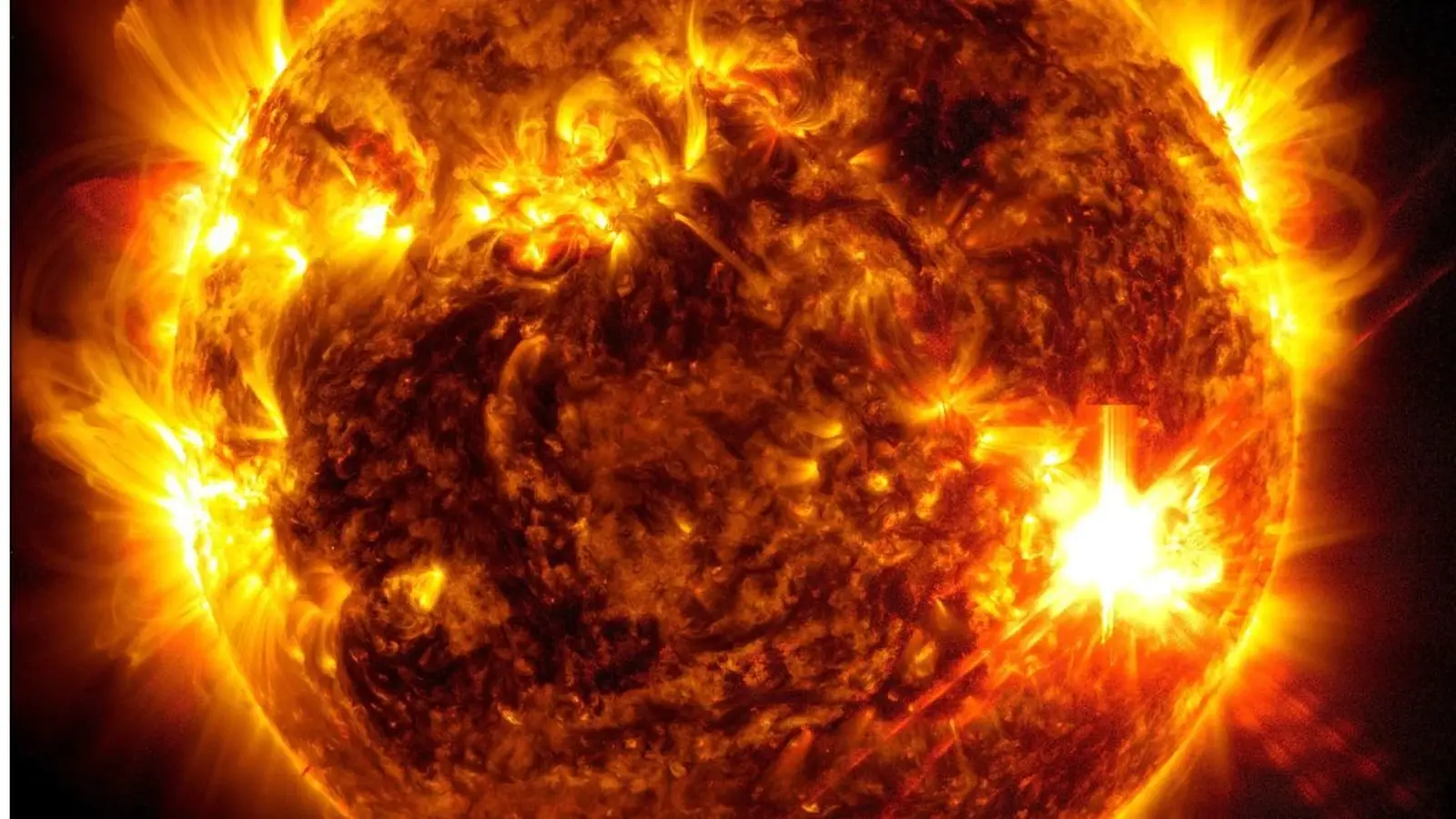
You can listen to the Sun if you stay patient and tune the right instruments. For nearly 40 years, a global network of spectrometers has done just that — measuring tiny ripples in sunlight that reveal the star’s inner motions. What these long records are now showing is not a simple weakening or strengthening of solar activity, but a rearrangement of where magnetic energy lives beneath the photosphere.
Listening to a star: the methods behind the discovery
The technique is called helioseismology. Like seismic waves on Earth, sound waves travel through the Sun and make its surface oscillate. These oscillations come in distinct frequency bands, known as p-mode oscillations, which probe different depths. Low-frequency modes sample deeper layers; high-frequency modes are sensitive to the outer few hundred to a thousand kilometres.
The Birmingham Solar Oscillations Network, or BiSON, has been monitoring these oscillations since the 1970s. With six spectrometers placed around the globe, BiSON keeps almost continuous watch on subtle Doppler shifts in sunlight generated by the Sun's internal sound waves. The team behind the new analysis assembled nearly four decades of Doppler velocity records, spanning solar Cycles 22 through 25, and split the oscillation data into three frequency bands: low, mid and high.
Why divide frequencies? Because waves of different pitches reach and respond to different layers. By comparing those internal signatures with familiar surface proxies — sunspot counts and radio emission measures — researchers can test whether the Sun's interior and exterior behavior remain tightly coupled, or if the relationship is changing.

Shifts revealed: magnetic activity moving closer to the surface
The outcome was surprising. Surface indicators have tended to show a drop in activity through recent cycles — Cycle 24 was notably weak in sunspots and some radiation bands — and some expected Cycle 25 to continue that trend. Yet the high-frequency oscillations, those that sense the shallowest subsurface layers, behaved more like older, more active cycles. In short: the Sun’s outer atmosphere looks quieter while the very near-surface interior appears more energized.

A comparison of the Sun's activity during solar maximum (left, imaged in 2014) and its much tamer solar minimum (right, imaged in 2019).
Researchers interpret this pattern as a confinement of magnetic activity into a thinner shell beneath the visible surface, on the order of 1,000 kilometres (621 miles). That is not a trivial detail. Magnetic fields govern flares and coronal mass ejections, which in turn shape space weather. If magnetic energy is reorganizing into shallower layers, it could alter how and when the Sun releases that energy into the heliosphere.
University of Birmingham astrophysicist Bill Chaplin, who led the study, notes that the trend emerged only because of BiSON’s longevity. Long baselines are essential when you try to separate the ordinary ebb and flow of an 11-year solar cycle from a longer-term structural shift. Yale astronomer Sarbani Basu, a coauthor, adds that the link between internal oscillations and surface activity has evolved across the last few cycles — a relationship that was tighter in earlier decades.
Why this matters for Earth and for theory
Space weather is not abstract. Energetic flares and coronal mass ejections can damage satellites, disrupt GPS and communications, and induce currents in power grids. Forecasting those hazards depends on models that connect magnetic field generation deep inside the Sun with the magnetic structures we observe on the surface and in the corona.
If the Sun is indeed shifting how it stores magnetic energy, models must adapt. A more surface-confined magnetism could change the timing and character of eruptive events. It may also affect the solar dynamo itself — the turbulent process of plasma motion and differential rotation that builds and flips the Sun’s large-scale magnetic field roughly every 11 years.
Practical improvements in forecasting may follow. By linking particular oscillation signatures to later space weather outcomes, we can develop additional early-warning indicators. That said, the current findings are an early chapter, not the final verdict. Continued BiSON monitoring through the remainder of Cycle 25 and into Cycle 26, expected around 2030, will show whether this pattern stabilizes, reverses, or evolves further.
Expert Insight
'Long, consistent records give us leverage we cannot get from snapshots,' says fictional astrophysicist Dr. Elena Ruiz, a solar physicist at a national space agency. 'Think of it like listening to a heartbeat over decades instead of a single clinic visit. Small changes that repeat from one cycle to the next reveal physiological shifts. In the Sun’s case, those shifts point to a reconfiguration of where magnetic energy is stored, which can subtly change both the rhythm and the outbursts.' Her view highlights why patient observation matters for both theory and practical forecasting.
Conclusion
The Sun remains a dynamic, changing star. What once looked like a steady decline in surface activity now appears more complex: exterior quieting coupled with a concentration of magnetic behavior just beneath the surface. BiSON’s nearly 40-year record has provided the first clear evidence of this subtle reorganization. The next decade of observations will tell whether we are witnessing a transient quirk or a new mode of solar behavior — and either outcome will refine our understanding of how stars like our own operate and affect their planetary systems.

“My work centers on sustainability, energy, and environmental science — examining how innovation can lead to a greener future.”

Discussion
Leave a Comment