
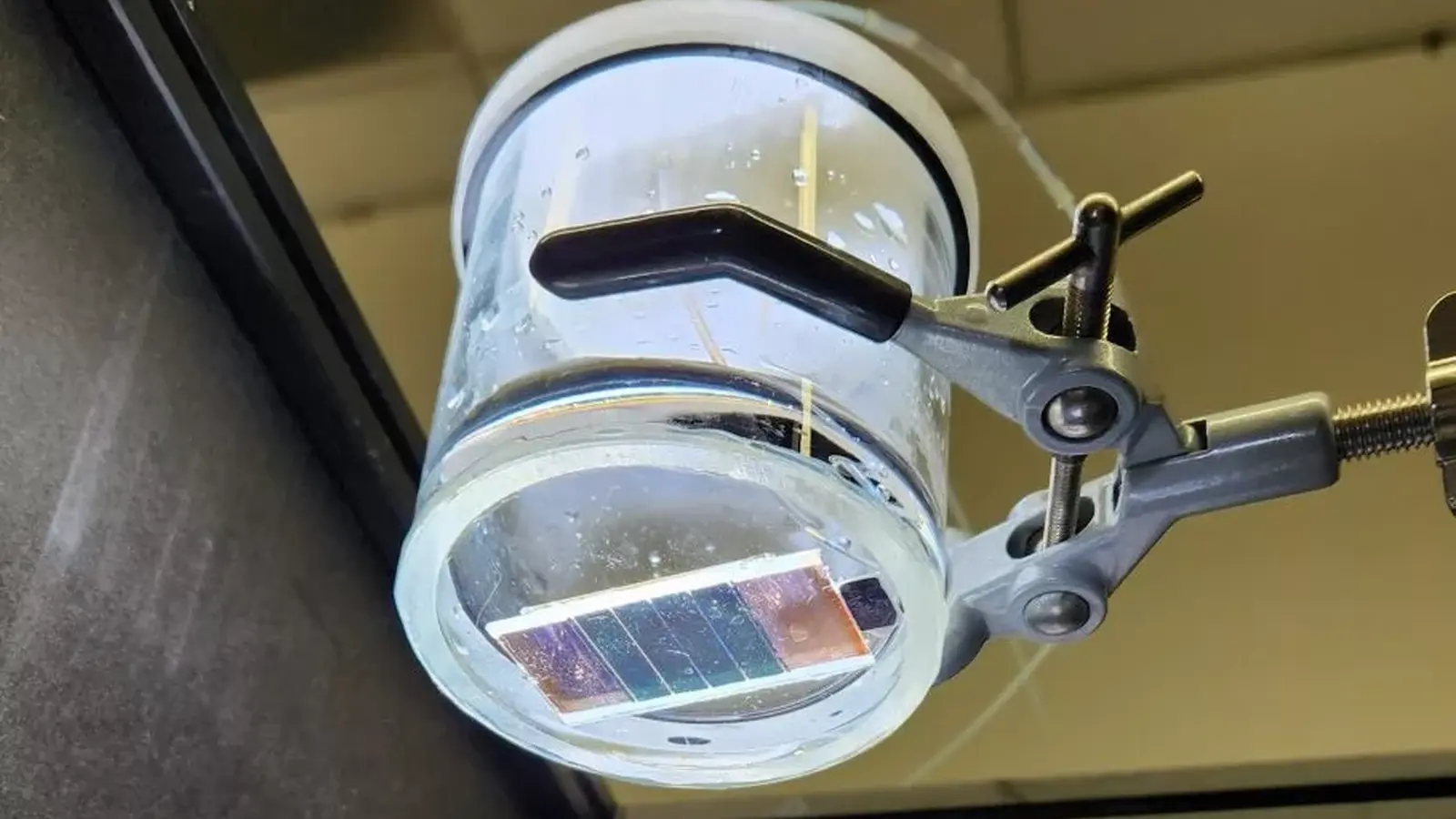
Imagine a leaf that inhales carbon dioxide and exhales liquid fuel. That is the image Yale researchers are chasing: a sunlight-driven device that converts air, water, and sunshine directly into methanol, a storable liquid fuel with wide industrial use.
A laboratory leaf that mimics photosynthesis
The system pairs a molecular heterogeneous catalyst with a silicon photoelectrode. No external electricity is required. Sunlight supplies the energy to run a complex chemical sequence that reduces carbon dioxide into methanol. The team reports an efficiency 32 times higher than previous alcohol-producing systems, a jump large enough to change how scientists think about practical artificial photosynthesis.
The six-electron breakthrough
Most past catalysts could only transfer two electrons at a time, which limited products to simpler molecules such as carbon monoxide. The new catalyst bypasses that limit by delivering six electrons directly to a single CO2 molecule, driving it all the way to methanol. To do that, researchers immobilized cobalt phthalocyanine molecules on carbon nanotube scaffolds. Think of the nanotubes as electronic highways that feed a steady flow of electrons into active reaction centers.

Silicon engineering for speed and surface area
The photoelectrode uses microscopic silicon columns coated with a layer of carbon fullerene. That geometry dramatically increases the available surface area and eases electron movement. Rapid electron flow plus the robust catalyst geometry lifts the device to become the most efficient silicon-based photoelectrocatalytic CO2-to-fuel system reported so far.
Why methanol matters and what stands in the way
Methanol is not a niche product. It is a versatile industrial feedstock and can serve as a liquid fuel compatible with existing storage and transport infrastructure. Producing methanol directly from the atmosphere addresses two problems at once: it recycles a greenhouse gas and generates an energy carrier that is easy to handle.
But the path from lab bench to petrol station is not immediate. Challenges remain. Durability under continuous sunlight, long-term catalyst stability, and scaling the capture of dilute atmospheric CO2 all require further engineering. The Yale team is already iterating the design to extend lifetime and boost commercial viability. They frame this device as a foundation for industrial carbon recycling and bulk production of renewable liquid fuels.
Published work in the American Chemical Society describes the experimental setup and performance metrics in detail. According to the researchers, the approach represents a precise mimic of biological photosynthesis while exploiting materials and architectures suited to manufacturing.
Implications and next steps
Can engineered leaves ever rival natural photosynthesis at planetary scale? Not yet. But this device reframes the question. Instead of competing with plants, it offers a targeted route to convert CO2 into a convenient, transportable energy form using sunlight alone. That could unlock new strategies for carbon management in heavy industry and energy storage.
Short-term priorities are clear: improve robustness, lower material costs, and demonstrate continuous operation under real-world conditions. If those hurdles fall, engineered photosynthesis could move from curiosity to climate tool—helping to close the loop between emissions and usable fuel.


“The cosmos has always fascinated me. I write about space missions, astronomy, and the technologies pushing humanity beyond Earth.”

Discussion
Leave a Comment
Comments (2)
wow, methanol from thin air!! if they nail stability and scale this could change fuels, not just a lab trick. curious how costly tho
hmm this reads like sci fi, but can cobalt phthalocyanine survive months under real sunlight? durability, scale and air capture are big unknowns