
Bitcoin shows IPO-like distribution as holders rotate
Macro analyst Jordi Visser argues that Bitcoin (BTC) appears to be undergoing what he describes as an "initial product offering" — effectively an IPO-like rotation — as long-time holders gradually sell and new investors step in. Rather than a panic-driven dump, Visser sees a measured transfer of supply from concentrated early believers to a wider base of long-term holders and institutions, a process that can create a prolonged sideways market before a meaningful breakout.
Why Visser likens this phase to an IPO
Visser explained on Anthony Pompliano’s podcast and in a Substack post that dormant coins — some unchanged for years — are becoming active again. The movement is slow and orderly: coins are not rushing into exchanges all at once but are being distributed steadily while buyers accumulate on dips. In traditional markets, this is analogous to the IPO lifecycle: founders and early backers realize gains, venture capital returns capital, and ownership moves from a small group of visionaries to a broader set of investors.
That shift, he says, brings a change in market dynamics. Concentrated ownership tends to create sharp directional moves, whereas distribution across a larger investor base can lead to more stable, durable price behavior. In practical terms, that means BTC could trade sideways for months as the market digests these ownership changes — frustrating short-term speculators but strengthening the asset’s long-term thesis.
Sideways action and the current price range
Over the last week, Bitcoin has been trading in a relatively tight band: roughly between $106,786 and $115,957, with a mid-range price near $110,904. Visser compares this consolidation to what happens when lock-up periods expire after a public offering: the stock or asset doesn’t necessarily crash; it consolidates while early holders sell and new, patient owners accumulate.
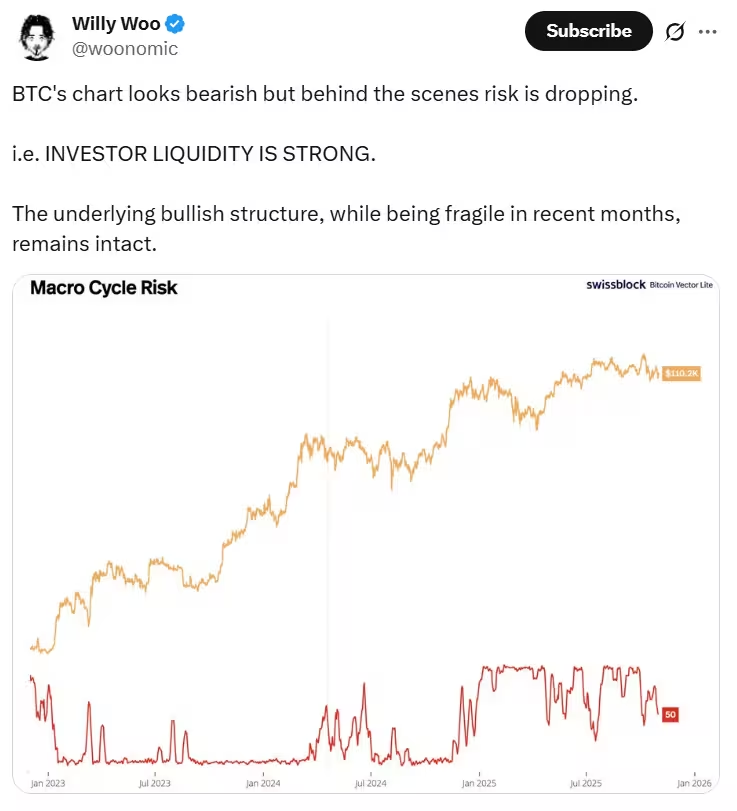
New hands are entering the market, but they are cautious. Many buyers are waiting for the distribution process to play out before increasing aggressiveness, which results in a slow, grinding pattern that can be maddening for traders expecting an immediate rally.
Fundamentals remain supportive despite poor sentiment
Market sentiment indicators such as the Crypto Fear & Greed Index have shown "fear" readings recently, reflecting uncertainty and short-term emotional pressure. However, Visser highlights several on-chain and regulatory signals that suggest confidence in Bitcoin’s durability:
- Ongoing approvals and institutional interest in bitcoin ETFs, which expand regulated exposure.
- Bitcoin network hashrate reaching new highs, indicating robust mining activity and security.
- Growing stablecoin adoption, which supports liquidity and on-ramps into crypto markets.
These fundamentals point to accumulation rather than capitulation. Visser underscores that in a true bear market there are almost no buyers and prices make new lows. Instead, Bitcoin is holding a range and each dip finds buyers — a sign that the market is consolidating, not collapsing.
What this means for investors and traders
Expect ongoing consolidation: Visser anticipates the "IPO phase" will persist, likely lasting around six months based on typical distribution timelines (though IPO cycles can span six to 18 months in traditional markets). Because Bitcoin often moves faster than many traditional assets, the current phase could still be in the earlier half of that timeframe.
For investors, the implications are:
- Reduced short-term volatility is possible once distribution widens ownership across institutions and retail alike.
- No clear breakout signal should be expected; momentum may arrive quietly as ownership fragmentation completes.
- Active traders should brace for frustrating, range-bound price action while monitoring on-chain metrics like hashrate and exchange flows.
Long-term view: maturation of an asset
The rotation Visser describes can be viewed positively: it may mark Bitcoin’s transition from an experimental, concentrated asset to a more mature monetary store-of-value embraced by diversified holders. As holdings move from a narrow group of early adopters to broader institutional and retail ownership, Bitcoin’s market structure could shift to favor stability and durability.
In short, the current sideways grind — driven by distribution after years of concentrated ownership — could be the groundwork for a future phase in which Bitcoin behaves less like a speculative novelty and more like an established financial asset. Until then, investors should expect consolidation, keep an eye on ETF developments, hashrate trends, and stablecoin flows, and avoid reading short-term sentiment as a signal that the macro thesis has failed.

“I cover automotive innovation, electric vehicles, and the future of mobility — where technology meets sustainability.”

Discussion
Leave a Comment