
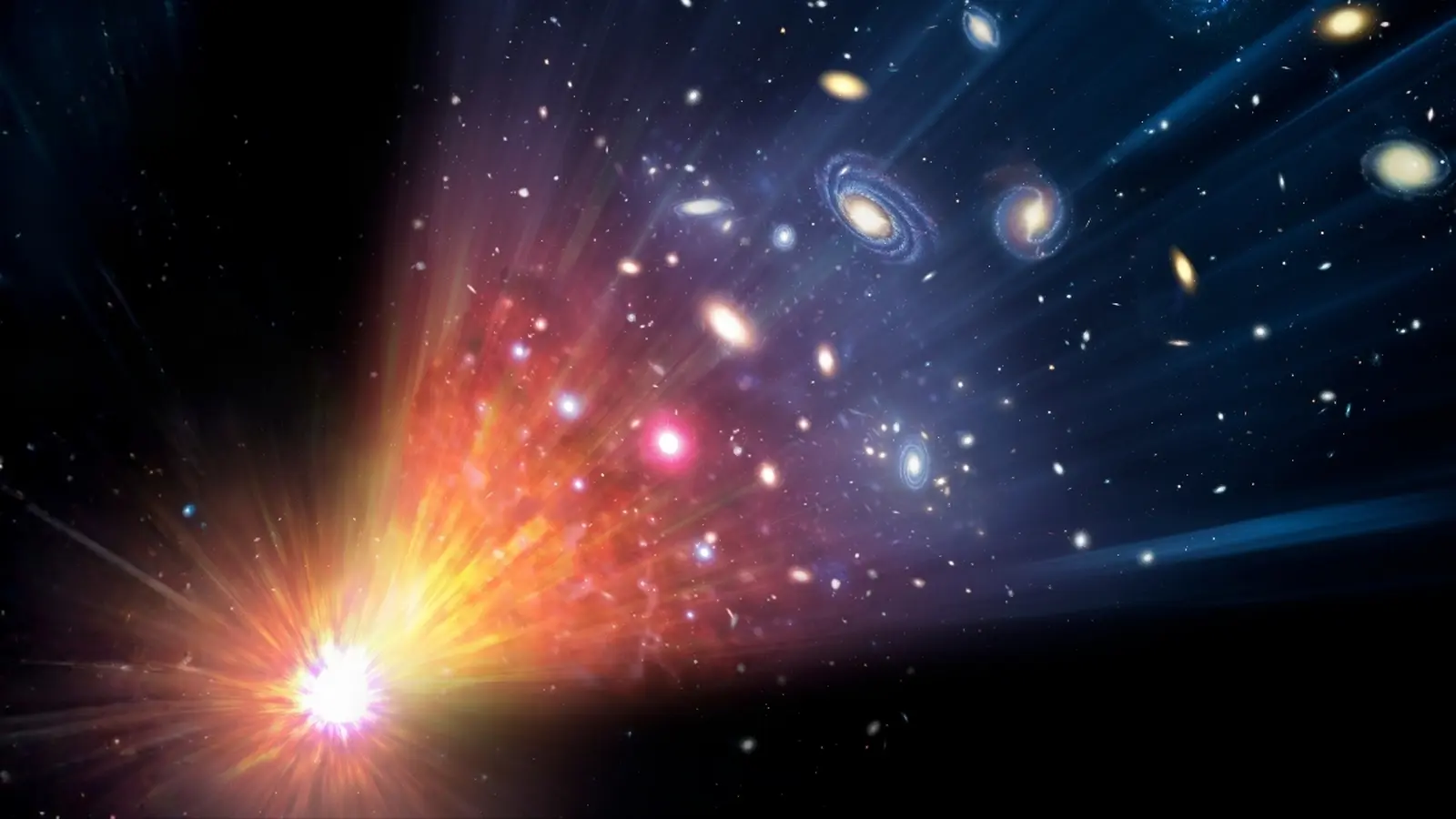
Astrophysicists have taken an exceptionally precise temperature reading of the Universe as it was seven billion years ago — and the result lines up neatly with a core prediction of Big Bang cosmology. Using archival observations from the Atacama Large Millimeter/submillimeter Array (ALMA), a Japanese team measured the cosmic microwave background (CMB) at an intermediate epoch and found it was roughly twice as warm as it is today.
A precise thermometer for cosmic history
Keio University researchers led by doctoral student Tatsuya Kotani and Professor Tomoharu Oka analyzed the faint afterglow of the Big Bang — the cosmic microwave background radiation — not as it appears nearby, but as it would have been seven billion years ago. Their result: a CMB temperature of 5.13 K ± 0.06 K. For context, the present-day CMB sits at about 2.7 K, so the new measurement is roughly double that value.
This measurement is more than an interesting data point. The standard cosmological model predicts that as the Universe expands, the CMB cools, with temperature scaling proportionally to (1 + z), where z is redshift. Confirming the CMB temperature at intermediate times provides a critical test of that prediction and of the overall framework used to describe cosmic evolution.
How the measurement was made
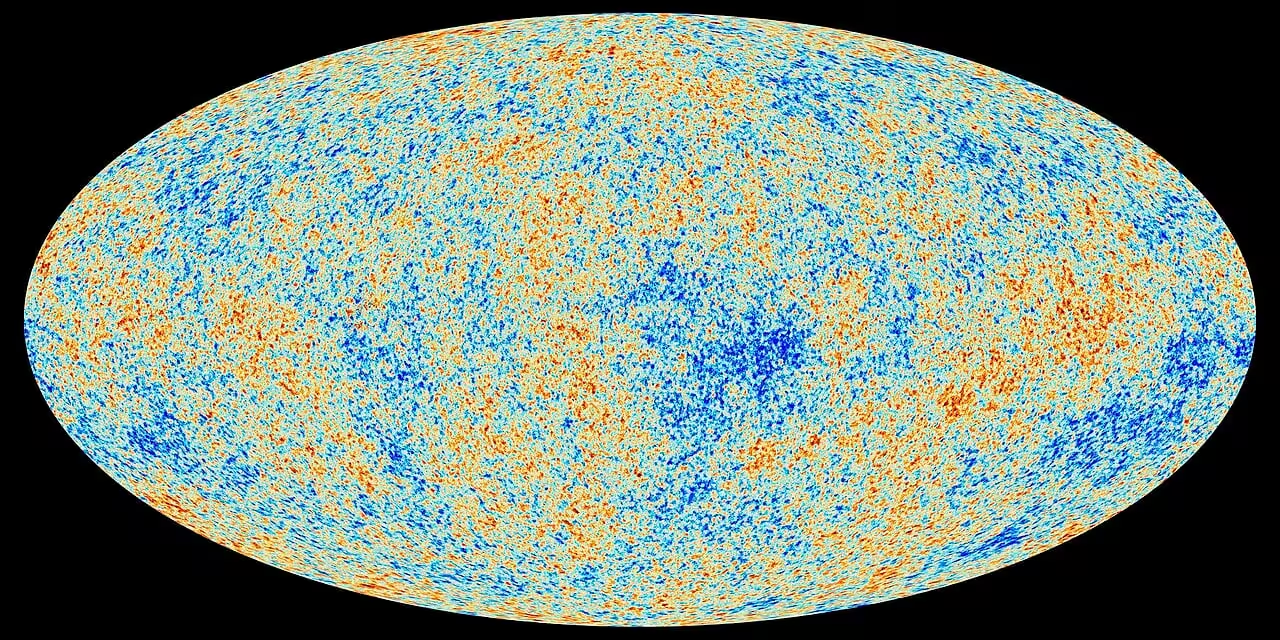
Temperature map of the cosmic microwave background measured by the Planck spacecraft (ESA and the Planck Collaboration)
The team mined ALMA's archived spectra of a bright background quasar. As the quasar’s light traversed space, it passed through a foreground galaxy located roughly seven billion years in the past. Molecules in that galaxy absorb and emit radio-frequency light in ways that depend on the ambient radiation field. By carefully modeling molecular excitation — in particular signatures linked to species sensitive to the CMB bath — the researchers could infer the background temperature that influenced those populations.
The analysis exploited narrow absorption features imprinted on the quasar spectrum, which act like tiny thermometers. Because the method relies on well-understood molecular physics and high-quality ALMA data, the uncertainty (±0.06 K) is impressively small for this redshift range.
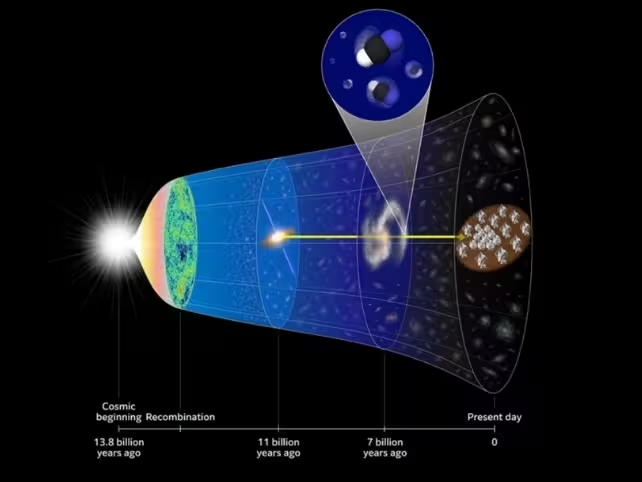
The relative positions of the background quasar (bright flare at 11 billion years ago), the foreground galaxy producing HCN absorption (7 billion years ago), and the observer (ALMA; Present day). (Keiko University)
Why this matters for cosmology
Confirming the CMB temperature at intermediate epochs strengthens confidence in the Big Bang picture and the standard model of cosmology. Measurements at the earliest times — from Planck and other CMB experiments — and at the present era already constrained the thermal history, but intermediate checks were sparser. This new point fills an important gap and shows the Universe’s cooling behavior follows theoretical expectations across billions of years.
Beyond validating theory, precise temperature points help limit exotic physics. Any unexpected deviation from the predicted cooling law could signal new energy injection, nonstandard dark sector interactions, or other departures from ΛCDM. So far, measurements like Kotani and Oka’s place tighter bounds on such scenarios.
What’s next?
Future work will widen the sample of intermediate-redshift temperature measurements, using ALMA and other facilities to observe different molecular transitions and lines of sight. Adding more points across cosmic time will sharpen tests of cosmological models and could reveal subtle anomalies if they exist. For now, this result is a notable success: an elegant application of molecular astrophysics to probe the thermal history written into the afterglow of the Big Bang.

“The cosmos has always fascinated me. I write about space missions, astronomy, and the technologies pushing humanity beyond Earth.”

Discussion
Leave a Comment